
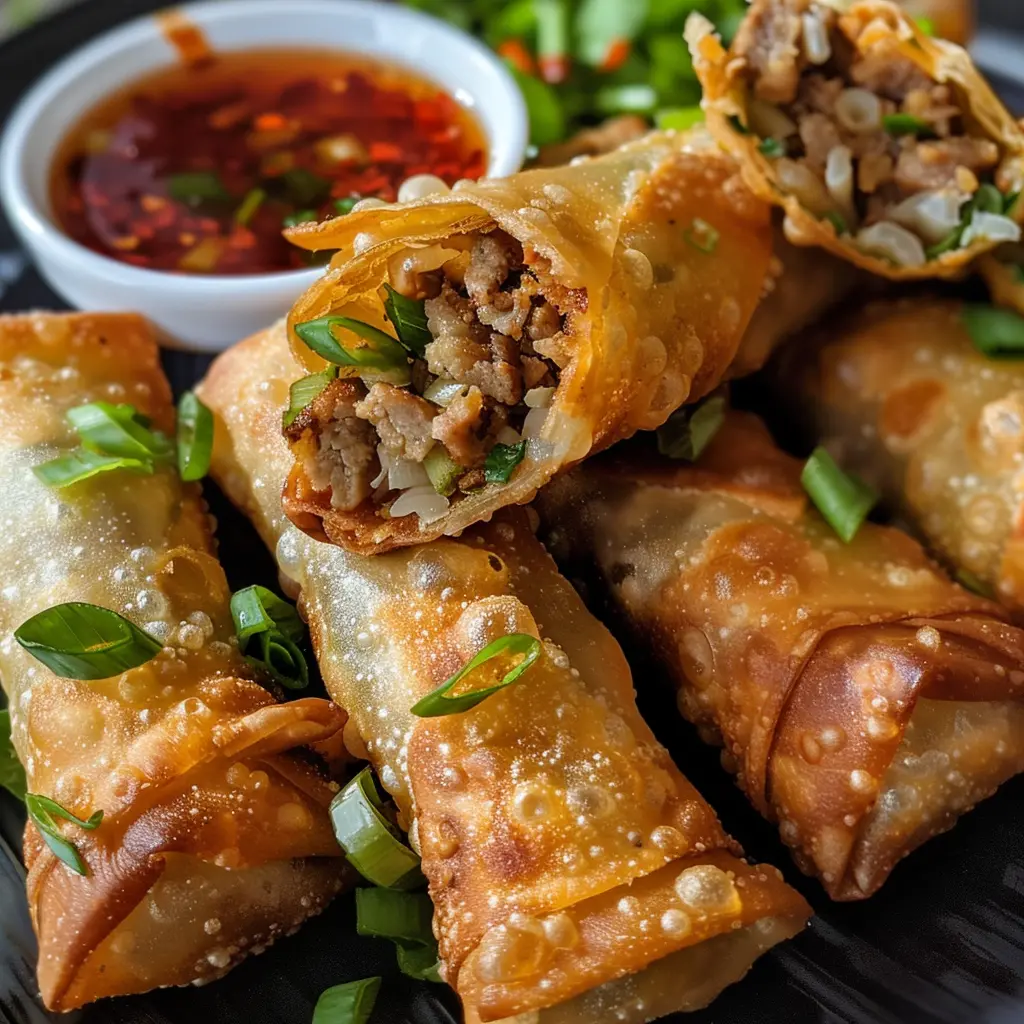
Easy Chinese egg rolls fill egg roll wrappers with a quick pork and coleslaw mix seasoned with soy sauce, roll them tight, and fry them in hot oil until the wrapper is shatteringly crisp and golden and the filling inside is savory, tender, and perfectly cooked. Four ingredients, 30 minutes, and a result that rivals any takeout version — because these are fresher, hotter, and made exactly the way you want them.
| Detail | Info |
|---|---|
| Prep Time | 15 minutes |
| Cook Time | 15 minutes |
| Total Time | 30 minutes |
| Servings | About 12 egg rolls |
| Difficulty | Easy |
| Cuisine | Chinese-American |
Why This Recipe Works
Pre-cooking the filling completely before it goes inside the wrapper is the foundational technique that makes homemade egg rolls both safe and texturally superior to versions made with raw filling. Raw ground pork inside a wrapper that fries for 3 to 4 minutes would be undercooked and potentially unsafe — the exterior reaches its golden, crispy state long before the interior can cook through fully. Pre-cooked filling eliminates this problem and introduces another benefit: the browned pork and slightly softened cabbage develop more flavor through the stovetop cook than they would from the brief frying time alone. The filling going into the wrapper is already fully flavored and cooked; the frying stage is purely about the wrapper.
Coleslaw mix is the convenience ingredient that makes this recipe genuinely easy without compromising the flavor or texture of the finished egg roll. A bag of coleslaw mix contains shredded cabbage and carrots — the same vegetables that appear in traditional egg roll filling — already shredded to the right size and in the right proportion. The coleslaw mix cooked briefly with the browned pork and soy sauce softens to exactly the right tender-but-not-mushy texture that egg roll filling needs. It’s one of those instances where the convenience product is genuinely the best tool for the job, not a shortcut that produces an inferior result.
Soy sauce as the sole seasoning agent does more work than its single-ingredient status suggests. Soy sauce’s combination of salt and umami (from the fermented soybean base) seasons both the pork and the cabbage simultaneously, and the small amount used — one tablespoon — is enough to permeate the entire filling without making it taste overtly salty or soy-forward. The umami the soy sauce adds to the pork amplifies the meat’s savory character in a way that plain salt alone wouldn’t. The result is a filling that tastes distinctly and correctly seasoned for an egg roll without tasting like any single identifiable ingredient.
Rolling the egg rolls tightly is the technique decision that determines whether the finished egg roll is a structural success or a filling-bursting failure in the fryer. A loosely rolled egg roll has air pockets between the filling and the wrapper — when placed in hot oil, those air pockets expand rapidly, causing the wrapper to separate from the filling and often burst, releasing filling into the oil. A tightly rolled egg roll has no air pockets; the wrapper is in direct contact with the filling throughout, and the heat transfers directly from the oil through the wrapper to the filling with no expansion issues. Tight rolling also produces a more satisfying crunch when bitten — there’s no hollow air space, just crispy wrapper directly against savory filling.
Frying in hot vegetable oil rather than baking or air frying produces the specific texture that defines a great egg roll. The egg roll wrapper is a thin wheat-based sheet that, when submerged in oil at the right temperature, undergoes rapid dehydration and browning simultaneously — moisture escapes as steam while the surface fats and starches brown through the Maillard reaction. The result is a wrapper that’s simultaneously golden, blistered, and shatteringly crisp in a way that oven baking and air frying can approximate but never fully replicate. The crunch of a properly fried egg roll wrapper is one of the most satisfying textures in food, and it only comes from direct contact with hot oil.
Ingredients
| Ingredient | Quantity | Notes |
|---|---|---|
| Ground pork | 1 pound | The primary protein; browned and drained before the cabbage is added |
| Coleslaw mix | 2 cups | Pre-shredded cabbage and carrot mix; adds texture and bulk to the filling |
| Soy sauce | 1 tablespoon | Seasons and adds umami depth to the filling |
| Egg roll wrappers | 1 package | Found in the refrigerated section; typically 25 per package |
| Vegetable oil | For frying | Enough to fill a deep skillet or pot 2 to 3 inches; neutral flavor and high smoke point |
| Optional additions and dipping sauce | ||
| Garlic, minced | 2 cloves | Add to the pork during cooking for more depth |
| Sesame oil | 1 teaspoon | Stir in at the end of cooking for a toasty, nutty finish |
| Sweet and sour sauce or duck sauce | For dipping | Classic pairing; soy sauce or hot mustard also work |
Step-by-Step Instructions
Phase 1: Make the Filling
- Brown the ground pork in a large skillet over medium heat, breaking it into fine crumbles. Cook until fully browned with no pink remaining. Drain the excess grease.
- Add the coleslaw mix and soy sauce to the skillet. Stir to combine with the pork. Cook for 2 to 3 minutes, stirring occasionally, until the cabbage has softened slightly but still has a little texture — it should be wilted but not mushy. Remove from heat and let the filling cool for 5 to 10 minutes. Rolling with hot filling makes the wrapper soggy and difficult to seal.
Phase 2: Roll the Egg Rolls
- Lay an egg roll wrapper flat on a clean surface with one corner pointing toward you — like a diamond shape. Place about 2 to 3 tablespoons of filling in the center of the wrapper, shaped into a horizontal log.
- Fold the bottom corner up over the filling, then fold the left and right corners in toward the center, tucking them snugly. Roll the wrapper upward tightly, pressing as you go to eliminate air pockets. Dab a small amount of water on the top corner before completing the final roll to seal it. Press firmly to secure.
- Repeat with the remaining wrappers and filling. Place finished rolls seam-side down on a plate or baking sheet while the oil heats.
Phase 3: Fry and Serve
- Pour vegetable oil into a deep skillet or heavy-bottomed pot to a depth of 2 to 3 inches. Heat over medium-high heat to 350 degrees F. If you don’t have a thermometer, test the oil by dipping the corner of an egg roll wrapper in — it should sizzle immediately and vigorously.
- Fry the egg rolls in batches of 3 to 4 — don’t crowd the oil, which drops the temperature and produces greasy rather than crispy rolls. Fry for 3 to 4 minutes, turning once or twice, until evenly golden brown on all sides.
- Remove with tongs or a slotted spoon and drain on a paper towel-lined plate. Let cool for 2 minutes before serving — the interior is very hot immediately from the oil.
- Serve warm with sweet and sour sauce, duck sauce, soy sauce, or hot mustard for dipping.
Chef Tips for Perfect Results
Let the filling cool before rolling. Hot filling produces steam inside the wrapper during rolling, which softens the wrapper and makes it difficult to roll tightly and seal cleanly. Five to ten minutes of cooling produces a filling that’s easy to handle and produces a wrapper that stays firm through the sealing process.
Don’t overfill. Two to three tablespoons of filling per wrapper is the right amount. Overfilled rolls are difficult to seal, prone to bursting in the oil, and produce an uneven wrapper-to-filling ratio where the filling dominates every bite. A properly filled egg roll has a distinct crispy wrapper experience with every bite.
Maintain oil temperature between batches. Adding too many egg rolls at once drops the oil temperature, producing a longer fry time during which the wrapper absorbs more oil and becomes greasy rather than crispy. Fry in small batches of 3 to 4, and allow the oil to return to 350 degrees F between batches before adding the next ones.
Seal the final flap with water. The small amount of water brushed or dabbed on the top corner before the final roll acts as a glue that seals the wrapper closed. Without it, the flap can come loose in the oil and unroll partially, spilling filling into the frying oil. A moistened corner takes two seconds and keeps every roll intact through frying.
Add garlic and a splash of sesame oil for a more complex filling. Two minced garlic cloves added to the pork during browning and a teaspoon of sesame oil stirred into the filling at the end of cooking adds depth and the characteristic toasty, nutty aroma that distinguishes restaurant-quality egg rolls from plain pork-and-cabbage versions.
Common Mistakes to Avoid
Rolling too loosely. Air pockets between the wrapper and filling expand in hot oil and can cause the roll to burst. Roll as tightly as possible and press firmly at each fold.
Frying at too low a temperature. Oil that isn’t hot enough produces egg rolls that absorb oil before the wrapper has a chance to crisp — the result is greasy and soft rather than golden and crunchy. Always check that the oil is at 350 degrees F before adding the first batch.
Crowding the pan. Adding too many egg rolls at once drops the oil temperature below the frying threshold and produces greasy, pale rolls. Three to four at a time maximum in a standard deep skillet.
Using wet filling. Filling with excess moisture produces a soggy wrapper from the inside out. Make sure the coleslaw mix is only slightly softened — not fully wilted — and drain any liquid that accumulates in the pan before removing the filling from the heat.
Not draining on paper towels. Egg rolls set on a plate without paper towels continue to sit in their own surface oil and can lose crispiness quickly. Paper towels absorb the surface oil and keep the wrapper crisp longer.
Variations and Substitutions
Ground chicken or shrimp: Ground chicken works identically to pork in this recipe with a slightly milder, leaner result. Finely chopped raw shrimp cooked in the skillet until pink before the coleslaw is added produces a shrimp egg roll filling that’s particularly popular as an appetizer.
Vegetarian version: Omit the pork and double the coleslaw mix. Add a cup of finely diced firm tofu browned in oil, a handful of bean sprouts, and sliced shiitake mushrooms for a filling with enough substance and umami depth to stand without meat.
Add glass noodles: A small handful of soaked and drained glass noodles (cellophane noodles) folded into the filling adds a slightly chewy, translucent noodle element that appears in many traditional Chinese egg roll fillings and adds textural interest.
Baked version: Brush assembled egg rolls with vegetable oil and bake at 425 degrees F for 15 to 20 minutes, turning once halfway through. The baked version produces a less shatteringly crisp but still pleasantly crunchy wrapper with significantly less oil.
Serving Suggestions
Serve immediately while the wrapper is at peak crispiness — egg rolls are best in the first 5 to 10 minutes after frying. Set out small bowls of sweet and sour sauce, duck sauce, soy sauce, and Chinese hot mustard alongside for dipping. As an appetizer, allow 2 egg rolls per person. As a main dish alongside steamed rice and stir-fried vegetables, 3 to 4 per person is satisfying. For a party spread, keep a batch warm in a 200 degree F oven on a wire rack set over a baking sheet while additional batches fry.
Storage and Reheating
Refrigerator: Store cooked egg rolls in an airtight container for up to 3 days. They lose their crispiness in the refrigerator but reheat well.
Reheating: The oven or air fryer restores crispiness that the microwave cannot. Reheat in a 375 degree F oven for 10 minutes, or in an air fryer at 375 degrees F for 5 to 6 minutes, until heated through and re-crisped. The microwave reheats quickly but produces a soft, steamed wrapper.
Freezer: Freeze uncooked assembled egg rolls on a parchment-lined baking sheet until solid, then transfer to a zip bag for up to 3 months. Fry directly from frozen — add 2 to 3 minutes to the frying time and watch the temperature carefully. Frozen egg rolls are the ultimate make-ahead appetizer.
Nutritional Information
| Nutrient | Per Egg Roll (approx.) |
|---|---|
| Calories | 180 |
| Protein | 9g |
| Carbohydrates | 14g |
| Fat | 10g |
| Saturated Fat | 3g |
| Fiber | 1g |
| Sodium | 280mg |
Nutritional values are estimates based on standard ingredient brands and include frying oil absorption. Values will vary based on specific wrapper brand and frying time.
FAQ
What’s the difference between egg rolls and spring rolls?
Egg rolls are an American-Chinese invention with a thicker, wheat-based wrapper that fries to a blistered, bubbly, crunchy exterior and typically contains pork and cabbage. Spring rolls are thinner — made with a rice paper or lighter wheat wrapper — and can be either fried to a more delicate crisp or served fresh and unfried. Chinese egg rolls have the thick, blistered wrapper; Vietnamese spring rolls (goi cuon) are fresh and wrapped in rice paper. The terms are often used interchangeably but refer to meaningfully different products.
Can I use an air fryer instead of frying in oil?
Yes. Brush assembled egg rolls lightly with vegetable oil on all sides and air fry at 390 degrees F for 8 to 10 minutes, turning once halfway through, until golden and crispy. The air fryer produces a good result — crispier than baking, less crispy and blistered than deep frying. For anyone who fries infrequently or prefers less oil, the air fryer version is an excellent alternative.
Why did my egg rolls burst open in the oil?
Bursting is caused by three things: filling that was too hot and produced steam inside the wrapper, rolling too loosely with air pockets, or not sealing the final flap with water. Address all three — cool the filling before rolling, roll as tightly as possible pressing out air at each fold, and always wet the final corner before sealing.
Can I make the filling ahead of time?
Yes. The cooked filling keeps refrigerated for up to 2 days before rolling. In fact, chilled filling rolls more easily and produces less steam during sealing than freshly cooked filling. Make the filling the day before for the most practical assembly experience.
What oil is best for frying egg rolls?
Any neutral oil with a high smoke point works well — vegetable oil, canola oil, peanut oil, and sunflower oil are all good choices. Peanut oil is the traditional choice for Chinese frying applications and produces a very clean, crispy result. Avoid olive oil, which has too low a smoke point for deep frying and will impart a flavor that doesn’t suit the dish.
Conclusion
Easy Chinese egg rolls are the recipe that proves four ingredients and 30 minutes can produce something genuinely impressive — crispy golden wrappers, savory pork and cabbage filling, and a result that stands up favorably next to any takeout version. Make a double batch: the first disappears before the table is fully set, and the second makes everyone feel like the evening was a success.