
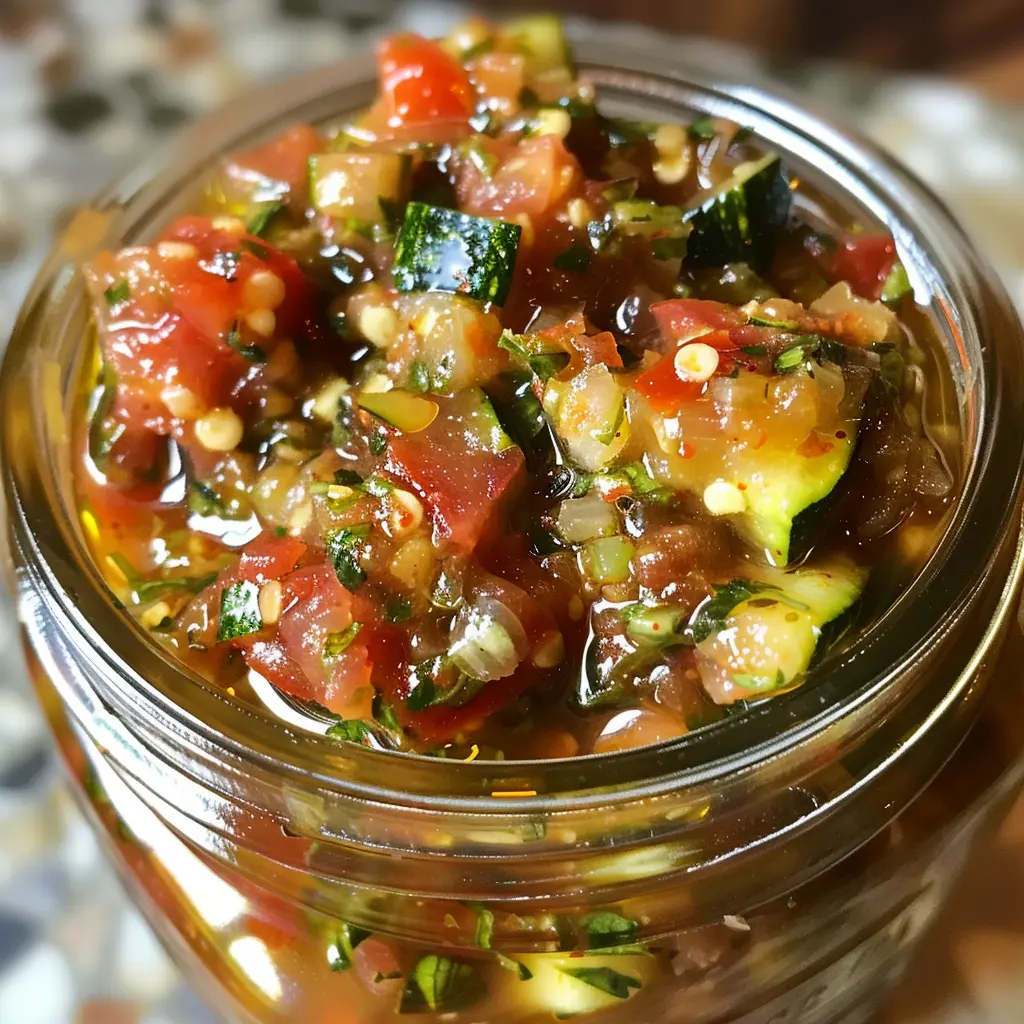
Zucchini salsa combines grated zucchini with fresh tomatoes, onion, bell peppers, jalapeños, and a blend of warm spices — turmeric, cumin, mustard seeds, red chili pepper — balanced with brown sugar and white vinegar, and simmers the whole thing until thick, deeply flavored, and ready to be canned in a water bath for a shelf-stable condiment that lasts all year. This is the recipe that turns the end-of-summer zucchini surplus into something genuinely worth having on every table from fall through spring.
| Detail | Info |
|---|---|
| Prep Time | 30 minutes (plus optional overnight salting) |
| Cook Time | 45 to 60 minutes |
| Total Time | 1 hour 30 minutes active |
| Yield | About 8 to 10 pints |
| Difficulty | Medium |
| Cuisine | American / Preserves |
Why This Recipe Works
Grated zucchini rather than diced or chunked produces a salsa with a smooth, integrated texture where the zucchini is present in every spoonful but doesn’t dominate the visual or textural character of the condiment. Diced zucchini pieces in a salsa remain visibly distinct — they look like a zucchini condiment with tomato added. Grated zucchini disperses through the tomato base and becomes part of the salsa’s body, adding volume, mild flavor, and substance without announcing itself. The finished salsa reads as a richly flavored tomato-based salsa that happens to have a very satisfying thickness — the zucchini’s contribution is structural and flavorful rather than visually prominent.
The optional overnight salt-and-drain step is the technique that removes the most moisture from the grated zucchini before cooking and produces a thicker salsa in significantly less simmering time. Zucchini is approximately 95 percent water, and twelve cups of grated zucchini contains an enormous amount of moisture that must either be drawn out through salting or cooked off through extended simmering. Pre-salting draws out much of that water through osmosis overnight, producing zucchini that’s already partially dehydrated before it hits the pot — the simmer time required to reach the right consistency is noticeably shorter. Skipping the salt step is entirely valid (as the original recipe acknowledges), but it requires a longer simmer — sometimes significantly longer depending on the tomatoes’ water content.
The combination of turmeric, cumin, mustard seeds, and red chili pepper alongside the more expected jalapeño and garlic produces a salsa with a warm, slightly exotic spice profile that distinguishes it from standard tomato salsas. Turmeric adds a warm, slightly bitter earthiness and a golden hue to the salsa. Mustard seeds pop slightly as they heat in the pot and distribute their pungent, slightly tangy flavor through the entire batch. Cumin adds the smoky, earthy depth most commonly associated with Southwestern cooking. Together they produce a salsa that’s recognizably a salsa in use but has a complexity in flavor that makes people ask what’s different about it.
Brown sugar and white vinegar together perform the dual function of sweetening and acidifying that makes this salsa suitable for both flavor and safe water bath canning. The vinegar brings the pH of the entire batch below 4.6 — the threshold below which Clostridium botulinum cannot grow — ensuring safety in the water bath process. The brown sugar balances the vinegar’s sharpness and the tomatoes’ natural acidity with warmth and caramel depth that makes the salsa taste more complex and less sharply acidic than a vinegar-only preservation. The ratio of vinegar to sweet is calibrated for both flavor balance and food safety simultaneously.
The extended 45 to 60 minute simmer is the step that transforms the individual vegetable and spice components into a unified condiment. During the simmer, the tomatoes break down and release their pectin, which naturally thickens the liquid as it reduces. The zucchini softens fully and its flavor merges with the tomato base. The spices bloom and their volatile aromatics distribute through the entire batch. The sugar caramelizes slightly into the liquid and the vinegar mellows from sharp acid to a background tang. The difference between this salsa at 15 minutes of simmering and at 60 minutes of simmering is not a matter of degree — it’s a fundamentally different condiment at 60 minutes, with depth and body that the early version doesn’t approach.
Ingredients
| Ingredient | Quantity | Notes |
|---|---|---|
| Zucchini, grated | 12 cups | About 4 to 5 large zucchini; grated on the large holes of a box grater |
| Fresh tomatoes, chopped | 12 cups | Roma or paste tomatoes produce less liquid; any variety works |
| Onion, diced | 2 cups | Yellow or white onion |
| Green bell pepper, chopped | 1 | Adds fresh pepper flavor and color |
| Red bell pepper, chopped | 1 | Adds sweetness and color contrast |
| Jalapeño peppers, diced | 3 to 4 | Adjust quantity for heat preference; remove seeds for milder salsa |
| Canning salt | 3.5 tablespoons | Used for optional overnight salt-draw; do not substitute table salt (different density) |
| Turmeric | 1 teaspoon | Adds warm earthiness and golden color |
| Cumin | 1 teaspoon | Adds smoky depth |
| Garlic powder | 1 teaspoon | Background savory depth |
| Black pepper | 1 teaspoon | Freshly cracked preferred |
| Red chili peppers | 1.5 to 2.5 tablespoons | Crushed red pepper flakes; adjust for heat preference |
| Mustard seeds | 1 tablespoon | Whole seeds; add pungency and texture |
| Light brown sugar | 1.5 cups | Balances the vinegar and tomato acidity |
| White vinegar | 2 cups | 5% acidity; essential for safe water bath canning |
Step-by-Step Instructions
Phase 1: Prep the Zucchini (Optional Overnight Salt Step)
- Grate the zucchini on the large holes of a box grater into a very large bowl. Sprinkle the canning salt over the grated zucchini and toss to distribute. Cover and refrigerate for several hours or overnight. The salt will draw out a significant amount of liquid from the zucchini.
- The following day or after several hours, transfer the salted zucchini to a colander and drain thoroughly. Rinse with cold water to remove excess salt, then press or squeeze firmly to remove as much remaining liquid as possible.
- If skipping the overnight salt step: proceed with ungrated, unsalted zucchini and plan for a longer simmer time to cook off the excess moisture.
Phase 2: Combine and Cook
- Chop the tomatoes, dice the onions, chop the bell peppers, and dice the jalapeños. Adjust jalapeño quantity up or down based on your heat preference. Removing the seeds and membranes from the jalapeños reduces heat significantly.
- Combine the prepared zucchini, tomatoes, onions, and all peppers in a large, heavy-bottomed stock pot. Add the turmeric, garlic powder, cumin, black pepper, red chili pepper, mustard seeds, brown sugar, and white vinegar. Stir to combine all ingredients.
- Bring the mixture to a boil over medium-high heat, stirring occasionally. Once boiling, reduce heat to medium and simmer for 45 minutes to 1 hour, stirring every 10 minutes, until the salsa has thickened to a scoopable, condiment-like consistency. The exact time depends on how much water the tomatoes contain and whether the zucchini was pre-salted. The salsa is ready when it holds its shape on a spoon rather than running off.
Phase 3: Can the Salsa
- While the salsa simmers, prepare the canning equipment: wash the jars and lids in hot soapy water and keep warm, prepare the water bath canner with enough water to cover the jars by at least one inch, and bring the water to a simmer.
- When the salsa has reached the right consistency, ladle it into hot jars, leaving half an inch of headspace at the top of each jar. A jar funnel makes this significantly cleaner and easier.
- Wipe the jar rims thoroughly with a damp clean cloth to remove any salsa residue — any residue on the rim prevents a proper seal. Apply the lids and rings, tightening to fingertip tight (not overly tight).
- Process pint jars for 15 minutes in a boiling water bath canner, or quart jars for 20 minutes. Start timing from when the water returns to a full boil after the jars are added.
- Remove the jars and place on a clean kitchen towel on the counter. Do not disturb for 12 to 24 hours. Listen for the satisfying “ping” as each jar seals. Check seals the next day by pressing the center of each lid — a properly sealed lid will not flex or pop up and down.
Chef Tips for Perfect Results
Use Roma or paste tomatoes for a thicker salsa with less simmer time. Regular slicing tomatoes are higher in water content and require more simmer time to reach the right consistency. Roma and paste tomatoes (San Marzano, Amish Paste) have more flesh, less juice, and less water, producing a naturally thicker salsa base that requires significantly less reduction. If using regular tomatoes, expect the longer end of the simmer range.
Use canning salt, not table salt. The recipe specifies canning salt (also called pickling salt) for a reason — it dissolves completely without additives that can make the brine cloudy or affect the flavor. Table salt contains iodine and anti-caking agents that can interfere with canning. Kosher salt can be substituted but the volume measurement is different — use the conversion on the package.
Test consistency on a cold plate before canning. Spoon a small amount of the simmering salsa onto a cold plate from the freezer. Let it sit for 30 seconds and push it with your finger — if it holds its shape rather than running, it’s ready. If it runs, simmer for another 10 minutes and test again. Canning thin salsa produces a watery product even after the jars are sealed.
Keep jars warm until filling. Room temperature jars filled with boiling hot salsa can crack from the thermal shock. Keep filled jars warm in the oven at 200 degrees F or in the simmering canner water until you’re ready to fill them.
Do not reduce the vinegar for safety. The 2 cups of white vinegar in this recipe is the safety-critical measurement for water bath canning. Reducing the vinegar could raise the pH above the safe threshold. If the salsa tastes too acidic, add more brown sugar to balance rather than reducing the vinegar.
Common Mistakes to Avoid
Not rinsing the salted zucchini thoroughly. The canning salt draw is generous — if the zucchini isn’t thoroughly rinsed after draining, the finished salsa will be far too salty. Rinse under cold running water for a full minute and taste a small piece before proceeding.
Reducing the vinegar. Never reduce the vinegar in a water bath canning recipe. It is the safety element. Adjust sweetness with sugar, not safety with reduced acid.
Overfilling the jars. Headspace is the gap between the food and the lid — half an inch is required to create the vacuum seal during processing. Overfilled jars may not seal or the lids may buckle during processing.
Canning thin salsa. Salsa that hasn’t reduced enough will be watery in the jar. Always test consistency before canning and simmer longer if needed.
Not checking jar seals after 24 hours. Any jar that didn’t seal properly (lid flexes when pressed) should be refrigerated and used within two weeks rather than stored as shelf-stable.
Variations and Adjustments
Milder version: Use only 2 jalapeños, remove all seeds and membranes, reduce the red chili pepper to 1 tablespoon. The mild version is accessible to children and heat-sensitive palates while retaining the full depth of the spice blend.
Hotter version: Use 5 to 6 jalapeños with seeds, use the full 2.5 tablespoons of red chili pepper, and add 1 to 2 habanero peppers for sustained heat. Test the heat level before canning by tasting a cooled spoonful on a chip.
Chunkier texture: Dice the zucchini rather than grating it (no salt-draw needed for diced zucchini) and chop the tomatoes into larger pieces. The chunkier version has more visible vegetable texture and resembles a traditional pico de gallo style more than the standard grated version.
Add corn: Two cups of fresh or frozen corn kernels added for the last 15 minutes of simmering adds sweetness, color, and a classic Southwestern flavor element that pairs naturally with the cumin and chili pepper spice profile.
Serving Suggestions
Serve with tortilla chips as a dip, spoon over tacos, burritos, or enchiladas, use as a topping for grilled chicken or fish, or stir into scrambled eggs for a quick breakfast. The unique spice profile — particularly the turmeric and mustard seeds — makes this salsa interesting alongside foods where standard tomato salsa might feel ordinary. It’s also an excellent gift for anyone who appreciates homemade preserves.
Storage
Shelf-stable (sealed jars): Properly sealed jars store in a cool, dark pantry for up to 12 to 18 months. Quality is best in the first year.
Refrigerator (open or unsealed jars): Store open jars or any unsealed jars in the refrigerator for up to 3 weeks.
Freezer: Can be frozen in freezer-safe containers for up to 1 year as an alternative to water bath canning, though the texture softens after thawing.
Nutritional Information
| Nutrient | Per Serving (2 tablespoons, approx.) |
|---|---|
| Calories | 21 |
| Protein | 0.3g |
| Carbohydrates | 4.5g |
| Fat | 0.3g |
| Fiber | 0.5g |
| Sugar | 3.5g |
| Sodium | 95mg |
Nutritional values are estimates based on standard ingredient brands. Values will vary based on specific tomato variety and exact jar fill.
FAQ
Can I skip the water bath canning and just refrigerate this salsa?
Yes. If you’re not interested in shelf-stable canning, simply make the salsa, let it cool completely, and store it in airtight containers in the refrigerator for up to 3 weeks. It also freezes very well for up to a year in freezer-safe containers. The water bath canning process is only necessary if you want shelf-stable jars that don’t require refrigeration.
Is it safe to reduce the vinegar in this recipe?
No. The vinegar quantity in this recipe is the safety-critical measurement for water bath canning. Reducing it could raise the pH above 4.6 — the threshold above which Clostridium botulinum can grow in a sealed jar. Never reduce the vinegar in a tested water bath canning recipe. If the salsa seems too acidic, balance with additional brown sugar rather than reducing the acid.
Can I use a pressure canner instead of a water bath?
Yes — a pressure canner is always acceptable for acidified products like this salsa, though it’s not required. Water bath canning is sufficient because the vinegar brings the pH well below the 4.6 safe threshold. If you have a pressure canner and prefer to use it, process at 10 lbs pressure for 10 minutes for pints.
My salsa is still very liquid after 60 minutes of simmering. What should I do?
Continue simmering — some batches, particularly those with very watery tomatoes and un-salted zucchini, can require 75 to 90 minutes of simmering to reach the right consistency. If the salsa is still quite liquid at 60 minutes, increase the heat slightly to a more vigorous simmer and check every 10 minutes. The test on a cold plate is your guide — not the clock.
How much salsa does this recipe yield?
The yield varies based on how much moisture the tomatoes and zucchini contained and how long the salsa simmered. A typical batch produces 8 to 10 pints. Having 10 to 12 clean pint jars prepared is good insurance against running short mid-canning.
Conclusion
Zucchini salsa is the recipe that transforms the vegetable most likely to be left on doorsteps across late August into something people genuinely look forward to all winter. The warm, complex spice profile, the combination of fresh tomatoes and grated zucchini, and the sweet-acidic balance from brown sugar and vinegar produce a salsa that stands completely on its own flavor merit — the zucchini’s role is to provide volume and body, but the flavor is what makes jar after jar disappear from the pantry long before the next garden season arrives.