
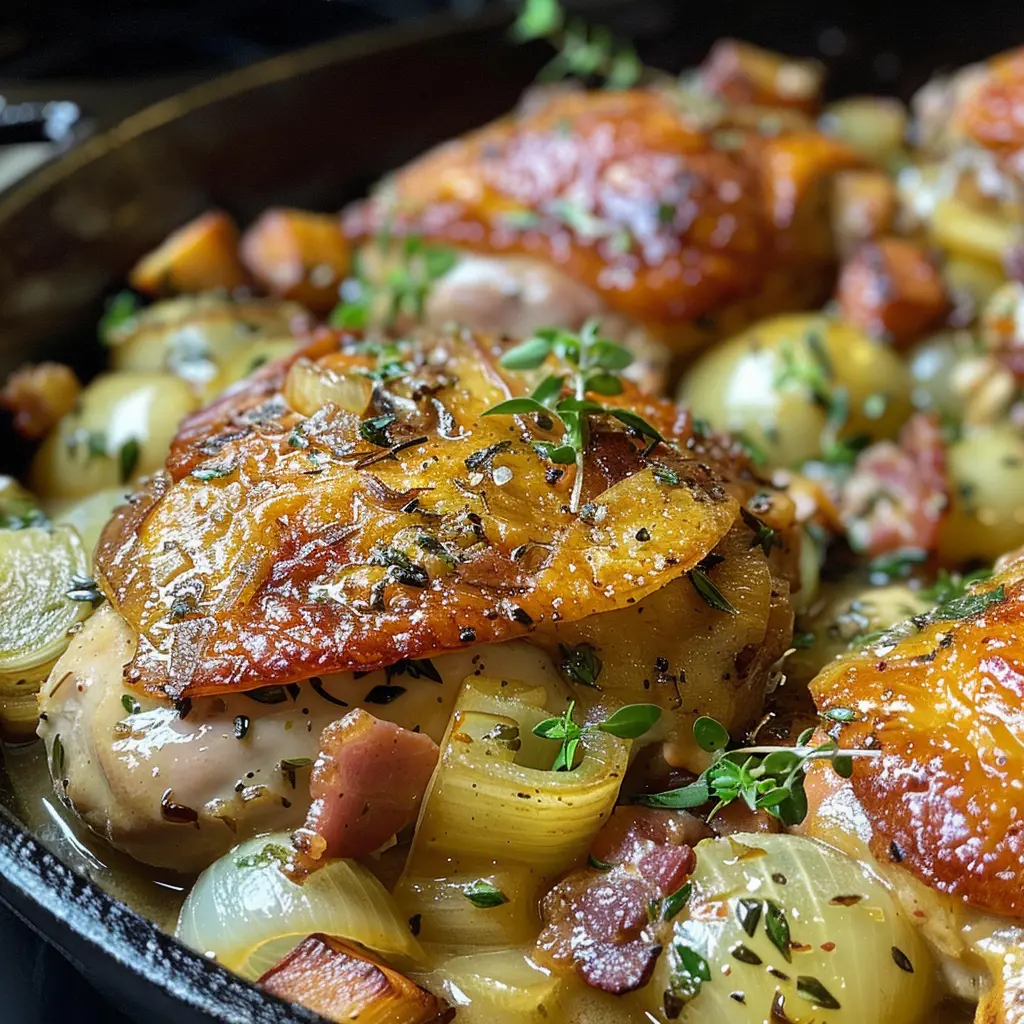
Coq au vin blanc sears chicken thighs until the skin is deeply golden and crispy, crisps bacon in the same pan, softens leeks and pearl onions in the rendered fat, deglazes with Chardonnay and chicken broth, returns the chicken to braise in the wine and aromatics, finishes in the oven, and stirs in heavy cream at the very end to produce a pale, silky, wine-scented sauce that coats the chicken and vegetables. It’s a lighter, brighter, more elegant variation on the classic red wine coq au vin — the kind of dinner that looks and tastes like restaurant cooking while happening entirely in one oven-safe skillet.
| Detail | Info |
|---|---|
| Prep Time | 15 minutes |
| Cook Time | 50 to 55 minutes |
| Total Time | 1 hour 10 minutes |
| Servings | 4 to 6 |
| Difficulty | Medium |
| Cuisine | French |
Why This Recipe Works
The crispy skin on the chicken thighs produced by the initial sear is the visual and textural element that elevates this dish from a simple braise to something genuinely impressive. Bone-in, skin-on chicken thighs placed skin-side down in a hot dry skillet and left undisturbed for 6 to 8 minutes render most of the subcutaneous fat from the skin, leaving behind a thin, deeply golden, shatteringly crispy layer that holds significant crispiness even through the subsequent oven braise because the fat has been rendered away and the skin’s structure set. This visible golden skin on each thigh presented in the pale cream sauce is what creates the visual contrast that makes the finished dish look like something that required classical training to produce.
Crisping the bacon in the same skillet after removing the chicken captures the chicken’s rendered fat and fond and combines it with the bacon’s own rendered fat and smoky flavor to create a cooking medium that, when the leeks and pearl onions are added, infuses those vegetables with the accumulated flavors of two different proteins before a drop of wine has been added. By the time the Chardonnay goes into the pan, the aromatic base has been built from three distinct fat and flavor sources — chicken skin, bacon, and butter — and the wine deglazes all of those concentrated flavors from the pan surface simultaneously, dissolving them into the braising liquid as the foundation of the sauce.
Leeks rather than yellow onion is the allium choice that defines the blanc version’s character as lighter and more elegant than the classic rouge. Leeks have a softer, more delicate onion flavor than yellow onion — slightly sweet, slightly herbal, and much less pungent in their raw state. When sauteed in the bacon fat, they become silky and almost buttery, adding a sweetness and body to the sauce base without the sharp onion note that would compete with the wine. The combination of leeks and pearl onions produces a layered onion flavor — the leeks’ sweetness and the pearl onions’ more pronounced onion character providing complementary rather than identical notes.
Deglazing with Chardonnay rather than red Burgundy is what produces the blanc version’s bright, pale, visually distinctive sauce. Chardonnay’s fruit is lighter and more acidic than red wine — it contributes apple, citrus, and a clean acidity to the braising liquid that brightens the chicken and cream without the tannins and color of red wine that would produce a darker, heavier sauce. The Chardonnay also pairs more naturally with the leeks, cream, and chicken combination — the white wine version of this dish has a coherent flavor profile where every component supports the light, bright, cream-based sauce rather than fighting against a dark, robust red wine reduction.
Stirring the heavy cream in only at the very end of cooking rather than adding it with the wine or broth is the technique that produces a stable, velvety sauce rather than a broken, curdled one. Heavy cream added to a liquid that then simmers for 30 minutes in the oven can reduce too far and separate, producing a greasy, split sauce. Added to the finished braising liquid after it comes out of the oven — while everything is still hot but no longer on active heat — the cream enriches and smooths the sauce without any risk of over-reduction or separation. One stir, and the pale braising liquid transforms into a silky, cream-enriched sauce that coats the back of a spoon.
Ingredients
| Ingredient | Quantity | Notes |
|---|---|---|
| Bone-in, skin-on chicken thighs | 4 to 6 | Skin-on is essential for the sear; bone-in for flavor and moisture |
| Bacon, diced | 4 slices | Crisped in the pan after removing the chicken; adds smokiness and fat |
| Leeks, sliced | 2 | White and light green parts only; cleaned thoroughly of grit |
| Pearl onions | 1 cup | Frozen peeled or fresh blanched and peeled; sauteed with the leeks |
| Dry white wine (Chardonnay) | 2 cups | Use a wine you’d drink; cheap cooking wine can make the sauce taste harsh |
| Chicken broth | 1 cup | Low-sodium preferred; combined with the wine for the braising liquid |
| Heavy cream | 1/2 cup | Stirred in only after the dish comes out of the oven |
| Garlic cloves | 2 | Added with the leeks and pearl onions; minced or thinly sliced |
| Fresh thyme | Several sprigs | Added with the braising liquid; remove before serving |
| Butter | 1 to 2 tablespoons | Added to the pan for sauteing the leeks and onions |
| Salt and black pepper | To taste | Season the chicken generously before searing |
Step-by-Step Instructions
Phase 1: Sear the Chicken and Crisp the Bacon
- Pat the chicken thighs completely dry with paper towels. Season generously with salt and black pepper on both sides. Dry skin sears; wet skin steams — this step determines whether the skin comes out crispy or pale.
- Heat a large oven-safe skillet (cast iron is ideal) over medium-high heat with no added oil. Place the chicken thighs skin-side down in the dry pan. Cook undisturbed for 6 to 8 minutes until the skin is deeply golden and releases cleanly from the pan. Flip and sear the flesh side for 2 minutes. Remove to a plate.
- Add the diced bacon to the same skillet over medium heat. Cook, stirring occasionally, until the bacon is crispy and has rendered its fat. Remove the bacon with a slotted spoon and set aside, leaving the fat in the pan.
Phase 2: Build the Aromatics
- Preheat the oven to 375 degrees F while proceeding with the stovetop steps.
- Add the butter to the skillet with the combined chicken and bacon fat. Once melted, add the sliced leeks, pearl onions, and garlic. Season with salt and cook over medium heat, stirring occasionally, for 4 to 5 minutes until the leeks are soft and silky and the pearl onions are beginning to color at the edges.
Phase 3: Deglaze and Braise
- Pour the Chardonnay into the skillet. The wine will immediately lift the fond from the pan bottom — scrape vigorously with a wooden spoon or spatula to dissolve all the browned bits into the liquid. This fond is concentrated flavor; don’t leave any on the pan.
- Add the chicken broth and fresh thyme sprigs. Bring to a simmer and cook for 5 minutes to reduce slightly and allow the alcohol to cook off.
- Return the seared chicken thighs to the skillet, skin-side up, nestling them into the liquid without submerging the skin. Scatter the crisped bacon over the liquid around the chicken.
Phase 4: Bake and Finish
- Transfer the skillet to the preheated oven. Bake uncovered for 25 to 30 minutes until the chicken is cooked through to 165 degrees F and the skin has maintained its golden color through the bake. The liquid should be simmering gently and reduced by roughly a third.
- Remove from the oven. Remove the thyme sprigs. Stir in the heavy cream, swirling it into the hot braising liquid until the sauce becomes pale, smooth, and silky. Taste and adjust seasoning.
- Let rest for 5 minutes before serving, allowing the cream sauce to settle and thicken slightly.
Chef Tips for Perfect Results
Use a wine you would drink. Two cups of wine cook down into a concentrated sauce — whatever quality the wine is going in, it’s amplified in the finished dish. A cheap, harsh cooking wine produces a harsh, thin sauce. A reasonably good drinking Chardonnay produces a sauce with genuine depth and complexity. This is not the recipe to use the bottle that’s been open for two weeks.
Keep the chicken skin above the braising liquid level throughout. Any skin submerged in the braising liquid will steam rather than stay crispy. Position the chicken skin-side up and ensure the braising liquid level stays below the skin line. If the liquid level is too high after deglazing, let it reduce a few minutes more before returning the chicken.
Use frozen pearl onions to skip blanching and peeling. Fresh pearl onions require blanching and peeling, which adds 15 minutes of tedious prep to the recipe. Frozen pearl onions (available in most grocery store frozen vegetable sections) are pre-peeled and ready to use directly from the bag. The flavor difference between fresh and frozen pearl onions in a braise is imperceptible.
Add a tablespoon of Dijon mustard with the cream. Whisked into the cream before stirring into the braising liquid, Dijon mustard adds a classic French element that enhances the sauce’s complexity and provides a barely perceptible sharpness that makes the cream sauce taste more vibrant rather than simply rich. It doesn’t taste like mustard in the finished dish — it tastes like depth.
Finish with a knob of cold butter swirled in before serving. A tablespoon of cold butter swirled into the sauce immediately before serving — the classic French monte au beurre technique — adds a final richness and produces a glossy, velvety sauce that looks professionally finished. Add off the heat and swirl until the butter is just melted and incorporated.
Common Mistakes to Avoid
Not drying the chicken skin before searing. Surface moisture prevents browning and produces pale, steamed skin rather than the crispy golden skin the dish depends on. Always pat dry first.
Moving the chicken during the sear. The skin releases cleanly when the crust is properly formed — pulling it before it’s ready causes it to tear and stick. Leave it completely undisturbed until it lifts without resistance.
Adding the cream too early. Cream added before the oven bake will over-reduce and can split. Always add at the very end after the pan comes out of the oven.
Using a wine that’s too sweet. Even a lightly sweet white wine like a Riesling or Gewurztraminer will produce a sauce that’s noticeably cloying alongside the cream and bacon fat. Use a fully dry Chardonnay or a dry Sauvignon Blanc.
Submerging the chicken skin in the braising liquid. Skin in liquid becomes soft and unappealing. Keep it above the liquid level throughout.
Variations and Substitutions
Add mushrooms: A cup of sliced cremini or chanterelle mushrooms sauteed with the leeks adds an earthy dimension that’s particularly compatible with the white wine and cream sauce. Chanterelles with white wine and cream is one of the great classical French flavor combinations.
Add tarragon: A tablespoon of fresh tarragon leaves stirred into the cream sauce at the very end adds the distinctive anise-herbal note that’s characteristic of classical French white wine chicken dishes. Tarragon cream sauce and chicken is one of the foundations of French bistro cooking.
Use chicken breasts: Bone-in, skin-on chicken breasts work in this recipe with a slightly reduced oven bake of 20 to 22 minutes. Check for 165 degrees F at the thickest point earlier than the thigh version, as breasts cook faster and dry out if overcooked.
Make it without bacon for a cleaner flavor: The bacon adds smokiness and depth but also some heaviness. A version without bacon — using only butter for the leek and onion saute — produces a cleaner, more delicate sauce that lets the wine, cream, and chicken flavors come through without the smoky note. Both versions are excellent; the choice depends on whether you want a richer or a lighter result.
Serving Suggestions
Serve directly from the skillet at the table, with each portion including a chicken thigh, a generous spoonful of the cream sauce with leeks, pearl onions, and bacon, and extra sauce ladled alongside. Buttered egg noodles, mashed potatoes, or crusty French bread are the classic accompaniments for soaking up the sauce. A simple green salad with Dijon vinaigrette is the natural side that echoes the mustard note and provides the light, acidic contrast the richness of the cream sauce benefits from. Serve with the same Chardonnay used in the cooking — it completes the table in a way no other pairing quite achieves.
Storage and Reheating
Refrigerator: Store covered for up to 3 days. The cream sauce will thicken significantly in the refrigerator. The chicken skin will soften — this is unavoidable when stored in a cream sauce.
Reheating: Reheat gently in a covered skillet over medium-low heat, adding a splash of chicken broth to loosen the sauce as it warms. The microwave works for individual portions in 90-second intervals. Avoid high heat which can cause the cream sauce to break.
Freezer: Not recommended for the cream sauce version — cream sauces separate after freezing and thawing. The dish without the cream added freezes well for up to 2 months; thaw overnight and add fresh cream when reheating.
Nutritional Information
| Nutrient | Per Serving (approx., based on 5 servings) |
|---|---|
| Calories | 580 |
| Protein | 38g |
| Carbohydrates | 10g |
| Fat | 38g |
| Saturated Fat | 16g |
| Fiber | 1g |
| Sodium | 580mg |
Nutritional values are estimates based on standard ingredient brands without sides. Values will vary based on chicken thigh size and specific wine and cream brands used.
FAQ
What’s the difference between coq au vin and coq au vin blanc?
Classic coq au vin uses red Burgundy wine and produces a dark, robust, deeply flavored braised chicken with a rich red-brown sauce that includes mushrooms, pearl onions, bacon lardons, and often a splash of cognac. Coq au vin blanc (literally “rooster in white wine”) uses white wine — traditionally Alsatian white wine in the French version, often Chardonnay in American recipes — and produces a paler, lighter, more delicately flavored braise with a cream-finished sauce that has a brighter, more acidic character. Both are classic French preparations; the blanc version is generally considered more elegant and approachable for cooks newer to French cooking.
Can I use a different white wine?
Yes. Any dry white wine works — Sauvignon Blanc produces a sharper, more acidic sauce; Pinot Grigio a lighter, more neutral one; Viognier a slightly more floral, aromatic version. Avoid oaky Chardonnays if the oak flavor is very prominent — it can become slightly bitter when reduced. Avoid any wine with noticeable sweetness, which will produce a cloying sauce alongside the cream.
Can I make this without pearl onions?
Yes. Substitute one medium yellow onion diced into half-inch pieces and sauteed with the leeks. The flavor is slightly more pronounced and less visually elegant than whole pearl onions but the dish is equally delicious. Shallots halved lengthwise are an even more elegant and classically French substitute.
How do I clean leeks properly?
Leeks are notoriously gritty between their layers. Slice off the dark green tops (save for stock) and the root end. Slice the white and light green parts into rounds, then place in a bowl of cold water and agitate with your hands — the grit sinks to the bottom and the leek floats. Lift the leek out with your hands (don’t pour through a colander or the grit pours back over the leek) and dry before cooking.
Can I make this ahead for a dinner party?
Yes — with one adjustment. Complete the recipe through the oven bake, but hold the cream. Cool and refrigerate the chicken in the braising liquid (without cream) for up to 2 days. When ready to serve, reheat gently on the stovetop, taste and adjust seasoning, then stir in the cream off the heat as directed. This approach means the only step on the night of the party is a 15-minute gentle reheat and the cream finish.
Conclusion
Coq au vin blanc is the dinner party recipe that justifies keeping a good bottle of Chardonnay in the kitchen — the wine that went into the sauce is the wine that should be on the table alongside it, and everything about this dish from the crispy golden skin to the pale, silky cream sauce communicates an occasion. One skillet, French technique without French difficulty, and a result that looks exactly as impressive as the name suggests it should.