
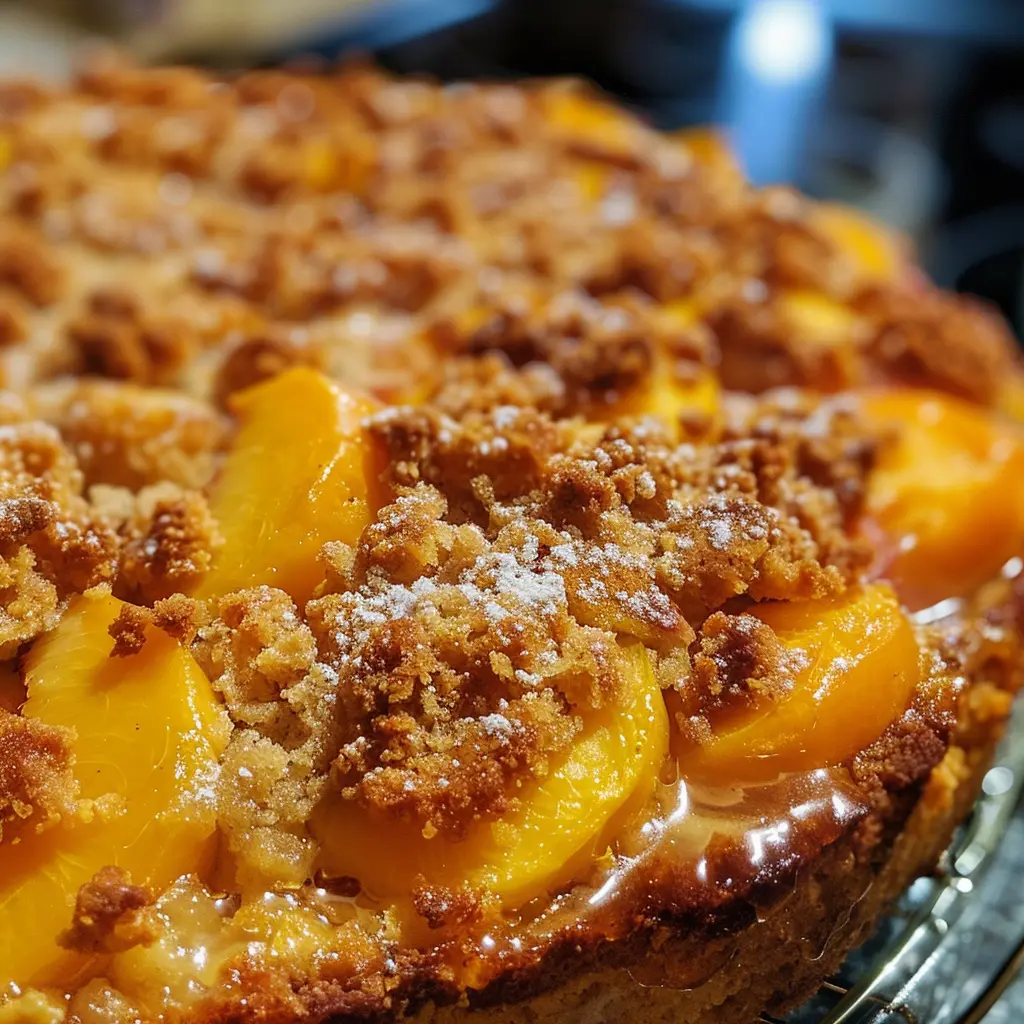
Homemade peach cake creams butter and sugar until light and fluffy, adds eggs, vanilla, almond extract, and sour cream, folds in two cups of diced fresh peaches, spreads the batter into a pan, blankets it with a cinnamon crumble, bakes until golden and clean at the center, and finishes with a peach glaze drizzled over the cooled cake and a dusting of powdered sugar. It’s a soft, buttery, fruit-forward summer cake with three distinct textural layers — tender crumb, crunchy crumble, and sweet glaze — that rewards peak-season peaches more than almost any other preparation.
| Detail | Info |
|---|---|
| Prep Time | 20 minutes |
| Bake Time | 45 to 50 minutes |
| Cool Time | 30 minutes |
| Total Time | About 1 hour 40 minutes |
| Servings | 10 to 12 |
| Difficulty | Easy |
| Cuisine | American |
Why This Recipe Works
Creaming the butter and sugar until light and fluffy before adding any other ingredient is the foundational technique that determines the cake’s texture more than any other step. When softened butter and granulated sugar are beaten together at medium-high speed for 3 to 5 minutes, the sharp edges of the sugar crystals cut millions of tiny air bubbles into the butter fat. Those air bubbles expand in the oven’s heat and produce a light, tender, fine-crumbed cake. The visual cue for properly creamed butter and sugar is a mixture that’s noticeably pale — almost white rather than yellow — and has increased in volume. That pale, airy mixture is the structure the finished cake is built on.
Sour cream in the batter rather than milk or buttermilk produces a cake with a distinctly tender, moist crumb that holds its moisture longer than a milk-based cake. Sour cream’s fat content contributes richness and its lactic acid tenderizes the gluten strands in the flour, producing a softer, more delicate crumb structure. It also adds a barely perceptible tang that counterbalances the sweetness of the sugar and glaze and makes the peach flavor more vivid by contrast.
Folding the diced peaches into the finished batter rather than layering them or pressing them into the surface distributes fresh peach pieces throughout every cross-section of the cake. During baking, the peaches release some of their juice into the surrounding batter, creating small pockets of intensely peach-flavored, slightly more moist cake around each piece — the most flavorful bites in the finished cake are the ones that contain a piece of peach surrounded by batter that absorbed its juice during the bake.
The cinnamon crumble made with cold rather than softened butter is the technique that produces distinct, sandy, crunchy crumble pieces rather than a uniform paste that bakes into a flat, cookie-like layer. Cold butter, when cut into the flour and brown sugar mixture, remains in small, distinct pieces rather than blending completely. In the oven, those butter pieces melt and create small steam pockets in the surrounding flour and sugar mixture, producing the irregular, crumbly texture of a proper crumble topping.
The peach glaze drizzled over a completely cooled cake rather than a warm one produces a glaze that sets on the cake’s surface as a visible, slightly opaque drizzle rather than absorbing entirely into the cake or running off the sides. A glaze drizzled over a warm cake encounters a surface still releasing steam — the moisture softens the glaze immediately and it soaks in rather than sitting on the surface. A glaze drizzled over a completely cool cake settles into a visible drizzle pattern and sets as a thin, sweet coating.
Ingredients
For the Cake
| Ingredient | Quantity | Notes |
|---|---|---|
| All-purpose flour | 2 cups | Spooned and leveled, not packed |
| Baking powder | 2 teaspoons | Check freshness — old baking powder won’t lift |
| Salt | 1/2 teaspoon | |
| Unsalted butter, softened | 1/2 cup | Room temperature; will not cream properly if cold |
| Granulated sugar | 1 cup | |
| Large eggs | 2 | Room temperature |
| Vanilla extract | 1 teaspoon | |
| Almond extract | 1/2 teaspoon | Optional but strongly recommended |
| Sour cream | 1/2 cup | Full-fat; produces a more tender crumb than low-fat |
| Fresh peaches, peeled and diced | 2 cups | Ripe but firm; about 3 to 4 medium peaches |
For the Cinnamon Crumble
| Ingredient | Quantity | Notes |
|---|---|---|
| All-purpose flour | 1/2 cup | |
| Brown sugar | 1/4 cup | Light or dark both work |
| Ground cinnamon | 1 teaspoon | |
| Cold unsalted butter, cubed | 1/4 cup | Must be cold from the refrigerator |
For the Peach Glaze
| Ingredient | Quantity | Notes |
|---|---|---|
| Powdered sugar | 1 cup | Sifted to prevent lumps |
| Peach juice or milk | 2 to 3 tablespoons | Use juice collected from dicing the peaches for best flavor |
| Vanilla extract | 1/2 teaspoon |
Step-by-Step Instructions
Phase 1: Make the Crumble
- Combine the flour, brown sugar, and cinnamon in a small bowl. Add the cold cubed butter. Using your fingertips or a pastry cutter, work the butter into the dry ingredients until the mixture resembles coarse, irregular crumbs — some pieces the size of a pea, some smaller. Do not overwork. Refrigerate while you make the batter.
Phase 2: Make the Cake Batter
- Preheat the oven to 350 degrees F. Grease and line a 9-inch round or square baking pan with parchment paper.
- Whisk together the flour, baking powder, and salt in a medium bowl. Set aside.
- In a large mixing bowl, beat the softened butter and granulated sugar together at medium-high speed for 3 to 5 minutes until the mixture is very pale, light, and noticeably increased in volume. Don’t rush this step.
- Add the eggs one at a time, beating well after each addition. Mix in the vanilla extract and almond extract if using.
- Add the sour cream and beat until smooth and fully incorporated.
- Add the dry ingredients in two additions, mixing on low speed just until no dry flour remains. Stop as soon as the batter comes together — do not overmix.
- Fold in the diced peaches gently with a spatula until evenly distributed.
Phase 3: Assemble and Bake
- Pour the batter into the prepared pan and spread evenly to the edges. Remove the crumble from the refrigerator and scatter it evenly over the batter surface.
- Bake for 45 to 50 minutes until the top is golden, the crumble is set and crunchy, and a toothpick inserted into the center comes out clean or with a few moist crumbs. No wet batter should appear on the toothpick.
- Cool the cake in the pan on a wire rack for 20 minutes, then turn out and cool completely before glazing — at least 30 additional minutes.
Phase 4: Glaze and Garnish
- Whisk together the powdered sugar, 2 tablespoons of peach juice or milk, and vanilla extract until smooth. Add the third tablespoon of liquid only if the glaze is too thick to drizzle. It should flow slowly off a spoon in a thin ribbon.
- Drizzle the glaze over the completely cooled cake in a back-and-forth motion. Dust lightly with powdered sugar just before serving.
Chef Tips for Perfect Results
Use ripe but firm peaches. Very ripe, soft peaches release too much juice into the batter during baking and can make the surrounding crumb gummy and wet. Peaches that are ripe enough to be sweet and fragrant but still firm enough to hold their dice shape during mixing produce the best result.
Bring butter, eggs, and sour cream to room temperature before starting. Cold butter won’t cream properly with the sugar. Cold eggs can cause the creamed butter to curdle. Room temperature ingredients blend smoothly and produce a cohesive, properly aerated batter.
Peel peaches using the blanching method. Score an X on the bottom of each peach, blanch in boiling water for 30 seconds, and transfer immediately to an ice bath. The skin slips off with almost no effort — significantly faster and cleaner than a vegetable peeler, particularly with ripe fruit.
Use peach juice from the dicing process for the glaze. As the peaches are diced, they release a small amount of juice. Collect it in the bowl and use it as the glaze liquid — it produces a more intensely peach-flavored glaze than milk.
Add a pinch of nutmeg to the crumble. A small pinch of ground nutmeg added with the cinnamon adds a warm spice note that pairs naturally with peach and cinnamon and adds complexity without being identifiable as a distinct flavor.
Common Mistakes to Avoid
Undercreaming the butter and sugar. Thirty seconds of beating is not enough. Three to five minutes at medium-high speed is the minimum for the pale, airy mixture that produces a light crumb.
Overmixing after adding the flour. Gluten develops with mixing — the more the batter is worked after the flour goes in, the tougher the finished cake. Mix just until no dry flour remains and stop immediately.
Using softened butter for the crumble. Softened butter produces a paste rather than a crumble. The butter must be cold and cubed directly from the refrigerator.
Glazing a warm cake. The glaze absorbs into warm cake rather than sitting on the surface. Always glaze a completely cool cake.
Not testing with a toothpick. The peaches add moisture that can make the visual golden-top cue misleading. Always test at 45 minutes.
Variations and Substitutions
Peach and Blueberry: Fold one cup of fresh blueberries in with the diced peaches. The blueberries burst during baking and create vivid pockets in the crumb — one of summer’s best fruit pairings.
Canned or Frozen Peaches: Well-drained canned peaches in juice (not syrup) or thawed, thoroughly drained frozen peaches substitute for fresh when peaches are out of season. Pat dry before folding into the batter.
Cream Cheese Swirl: Beat 4 oz softened cream cheese with 2 tablespoons sugar and 1 egg yolk until smooth. Pour half the batter into the pan, dollop the cream cheese mixture over it, swirl with a knife, add the remaining batter, then the crumble.
Brown Butter Version: Brown the butter before creaming — melt in a saucepan until the milk solids turn golden and nutty, cool to room temperature until solid, then beat with the sugar. Adds a nutty, caramel-adjacent depth that pairs beautifully with peaches.
Serving Suggestions
Serve at room temperature with a scoop of vanilla ice cream or a dollop of lightly sweetened whipped cream. The contrast of warm cake and cold ice cream is ideal if the cake is served the day it’s baked. A few thin peach slices arranged on top before the glaze sets is a beautiful addition for a special occasion.
Storage
Room temperature: Cover loosely and store for up to 2 days. The crumble stays relatively crunchy for the first day and softens slightly by day two.
Refrigerator: Store covered for up to 5 days. The cake improves in flavor in the refrigerator as the peach juices continue to distribute through the crumb. Bring to room temperature before serving.
Freezer: Freeze individual slices wrapped tightly in plastic and foil for up to 2 months. Thaw at room temperature for 2 hours. The crumble softens after freezing but the cake itself is excellent.
Nutritional Information
| Nutrient | Per Serving (approx., based on 11 servings) |
|---|---|
| Calories | 380 |
| Protein | 5g |
| Carbohydrates | 58g |
| Fat | 15g |
| Saturated Fat | 9g |
| Fiber | 1g |
| Sugar | 38g |
| Sodium | 180mg |
Nutritional values are estimates based on standard ingredient brands with almond extract and peach juice glaze included. Values will vary based on peach size and specific butter and sour cream brands used.
FAQ
Can I use yellow peaches or white peaches?
Both work well. Yellow peaches have a more acidic, tangy-sweet flavor with pronounced peach character. White peaches are milder, more floral, and sweeter with less acidity. Yellow peaches produce a more assertively peachy flavor; white peaches a more delicate one. Both are excellent.
Do I need to peel the peaches?
Technically no, but peeling produces a better texture. Unpeeled peach skin can become slightly chewy and leathery during baking. Peeling takes two minutes with the blanching method and produces a more uniform, pleasant texture throughout the finished cake.
Why did my cake sink in the middle?
Three common causes: the oven door was opened before the cake had set, the baking powder was old and didn’t produce enough lift, or the batter was overmixed and the gluten structure collapsed under the weight of the peaches. Use fresh baking powder, don’t open the oven before 40 minutes, and mix only until the flour is just incorporated.
Can I make this in a different pan size?
Yes with adjusted bake times. A 9×13 pan produces a thinner cake that bakes in 30 to 35 minutes. An 8-inch pan needs 50 to 55 minutes and benefits from a foil tent over the top for the last 15 minutes if the crumble is browning too fast. A bundt pan works with the same batter — skip the crumble and double the glaze.
Can I make this cake the day before serving?
Yes — and it’s better on day two. The peach juices continue to distribute through the crumb overnight, producing a more uniformly moist and flavorful cake than the same-day version. Cover loosely and add the powdered sugar dusting just before serving.
Conclusion
Homemade peach cake earns a permanent spot in the warm-weather rotation by producing exactly what it promises — a soft, buttery, peach-packed cake with a crunchy cinnamon crumble and a sweet glaze that looks and tastes like it took considerably more skill than it did. Make it when peaches are at their peak, serve it with vanilla ice cream, and accept that there won’t be leftovers.