
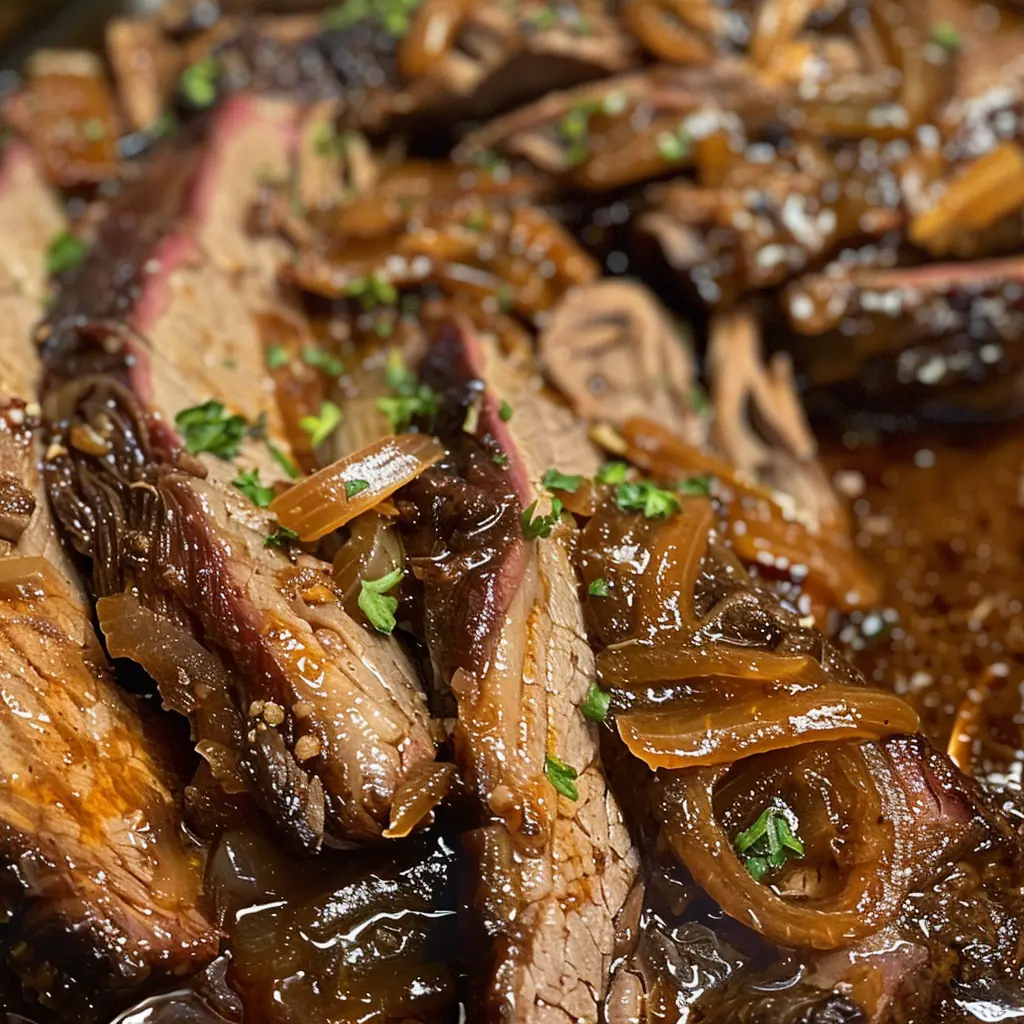
Slow cooker beef brisket takes one of the most notoriously difficult cuts of beef to cook well and makes it completely approachable with 10 minutes of prep and a slow cooker that does the rest. The brisket braises all day in a smoky, savory liquid of beef broth, Worcestershire sauce, and brown sugar, and what comes out 8 to 10 hours later pulls apart effortlessly and fills the house with a smell that makes the wait genuinely difficult.
| Detail | Info |
|---|---|
| Prep Time | 10 minutes |
| Cook Time | 8 to 10 hours (Low) / 5 to 6 hours (High) |
| Rest Time | 15 to 20 minutes |
| Total Time | 8 to 10 hours 30 minutes |
| Servings | 8 to 10 |
| Difficulty | Easy |
| Cuisine | American Comfort Food |
Why This Recipe Works
Brisket is one of the hardest-working muscles on a cow and is consequently one of the toughest cuts of beef available. It contains dense connective tissue — primarily collagen — that makes it unpleasantly chewy and tough when cooked quickly at high temperatures. The slow cooker solves this problem elegantly. Eight to ten hours at the gentle heat of the Low setting maintains a steady temperature just below the simmering point, which is exactly what collagen needs to convert into gelatin. That conversion is what transforms a tough, fibrous brisket into something that falls apart at the touch of a fork and has a rich, silky quality in every bite that no quick-cook method can replicate.
Placing the brisket fat-side up in the slow cooker is a deliberate technique choice. As the fat cap on the top of the brisket renders during the long cook, it bastes the meat continuously from above, keeping the surface from drying out and adding richness to the cooking liquid below. The fat layer also acts as an insulator that slows the surface of the meat from overcooking relative to the interior, producing more even doneness throughout the thick cut.
The onion and garlic bed beneath the brisket serves two functions. It elevates the meat slightly off the bottom of the slow cooker insert so it sits in the braising liquid rather than directly on the metal surface, which can produce uneven cooking and potential scorching. More importantly, the onion and garlic slowly caramelize in the braising liquid over 8 to 10 hours, releasing their natural sugars and aromatics into the cooking juices and transforming what started as a simple broth into a deeply flavored, complex braising sauce.
Brown sugar in the braising liquid is a small addition with a meaningful impact. It balances the saltiness of the broth and Worcestershire sauce and the acidity of the vinegar, producing a sauce that’s well-rounded and slightly sweet rather than sharp and one-dimensional. It also promotes caramelization on any surface of the brisket that’s exposed above the liquid, helping develop the color and flavor that makes the finished brisket look and taste like something that took real skill to produce.
Smoked paprika is the seasoning that makes this slow cooker brisket taste like it spent time near smoke even though it never came close to a grill or smoker. Smoked paprika contains pyrazines and other compounds from the smoking of the peppers used to make it that genuinely replicate some of the aromatic complexity of wood smoke. Combined with the Worcestershire sauce — which provides its own umami depth from tamarind, anchovies, and vinegar — the braising liquid develops a flavor profile that’s rich, savory, and subtly smoky in a way that makes people wonder how much more work went into this dish than actually did.
Ingredients
| Ingredient | Quantity | Notes |
|---|---|---|
| Beef brisket flat, trimmed | 6 to 7 pounds | Flat cut preferred; leaner, slices more neatly, fits better in slow cooker |
| Large onion, sliced | 1 | Creates an aromatic bed that elevates the brisket and flavors the sauce |
| Garlic cloves, smashed | 4 | Smashing rather than mincing releases flavor more gradually over the long cook |
| Beef broth | 2 cups | Good quality low-sodium broth; the flavor concentrates during the long cook |
| Worcestershire sauce | 1/4 cup | Adds umami depth; use gluten-free version if needed |
| Brown sugar | 2 tablespoons | Balances saltiness and acidity; promotes surface caramelization |
| Smoked paprika | 1 tablespoon | Provides smoky depth without a smoker; regular paprika plus liquid smoke works too |
| Black pepper | 1 teaspoon | Applied to the braising liquid; season the meat separately if searing |
| Bay leaves (optional) | 2 | Add herbal depth; remove before serving |
| Apple cider vinegar (optional) | 1 tablespoon | Adds brightness and acidity that balances the rich braising liquid |
Step-by-Step Instructions
Phase 1: Prepare the Slow Cooker and Brisket
- If searing the brisket before slow cooking — strongly recommended for maximum flavor — heat a large skillet or Dutch oven over high heat until very hot. Pat the brisket completely dry with paper towels and season generously on all sides with salt and black pepper. Sear for 3 to 4 minutes per side without moving until a deep brown crust develops. Transfer to a plate. The skillet will smoke — this is normal and desirable. The crust from searing doesn’t seal in juices, but it does create Maillard reaction flavor compounds that infuse the braising liquid and significantly deepen the flavor of the finished dish.
- Spread the sliced onion and smashed garlic across the bottom of a 6-quart slow cooker in an even layer. The onion and garlic should cover the entire bottom — they form the aromatic bed that prevents the brisket from sitting directly on the insert.
- Place the brisket on top of the onion and garlic bed with the fat side facing up. If the brisket is too long for the slow cooker, cut it in half and stack the pieces — the cook time stays the same since the individual pieces are thinner.
Phase 2: Make and Add the Braising Liquid
- In a medium bowl, whisk together the beef broth, Worcestershire sauce, brown sugar, smoked paprika, and black pepper until the brown sugar is fully dissolved and everything is combined.
- Pour the braising liquid evenly over and around the brisket. Add the bay leaves and apple cider vinegar if using. The liquid should come about halfway up the sides of the brisket — it doesn’t need to fully submerge the meat since the steam created in the covered slow cooker will cook the upper half.
Phase 3: Cook Low and Slow
- Cover the slow cooker and cook on Low for 8 to 10 hours or on High for 5 to 6 hours. Low is strongly preferred — the longer, gentler cook converts more collagen to gelatin and produces a more tender, silky result than the High setting. Set it in the morning and let it go all day.
- Do not lift the lid during cooking. Every time the lid is removed, the slow cooker loses 20 to 30 minutes of accumulated heat and steam. The brisket needs that steam environment to cook properly. Resist the urge to check until the minimum cook time has elapsed.
- The brisket is done when a fork inserted into the thickest part meets almost no resistance and the meat begins to pull apart. If it still feels firm or tight, it needs more time — return the lid and continue cooking in 30-minute increments until it reaches the right tenderness. Brisket timing varies based on the thickness of the flat and the specific slow cooker model.
Phase 4: Rest, Slice, and Serve
- Carefully transfer the brisket to a large cutting board. It will be very tender and may begin to pull apart during transfer — use two large spatulas or a pair of tongs to support it from below as you move it.
- Tent the brisket loosely with aluminum foil and let it rest for 15 to 20 minutes. Resting allows the juices — which have been driven toward the center of the meat during cooking — to redistribute throughout the brisket. Slicing immediately after cooking causes those juices to pour out onto the cutting board rather than staying in the meat.
- While the brisket rests, skim the excess fat from the surface of the cooking liquid using a large spoon or fat separator. The remaining cooking liquid is the sauce — taste it and adjust seasoning if needed. If it seems thin, pour it into a small saucepan and simmer over medium heat for 5 to 10 minutes to reduce and concentrate. Remove the bay leaves if using.
- Slice the brisket against the grain into half-inch slices. Cutting against the grain is not optional — brisket’s long muscle fibers run in a visible direction, and cutting with the grain produces long, chewy, stringy slices. Cutting perpendicular to those fibers shortens them and produces slices that are tender and easy to chew. Identify the direction of the grain before making the first cut and maintain that perpendicular angle throughout.
- Arrange the sliced brisket on a serving platter and spoon the cooking juices generously over the top. Serve immediately.
Chef Tips for Perfect Results
Sear before slow cooking. This is the single upgrade that most dramatically improves the finished dish. A 6 to 8 minute sear in a very hot pan creates a deeply browned, Maillard-reaction crust on the surface of the brisket that adds layers of savory, slightly caramelized flavor that slow cooking alone cannot produce. The braising liquid dissolves these flavors during the cook and distributes them throughout the sauce. Without the sear, the brisket tastes good. With it, it tastes like something you’d pay for at a proper barbecue restaurant.
Add two tablespoons of tomato paste. Stir the tomato paste into the braising liquid with the broth and Worcestershire. Tomato paste adds body, a concentrated umami depth, and a slight sweetness that makes the cooking juices taste richer and more complex. It dissolves into the liquid during the long cook and becomes unidentifiable in the finished sauce — you just notice that everything tastes more complete.
Refrigerate overnight and serve the next day. Brisket that has been cooked, cooled, and refrigerated overnight in its cooking juices tastes significantly better than brisket served the same day it’s cooked. The flavors deepen and meld during the rest, the fat solidifies on the surface and can be lifted off cleanly, and the gelatin in the cooking liquid sets around the brisket and keeps it moist. Reheat gently in a 325-degree F oven covered with foil with the cooking juices poured over the slices for 20 to 30 minutes. This make-ahead approach also makes it the ideal dish for holiday entertaining.
Use flat-cut brisket over point-cut. The flat is the leaner, more uniform section of the whole brisket. It cooks more evenly, slices more neatly into consistent pieces, and fits flat in most slow cooker inserts. The point cut has more fat marbling and is more flavorful but irregular in shape and harder to slice cleanly. For a slow cooker application where presentation matters, the flat is the right choice.
Don’t trim all the fat. Leave about a quarter inch of fat cap on the top of the brisket. The fat renders during the long cook and bastes the meat continuously. Removing all the fat before cooking produces a drier brisket that can become stringy and tight during the long cook. Trim excess or very thick fat deposits, but leave enough to do its self-basting work.
Common Mistakes to Avoid
Cooking on High when you have the time for Low. High heat produces brisket that’s technically fork-tender but has a slightly different texture than the Low setting — the fibers can be slightly more stringy and the collagen conversion is less complete. If you have 8 to 10 hours available, always choose Low. The extra time produces a genuinely superior result that justifies the patience.
Cutting with the grain. This is the most common serving mistake with brisket. Brisket cut with the grain produces long, fibrous, chewy pieces that work against every hour of effort you put into cooking it correctly. Look at the surface of the cooked brisket and identify the direction the muscle fibers run — they’ll be visible as long, parallel lines. Your knife should be perpendicular to those lines, not parallel.
Not resting the meat before slicing. The rest period is not a suggestion. Brisket sliced immediately after cooking releases a significant amount of juice onto the cutting board — juice that should be in the meat. Fifteen to twenty minutes of rest under loose foil allows the juice to redistribute and produces slices that are visibly more moist and flavorful than unrested brisket.
Lifting the lid during cooking. Every lid lift costs 20 to 30 minutes of cooking progress. During an 8 to 10 hour cook, two or three unnecessary lid lifts can add an hour or more to the total time. Set it and leave it alone until the minimum cook time has elapsed.
Adding too much liquid. Two cups of broth is the right amount for this recipe. More liquid produces a thin, diluted sauce rather than a concentrated, flavorful braising liquid. Brisket releases significant moisture during the long cook — the liquid level will be considerably higher when the brisket is done than when it started. Trust the amount in the recipe.
Variations and Substitutions
BBQ brisket version: Replace the beef broth with 1 cup of your favorite barbecue sauce and 1 cup of beef broth. Add a teaspoon of liquid smoke to the braising liquid. The finished brisket will have a distinctly barbecue character that works particularly well piled onto toasted buns with coleslaw.
Beer-braised brisket: Replace one cup of the beef broth with a dark beer — a stout or porter works best. The beer adds malty depth and a slight bitterness that balances the sweetness of the brown sugar and the richness of the beef. The alcohol cooks off completely during the long cook, leaving only the flavor.
Jewish-style brisket: Add a 28-ounce can of crushed tomatoes and two additional tablespoons of brown sugar to the braising liquid. Omit the Worcestershire sauce. This version has a sweet-tomato braising sauce in the Ashkenazi tradition and is a classic Passover and holiday preparation.
No smoked paprika: Use regular sweet paprika in the same quantity and add half a teaspoon of liquid smoke to the braising liquid. Liquid smoke is highly concentrated — half a teaspoon is enough for a full brisket. More than that and the smoke flavor can become acrid and artificial-tasting.
Serving Suggestions
Sliced brisket with the cooking juices spooned over it is a complete dish that needs very little alongside. Creamy mashed potatoes are the classic accompaniment — they absorb the braising liquid and provide a rich, starchy base that balances the intense flavor of the beef. Buttered egg noodles work equally well. Roasted root vegetables — carrots, parsnips, turnips — roasted separately and served alongside add color and sweetness.
For a more casual presentation, pile sliced or roughly pulled brisket onto toasted brioche buns with a spoonful of cooking juices, pickled red onions, and coleslaw for the most satisfying brisket sandwich. The cooking juices spooned over the meat just before the bun goes on top seep into the bread and make every bite deeply flavored from first to last.
Storage and Reheating
Refrigerator: Store sliced brisket in an airtight container with cooking juices poured over the top for up to 4 days. The juices keep the slices moist during storage and the flavor continues to develop. The fat in the juices will solidify overnight and can be skimmed off before reheating for a leaner sauce.
Freezer: Freeze brisket and cooking juices together in airtight freezer-safe containers for up to 3 months. Thaw overnight in the refrigerator before reheating. Brisket freezes exceptionally well — the texture and flavor are virtually unchanged after thawing.
Reheating: The oven is the best method for maintaining moisture. Arrange slices in a single layer in a baking dish, pour the cooking juices over the top, cover tightly with foil, and warm at 325 degrees F for 20 to 25 minutes until heated through. The microwave works for individual portions — cover and heat in 60-second intervals with a spoonful of cooking juice over the slices to prevent drying.
Nutritional Information
| Nutrient | Per Serving (approx.) |
|---|---|
| Calories | 480 |
| Protein | 52g |
| Carbohydrates | 8g |
| Fat | 26g |
| Saturated Fat | 10g |
| Fiber | 0g |
| Sodium | 620mg |
Nutritional values are estimates based on a trimmed flat-cut brisket. Values will vary significantly based on how much fat remains on the brisket and the specific broth used.
FAQ
How do I know when the brisket is truly done?
Fork-tenderness is the most reliable indicator. Insert a fork or a skewer into the thickest part of the brisket and twist slightly — it should meet almost no resistance and the meat should begin to separate. If you feel significant resistance, the collagen hasn’t fully converted yet and the brisket needs more time. A brisket that seems done at the edges but tight at the center also needs more time. Continue cooking in 30-minute increments until the entire piece is uniformly tender. Brisket can handle additional cooking time without becoming worse — it simply becomes more tender the longer it goes, up to a point where the fibers begin to shred.
Can I cook a smaller brisket in the same slow cooker?
Yes. A 3 to 4 pound brisket flat cooks well in the same slow cooker with the same braising liquid. Reduce the cook time to 6 to 7 hours on Low. The method stays identical — only the time changes. Check for fork-tenderness at the 6-hour mark and continue in 30-minute increments if needed.
My brisket came out tough. What went wrong?
Tough brisket almost always means it needed more time, not that it was overcooked. Brisket goes through a phase during cooking where the collagen is in the process of converting to gelatin and the meat actually feels tighter than when it started. If you pull it at this stage, you get tough, chewy brisket. Push through this phase — usually an extra 1 to 2 hours on Low — and the collagen conversion completes and the brisket becomes tender. If you have a tough brisket, return it to the slow cooker with the juices, add half a cup of additional broth, and cook for another hour on Low.
Can I make this ahead for a holiday dinner?
Brisket is one of the best make-ahead dishes in existence and actually improves significantly when made 1 to 2 days ahead. Cook completely, cool to room temperature, then refrigerate the whole brisket in its cooking juices. The day of serving, lift off the solidified fat from the surface of the juices, slice the cold brisket (it actually slices more cleanly when cold), arrange in a baking dish, pour the juices over the slices, cover with foil, and reheat at 325 degrees F for 30 to 35 minutes. The reheated brisket will be more flavorful and just as tender as freshly cooked.
Is this recipe gluten-free?
The recipe is naturally gluten-free with one substitution: standard Worcestershire sauce contains malt vinegar derived from barley and is not gluten-free. Lea & Perrins makes a gluten-free version, and several other brands do as well. With gluten-free Worcestershire and a certified gluten-free beef broth, this recipe is completely safe for those with celiac disease or gluten sensitivity.
Conclusion
Slow cooker beef brisket is the rare recipe that rewards patience with results that feel genuinely disproportionate to the effort. Ten minutes of prep, a good slow cooker, and a full day of hands-off cooking produce a brisket that competes with results from much more labor-intensive methods. Serve it at a holiday table, pile it onto buns for a casual weekend lunch, or make it on a Sunday and eat it all week. However you serve it, it’s the kind of meal that makes people ask when you’re making it again before the plates are cleared.