
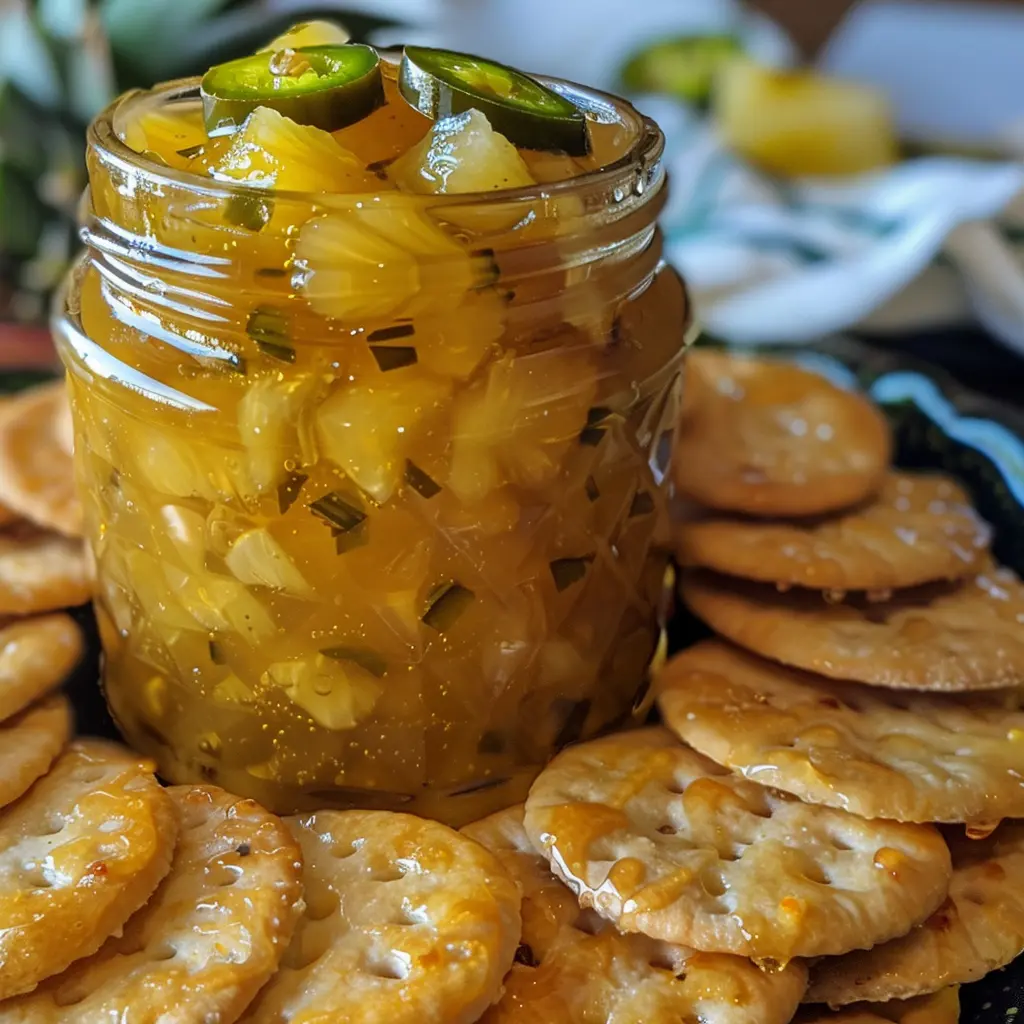
Sweet heat pineapple jalapeño pepper jelly combines ripe fresh pineapple, jalapeños, and red bell pepper with apple cider vinegar, sugar, and liquid pectin into a glossy, jewel-toned jelly that sets up firm enough to slice but loose enough to spoon. It’s sweet, tangy, and spiced with a slow jalapeño heat that builds through the sweetness rather than hitting first, and the applications for it go far beyond the classic cream cheese and crackers pairing — though that alone is worth making five jars for.
| Detail | Info |
|---|---|
| Prep Time | 15 minutes |
| Cook Time | 20 minutes |
| Total Time | 35 minutes (plus setting time) |
| Yield | About 5 half-pint (8 oz) jars |
| Difficulty | Medium |
| Cuisine | American |
Why This Recipe Works
The combination of pineapple and jalapeño is not arbitrary — it’s a flavor pairing grounded in how sweetness and heat interact on the palate. Sweet flavors suppress the perception of heat, which means jalapeño in a sweet medium tastes warmer and more complex than the same quantity of jalapeño in a savory or neutral context. The pineapple’s natural sweetness moderates the jalapeño’s capsaicin so it registers as pleasant warmth rather than sharp, aggressive heat. The pineapple’s acidity, meanwhile, brightens the flavor of the jelly and prevents it from tasting flat or cloying despite the five cups of sugar. The result is a condiment that’s layered rather than one-dimensional — sweet first, then tangy, then warm.
Red bell pepper is in this recipe for two reasons beyond its mild sweetness. Bell pepper adds body and texture to the jelly — small, finely chopped pieces distributed through the set jelly create the characteristic appearance of a pepper jelly (as opposed to a smooth fruit jelly), and the slight chewiness of the cooked pepper pieces adds textural interest. Red bell pepper also contributes a vibrant color that intensifies the jelly’s visual appeal, turning the finished product a deeper, more saturated amber-orange that signals flavor and heat before anyone tastes it.
Apple cider vinegar provides the acidity that both balances the sweetness and ensures proper preservation. Vinegar in jelly making is not just flavor — it’s chemistry. A pH low enough to inhibit bacterial growth is part of what makes home-canned jelly shelf-stable, and the apple cider vinegar brings this jelly into the correct pH range for safe water bath canning. The apple cider variety specifically adds a mild fruity acidity that complements the pineapple without the sharp edge that white vinegar can introduce.
Liquid pectin rather than powdered pectin is what the recipe calls for, and the order of addition matters with liquid pectin in a way it doesn’t with powder. Powdered pectin is added before the sugar; liquid pectin is added after the full rolling boil with the sugar, at the very end of cooking. Adding liquid pectin at the correct stage — after the full boil rather than before — ensures it activates properly and produces a reliable set. Liquid pectin produces a slightly softer, cleaner gel than powdered pectin and is ideal for fruit jellies where clarity and texture are part of the appeal.
The rolling boil sequence — fruit mixture to a boil, sugar added and returned to a full rolling boil for one minute, pectin added and boiled one more minute — is a specific timing protocol that activates the pectin correctly. A full rolling boil is one that cannot be stirred down; it’s more vigorous than a gentle boil and produces more agitation and heat throughout the pot. The precise one-minute timings at each stage are what the pectin manufacturer’s research has determined to produce consistent gels. Shortening either boil produces a soft set or no set at all; extending either can cause over-extraction of pectin and a syrupy texture.
Ingredients
| Ingredient | Quantity | Notes |
|---|---|---|
| Fresh pineapple, finely chopped | 4 cups | About 1 medium pineapple; measure after chopping |
| Jalapeños, finely chopped | 4 to 5 | Seeds removed for less heat; left in for more; adjust to taste |
| Red bell pepper, finely chopped | 1/2 cup | Adds body, color, and mild sweetness |
| Apple cider vinegar | 1/4 cup | Provides acidity for flavor and food safety |
| Granulated sugar | 5 cups | Measured precisely; do not reduce — sugar is essential for both set and preservation |
| Liquid fruit pectin | 1 pouch (3 oz) | Added after the full rolling boil with sugar; not before |
Step-by-Step Instructions
Phase 1: Prepare Jars and Ingredients
- Sterilize 5 half-pint (8 oz) canning jars by washing in hot soapy water, rinsing well, and keeping hot in a 200 degree F oven or in simmering water until needed. Sterilize the lids by simmering in water for 5 minutes. Have your canning tools — jar lifter, lid wand, and funnel — ready before you start cooking. Jelly moves fast once it’s ready and there’s no time to search for equipment.
- Finely chop the pineapple, jalapeños (removing seeds for a milder result or leaving them in for more heat), and red bell pepper. The pieces should be small and consistent — roughly an eighth of an inch — so they distribute evenly through the finished jelly and every spoonful has a balanced mix of fruit, pepper, and heat.
Phase 2: Cook the Jelly
- Combine the chopped pineapple, jalapeños, red bell pepper, and apple cider vinegar in a large, heavy-bottomed saucepan — at least 6 quarts to allow for the vigorous boil without overflow. Bring to a boil over medium-high heat, stirring occasionally.
- Add all 5 cups of sugar at once and stir well to dissolve. Return to a full rolling boil — a boil vigorous enough that it cannot be stirred down — over high heat, stirring constantly. Once at a full rolling boil, boil for exactly 1 minute, stirring continuously.
- Remove from the heat briefly to add the liquid pectin pouch, squeezing every drop into the pot. Return to the heat and bring back to a full rolling boil. Boil for exactly 1 more minute, stirring constantly.
- Remove from the heat. Skim off any foam from the surface with a spoon — foam is harmless but affects the clarity and appearance of the finished jelly.
Phase 3: Jar and Process
- Working quickly while the jelly is still hot and fluid, ladle it carefully into the hot sterilized jars using a wide-mouth funnel. Leave exactly 1/4 inch of headspace between the surface of the jelly and the rim of the jar — too much headspace affects the seal, too little can prevent a proper seal as well.
- Wipe the rim of each jar clean with a damp cloth before applying the lid. Any jelly on the rim can prevent a proper seal. Apply the lids and bands, tightening to fingertip-tight — snug but not over-tightened.
- For shelf-stable storage: Process in a boiling water bath for 10 minutes (adjusting for altitude if above 1,000 feet). Remove with a jar lifter and place on a towel-lined surface. Do not tilt or turn the jars. Listen for the satisfying pop of each lid sealing as the jars cool. Check seals after 24 hours — properly sealed lids should be concave and shouldn’t flex when pressed.
- For immediate use: Simply allow the jars to cool to room temperature and refrigerate. Use within 3 weeks.
Chef Tips for Perfect Results
Measure all ingredients before you start cooking. Once the jelly reaches a full rolling boil, the process moves fast and there’s no time to measure mid-cook. Have every ingredient measured, every jar sterilized, and every tool within reach before the pineapple hits the pan.
Use a pot much larger than you think you need. Jelly at a full rolling boil doubles in volume. A pot that looks half-empty before the boil can overflow at the peak. A 6 to 8 quart pot for this recipe gives the jelly room to climb without going over the sides.
Test the set before jarring if uncertain. Place a small plate in the freezer for 5 minutes before cooking. When the jelly is done, drop a teaspoon onto the cold plate and return it to the freezer for 1 minute. If it wrinkles when pushed with a finger and doesn’t run, the set is good. If it runs and stays liquid, the jelly may need another 30 seconds of boiling.
Adjust heat at the jalapeño stage, not after. Once the jelly is made, the heat level is fixed. Taste the raw jalapeños before chopping — some are mild, some are quite hot, and the heat level varies significantly by pepper and season. Use 4 jalapeños with seeds removed for a mild jelly, 5 with seeds for a hot one, and adjust anywhere in between based on the actual peppers you have.
Wear gloves when handling jalapeños. The capsaicin from several jalapeños finely chopped stays on your hands for hours after washing and will transfer to your eyes and face at inopportune moments. Food-safe gloves for the chopping stage cost almost nothing and prevent an uncomfortable experience.
Common Mistakes to Avoid
Reducing the sugar. The sugar in jelly is not just sweetening — it’s a preservative and a structural component of the gel. Reducing the sugar disrupts the sugar-to-pectin ratio the recipe is calibrated for and can produce a soft set, no set, or a jelly that doesn’t store safely. Use the full 5 cups.
Not reaching a true rolling boil. A gentle boil or a vigorous simmer is not the same as a full rolling boil. The distinction matters because the pectin activation depends on specific temperatures that only a true rolling boil reaches. If the boil can be stirred down, it isn’t at a full rolling boil yet.
Adding the pectin at the wrong stage. Liquid pectin goes in after the full rolling boil with the sugar, not before. The sequence in this recipe is specific to how liquid pectin activates — reversing the order or adding it at a different stage produces unreliable results.
Overfilling the jars. The 1/4-inch headspace is a canning standard for a reason — it’s the correct amount of air space for the vacuum seal to form during processing. Too much or too little headspace affects the seal quality and can lead to failed seals.
Processing jars in water that isn’t fully boiling. The water bath must be at a full boil when the jars go in and throughout the 10-minute processing time. A sub-boiling water bath doesn’t achieve the temperatures needed for proper processing and can result in inadequate preservation.
Variations and Substitutions
Mango jalapeño version: Replace half the pineapple with fresh mango for a more tropical, slightly sweeter jelly with the same heat profile. Mango’s lower acidity pairs beautifully with the jalapeño and produces a deeper golden color.
Habanero version: Substitute one to two habaneros for one of the jalapeños for a jelly with significantly more heat and a fruity, floral pepper note that habaneros contribute alongside their heat. Use with more caution — habaneros are three to ten times hotter than jalapeños.
Serrano peppers: Replace some or all of the jalapeños with serranos for a cleaner, more direct heat without the fruity character of jalapeño. Serranos are about twice as hot as jalapeños, so adjust the quantity accordingly.
No canning version: Skip the water bath processing entirely and refrigerate all five jars. The jelly keeps for up to 3 weeks refrigerated without the water bath. This is the simplest approach for first-time jelly makers who want the finished product without the canning process.
Serving Suggestions
The classic presentation: pour a jar over a block of full-fat cream cheese and serve with an assortment of crackers for scooping. The sweet-spicy jelly against the cool, tangy cream cheese is one of the great simple appetizers. Beyond that: glaze pork tenderloin or chicken thighs in the last 10 minutes of roasting for a caramelized, slightly spicy finish. Spread on a grilled cheese sandwich alongside sharp cheddar. Use as a condiment for turkey or ham on a sandwich. Stir a tablespoon into a vinaigrette for a sweet-heat salad dressing. Mix with soy sauce and garlic for an Asian-inspired dipping sauce.
Storage
Shelf-stable (processed): Store in a cool, dark place for up to 1 year. Once opened, refrigerate and use within 3 weeks.
Refrigerator only (unprocessed): Use within 3 weeks. The vinegar and sugar provide significant preservation but water bath processing is required for shelf-stable storage.
Nutritional Information
| Nutrient | Per 1 Tablespoon (approx.) |
|---|---|
| Calories | 55 |
| Protein | 0g |
| Carbohydrates | 14g |
| Fat | 0g |
| Fiber | 0g |
| Sugar | 13g |
| Sodium | 0mg |
Nutritional values are estimates per tablespoon serving. Values will vary based on the specific sweetness and size of the pineapple used.
FAQ
What if my jelly doesn’t set?
Wait 24 to 48 hours before judging the set — pectin continues to work as the jelly cools and some jellies need the full time to firm up. If after 48 hours the jelly is still syrupy, it can be re-processed: open all the jars, pour the jelly back into the pot, and follow the full cooking sequence again with a fresh pouch of liquid pectin. Re-processed jelly is slightly less bright in color but sets reliably.
Do I have to use liquid pectin or can I use powdered?
Powdered pectin can be used but the method changes significantly. Powdered pectin is combined with the fruit mixture before the sugar, while liquid pectin goes in after the full boil with the sugar. Using powdered pectin with the liquid pectin method (adding it after the sugar boil) will produce unreliable results. If substituting powdered, follow the manufacturer’s directions for the adjusted sequence.
Is this jelly safe for canning at home?
Yes, when made exactly as directed. The combination of high sugar content, vinegar acidity, and the water bath processing creates conditions hostile to bacterial growth including botulism. The key safety elements are: using the correct amount of vinegar (do not reduce), processing for the full 10 minutes in a true boiling water bath, and confirming each lid has properly sealed before storing. The USDA and National Center for Home Food Preservation both provide guidance on home canning safety that’s worth reviewing for first-time canners.
How do I know if a jar sealed properly?
After the jars cool completely (12 to 24 hours), press the center of each lid. A properly sealed lid will be concave (bowed inward) and won’t flex or pop when pressed. Remove the band and try to lift the lid with your fingertips — a sealed lid won’t budge. Any jar that shows a convex lid, flexes when pressed, or lifts easily hasn’t sealed properly and should be refrigerated and used within 3 weeks rather than stored at room temperature.
Can I use canned pineapple instead of fresh?
Canned pineapple in juice (not syrup) can be used as a substitute. Drain it well and measure 4 cups of the chopped fruit. The jelly will have a slightly less vibrant, less complex flavor than the fresh version since canning concentrates and mutes some of the pineapple’s aromatic compounds. If using canned, reduce the sugar to 4.5 cups since canned fruit often has more residual sweetness than fresh.
Conclusion
Sweet heat pineapple jalapeño pepper jelly is the kind of homemade condiment that earns its place in every kitchen it enters. The sweet-tangy-hot balance is genuinely hard to stop reaching for, the applications are endless, and a batch of five jars made in under an hour produces gifts, party appetizers, and meal upgrades for weeks. Make it once and you’ll understand immediately why pepper jelly has been a pantry staple for generations.