
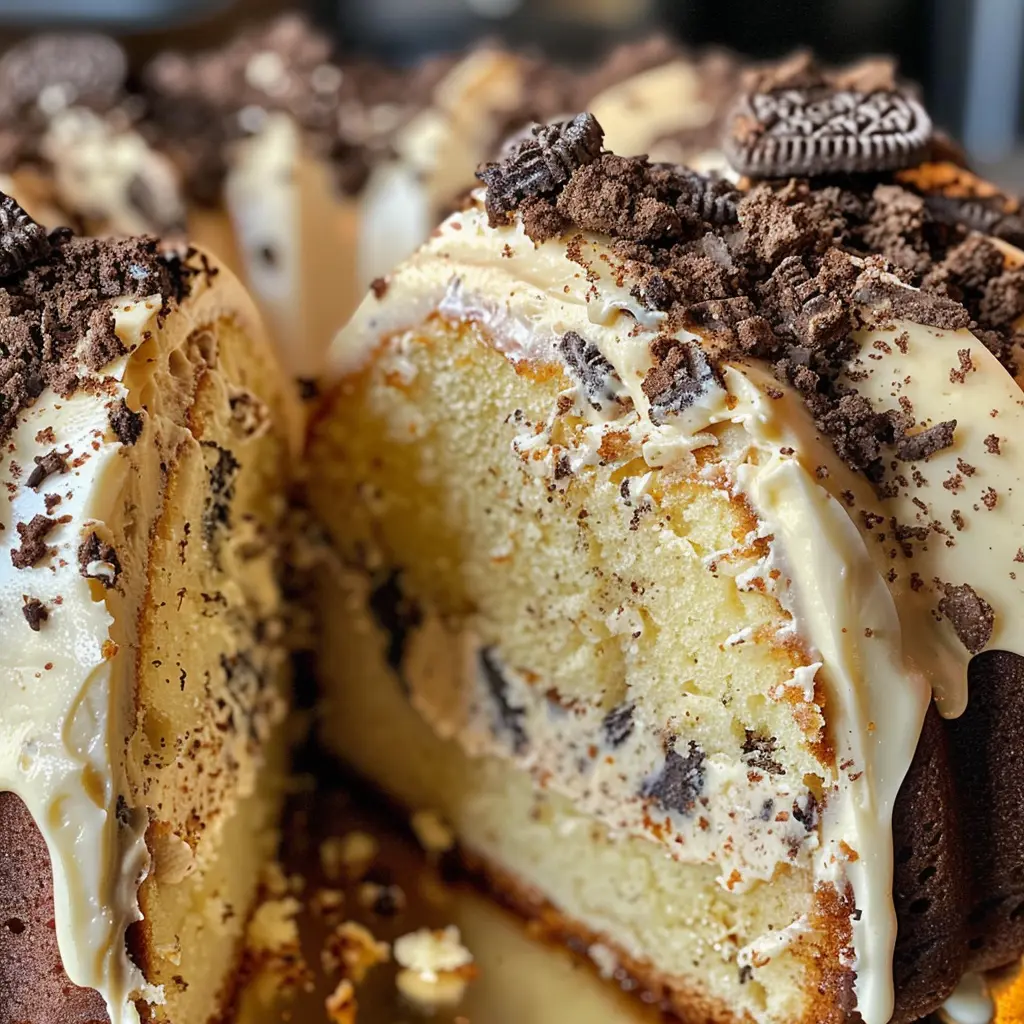
Blondie Oreo buttermilk pound cake is a dense, buttery, cream cheese-enriched Bundt built on five eggs and a full cup of buttermilk, loaded with crushed Golden Oreo cookies folded into the batter, and finished with a cream cheese frosting and another layer of crushed cookies on top. It’s a cake that tastes as rich as it looks, and it looks like something that took considerably more expertise than creaming butter and folding in cookies actually requires.
| Detail | Info |
|---|---|
| Prep Time | 20 minutes |
| Bake Time | 70 to 80 minutes |
| Cool Time | 1 hour minimum |
| Total Time | About 2 hours |
| Servings | 12 to 14 |
| Difficulty | Medium |
| Cuisine | American |
Why This Recipe Works
Adding cream cheese to the butter and sugar at the creaming stage rather than using butter alone is what gives this pound cake its characteristic dense yet impossibly moist crumb. Cream cheese contains fat, moisture, and protein — all three of which contribute differently to the finished cake. The fat adds richness alongside the butter’s fat. The moisture keeps the crumb from drying out over the long bake time. The protein structure, when creamed with the butter and sugar, produces a slightly tighter, more uniform crumb than butter alone achieves. The result is a pound cake with the density you expect from the genre and a moistness that lasts for days after baking.
Buttermilk is the liquid ingredient that makes this cake more tender than a standard pound cake made with whole milk or regular cream. Buttermilk is acidic, and that acid reacts with the baking powder and with the proteins in the flour, inhibiting gluten development and producing a more tender, finer-crumbed cake. It also reacts with the fat in the butter and cream cheese to create an emulsion that keeps the crumb moist. A pound cake made with whole milk bakes with a slightly tighter, more uniform crumb; one made with buttermilk has a more tender, yielding texture that practically melts on the palate.
Alternating the dry ingredients and buttermilk when adding them to the batter — rather than adding all the flour at once or all the buttermilk at once — is the mixing technique that preserves the emulsion built during the creaming stage. Adding all the flour at once can seize the batter and break the emulsion. Adding all the liquid at once can over-loosen the batter and cause it to curdle. The alternating method, typically beginning and ending with dry ingredients, allows each addition to be fully incorporated before the next, maintaining the smooth, cohesive batter that produces even rise and consistent texture.
Golden Oreos rather than regular Oreos is a specific choice that determines the character of the whole cake. Regular Oreos would turn the crumb dark and introduce a strong chocolate flavor that competes with the vanilla-forward butter and cream cheese base. Golden Oreos have the same crisp, sweet-cream filling and cookie structure but with a vanilla wafer rather than chocolate, which means they add their characteristic sweet, vanilla cookie flavor and slightly crunchy texture without disrupting the cake’s blonde, golden color and delicate flavor profile. The crushed Oreos fold into the batter as distinct pieces that soften during baking to a texture somewhere between cookie and cake, adding bursts of vanilla cream flavor throughout.
The low oven temperature — 325 degrees F rather than the more typical 350 degrees F for cakes — is what allows a Bundt cake this large and dense to bake evenly without a burnt exterior and raw center. A pound cake baked at higher temperature would set and brown on the outside before the heat penetrates the thick interior. At 325 degrees F, the heat moves more slowly and evenly through the batter, and the 70 to 80 minute window is enough for the cake to bake completely from the edge of the pan to the center without over-browning the crust.
Ingredients
Pound Cake
| Ingredient | Quantity | Notes |
|---|---|---|
| All-purpose flour | 3 cups | Spoon and level; don’t scoop directly from the bag |
| Granulated sugar | 2 cups | Creamed with the butter and cream cheese |
| Unsalted butter, softened | 1 cup (2 sticks) | Room temperature; soft enough to leave an indent when pressed |
| Cream cheese, softened | 8 oz | Full-fat block cream cheese; room temperature |
| Large eggs, room temperature | 5 | Added one at a time; room temperature incorporates more smoothly |
| Buttermilk | 1 cup | Full-fat; do not substitute regular milk |
| Vanilla extract | 2 teaspoons | The primary flavor of the cake |
| Almond extract (optional) | 1 teaspoon | Adds a subtle, warm depth; omit if preferred |
| Baking powder | 1 teaspoon | The sole leavener; provides lift without making the cake too airy |
| Salt | 1/2 teaspoon | Balances the sweetness and sharpens all the flavors |
| Golden Oreo cookies, crushed | 1 cup | Crushed into roughly half-inch pieces; not powdered finely |
Cream Cheese Frosting
| Ingredient | Quantity | Notes |
|---|---|---|
| Cream cheese, softened | 8 oz | Room temperature; beats smooth without lumps |
| Unsalted butter, softened | 1/2 cup | Room temperature; beaten with the cream cheese first |
| Powdered sugar | 3 cups | Sifted for the smoothest frosting |
| Vanilla extract | 1 teaspoon | Flavors the frosting |
| Heavy cream or milk | 2 to 3 tablespoons | Added as needed for a spreadable, pourable consistency |
| Crushed Golden Oreo cookies | For topping | Sprinkled generously over the frosted cake |
Step-by-Step Instructions
Phase 1: Prepare and Cream
- Preheat the oven to 325 degrees F. Thoroughly grease and flour a 10-inch Bundt pan, making sure to coat every groove and curve. A Bundt pan is the single greatest source of frustration in cake baking — inadequate greasing causes the cake to stick and break when unmolded. Use softened butter or shortening rubbed into every surface, then a dusting of flour tapped to cover completely, tipping out the excess. Baking spray with flour is the most reliable alternative.
- In a large bowl using a stand or hand mixer, beat the softened butter, softened cream cheese, and granulated sugar together on medium-high speed for 3 to 4 minutes until the mixture is pale, noticeably increased in volume, and very fluffy. This creaming stage builds the structure of the cake — under-creaming produces a denser, less risen result.
- Add the eggs one at a time, beating well after each addition and scraping down the sides and bottom of the bowl between each egg. Adding eggs too quickly or not mixing fully between additions can cause the batter to curdle. Add the vanilla extract and almond extract if using, and beat until incorporated.
Phase 2: Add Dry and Wet Ingredients
- In a separate bowl, whisk together the flour, baking powder, and salt until evenly combined.
- With the mixer on low, add the flour mixture to the batter in three additions, alternating with the buttermilk in two additions (flour, buttermilk, flour, buttermilk, flour). Begin and end with the flour mixture. Mix after each addition only until just combined — overmixing at this stage develops gluten and produces a tough cake.
- Remove the bowl from the mixer and fold in the crushed Golden Oreo cookies by hand using a spatula. Fold gently with two or three sweeping motions to distribute the cookies evenly without further developing the gluten.
Phase 3: Bake and Cool
- Pour the batter into the prepared Bundt pan, smoothing the top with a spatula. Tap the pan gently on the counter two or three times to release any air bubbles trapped in the thick batter.
- Bake for 70 to 80 minutes, until a long toothpick or skewer inserted into the thickest part of the cake comes out clean or with dry crumbs. Check at 65 minutes — if the top is browning too quickly before the interior is done, lay a loose piece of aluminum foil over the pan for the remaining bake time.
- Cool in the pan on a wire rack for exactly 15 minutes. This rest period allows the cake to firm up enough to release from the pan without breaking, but not so long that steam condenses and creates sticking. After 15 minutes, invert the pan over a wire rack and lift it away. If the cake doesn’t release immediately, tap the pan firmly on the counter a few times before trying again.
- Allow the cake to cool completely on the wire rack before frosting — at least 1 hour. Frosting a warm cake melts the butter and cream cheese in the frosting and produces a runny, uneven result.
Phase 4: Make the Frosting and Finish
- Beat the softened cream cheese and softened butter together on medium speed until completely smooth, about 2 minutes. Add the sifted powdered sugar and vanilla extract and beat on low initially to avoid a sugar cloud, then increase to medium-high and beat for 2 minutes until light and fluffy. Add heavy cream or milk one tablespoon at a time until the frosting reaches a consistency that flows slowly but holds soft peaks — just loose enough to drizzle attractively over a Bundt without being so thin it pours off immediately.
- Spoon or pour the frosting over the cooled cake, allowing it to drizzle naturally down the sides and into the grooves of the Bundt shape. Immediately scatter crushed Golden Oreo cookies generously over the frosted surface before the frosting sets.
Chef Tips for Perfect Results
Grease the Bundt pan obsessively. Every baker has a story about a beautiful cake that stuck to the pan on unmolding. The grooves of a Bundt pan are where the batter loves to cling and the frosting wants to hide. Use softened butter applied with a pastry brush into every groove, then flour every surface, then tap out the excess. Alternatively, use a baking spray specifically formulated with flour. Check the pan before pouring in the batter and re-grease any spots that look dry.
Don’t rush the creaming stage. The full 3 to 4 minutes of beating butter, cream cheese, and sugar is what incorporates air into the fat and builds the light, fluffy base that the eggs and flour will expand from. Under-creamed fat produces a cake that doesn’t rise as high and has a denser, more uniform crumb. Use a timer and let the mixer run.
Crush the Oreos to a varied texture, not a fine powder. Half-inch pieces of Golden Oreo scattered through the batter produce distinct bursts of cookie flavor and slightly different texture in every slice. Oreos powdered to dust blend invisibly into the batter and lose the textural interest that makes this cake distinctive. A zip-lock bag and a rolling pin or the flat side of a meat mallet produces the right mix of larger pieces and fine crumbs.
Check for doneness with a skewer, not a standard toothpick. A Bundt cake is thick and a standard toothpick may not reach the center. A long bamboo skewer or a thin cake tester reaches the deepest part of the batter. It should come out clean or with very dry crumbs — wet batter means more time is needed.
Make the frosting pourable for Bundt cakes. Standard cream cheese frosting is too stiff to drizzle attractively over a Bundt’s ridges and grooves. The heavy cream additions are what makes it loose enough to flow naturally down the sides. Add cream conservatively — a tablespoon at a time — until it just barely flows when lifted on a spoon.
Common Mistakes to Avoid
Using cold butter or cream cheese. Cold fat doesn’t cream properly — it produces a lumpy, under-aerated base that bakes into a dense, flat cake. Both must be genuinely room temperature: soft enough to leave a clear indent when pressed with a finger.
Adding all the eggs at once. Adding five eggs to the batter at once overwhelms the emulsion and can cause curdling — small, separated-looking lumps in the batter. Adding one at a time with thorough mixing between each allows the batter to incorporate each egg fully before the next one challenges the emulsion.
Overmixing after the flour goes in. Gluten development happens when flour and liquid are combined and agitated. Every beat after the flour goes in builds more gluten and makes the cake tougher. Mix only until the flour disappears and stop.
Unmolding too soon or too late. Too soon (under 10 minutes) and the cake is too fragile and wet to release cleanly. Too late (over 20 minutes) and the steam from the hot cake condenses and creates a sticky bond with the pan. The 15-minute window is the sweet spot for a clean release.
Frosting before the cake is completely cool. Any residual warmth in the cake will melt the cream cheese and butter in the frosting, turning it from a spreadable, fluffy coating into a thin, runny glaze that pools at the base rather than draping attractively over the Bundt’s ridges.
Variations and Substitutions
Classic Oreo version: Replace the Golden Oreos with regular Oreos for a chocolate-vanilla contrast. The cake crumb will be speckled with dark cookie pieces and the flavor will be decidedly more chocolate-forward.
Lemon version: Replace the almond extract with a tablespoon of fresh lemon zest and add a tablespoon of fresh lemon juice to the batter. Use a lemon glaze (powdered sugar and lemon juice) in place of the cream cheese frosting for a brighter, more refreshing cake.
Strawberry Oreo version: Use Strawberry Golden Oreos in place of the original for a pink-hued, fruity twist. The strawberry cookie complements the cream cheese base beautifully and produces a cake with a notably different character from the vanilla original.
Loaf cake version: Divide the batter between two greased 9×5-inch loaf pans and bake at 325 degrees F for 55 to 65 minutes. The loaf format is easier to unmold and produces slices that are easier to frost individually.
Serving Suggestions
Slice with a sharp serrated knife, wiping the blade clean between cuts for the neatest slices that show the cookie pieces distributed through the crumb. Serve at room temperature — refrigeration firms the cream cheese frosting and slightly dulls the flavor of the cake. A cup of coffee or tea alongside is the natural pairing. For a dessert table, the Bundt shape makes it the natural centerpiece, and the cream cheese frosting and cookie topping provide enough visual drama that no additional decoration is needed.
Storage
Refrigerator: Store covered in the refrigerator for up to 5 days due to the cream cheese frosting. Bring to room temperature for 20 to 30 minutes before serving for the best texture and flavor.
Freezer: Freeze the unfrosted cake, tightly wrapped in plastic wrap and then foil, for up to 3 months. Thaw overnight at room temperature and frost before serving. Frosted slices can also be frozen individually — wrap tightly and freeze for up to 2 months.
Nutritional Information
| Nutrient | Per Slice (based on 13 slices) |
|---|---|
| Calories | 580 |
| Protein | 7g |
| Carbohydrates | 72g |
| Fat | 30g |
| Saturated Fat | 17g |
| Fiber | 1g |
| Sugar | 52g |
| Sodium | 280mg |
Nutritional values are estimates based on standard ingredient brands and 13 servings. Values will vary based on frosting quantity applied and specific brands used.
FAQ
Can I make this without a Bundt pan?
Yes. Two 9×5-inch loaf pans or a 9×13-inch baking pan both work. Loaf pans need 55 to 65 minutes at 325 degrees F; the 9×13 pan needs 45 to 55 minutes. Check for doneness with a toothpick at the shorter end of the range. The Bundt shape is purely aesthetic — the flavor and texture are identical in any format.
What if I don’t have buttermilk?
Make a quick substitute: measure 1 cup of whole milk, remove 1 tablespoon of milk, and replace it with 1 tablespoon of white vinegar or fresh lemon juice. Stir and let sit for 5 minutes until it curdles slightly. This mimics buttermilk’s acidity well enough for baking and produces a nearly identical result.
Can I reduce the sugar?
The sugar can be reduced slightly — to 1.75 cups — without significantly affecting the texture, though the cake will be less sweet and slightly less moist since sugar contributes to both. Reducing below 1.5 cups begins to affect the crumb structure and moisture retention in ways that are noticeable in the finished cake.
Why did my cake stick to the Bundt pan?
Almost certainly insufficient greasing in the grooves. The remedy for next time is more fat applied more thoroughly into every curve and groove, followed by flour or cocoa powder (for dark cakes) tapped to coat every surface. For this time: let the stuck cake cool completely, then carefully use a thin offset spatula to release the edges and try again — a fully cooled cake releases more cleanly than a warm one.
Can I add the Oreos to the frosting instead of just on top?
Yes. Fold half a cup of finely crushed Golden Oreos into the finished frosting before spreading for a cookies-and-cream cream cheese frosting with cookie pieces distributed throughout. This version is particularly good if you plan to pipe the frosting rather than drizzle it, as the cookie pieces add visual texture to the piped swirls.
Conclusion
Blondie Oreo buttermilk pound cake is the Bundt that earns every compliment it receives. The cream cheese and butter base produces a crumb that stays moist for days, the buttermilk keeps it tender, the Golden Oreos add a sweet cookie dimension that makes every slice interesting, and the cream cheese frosting and cookie topping make it look as impressive as it tastes. Bake it once and it becomes the cake people request for birthdays, holidays, and every occasion in between.