
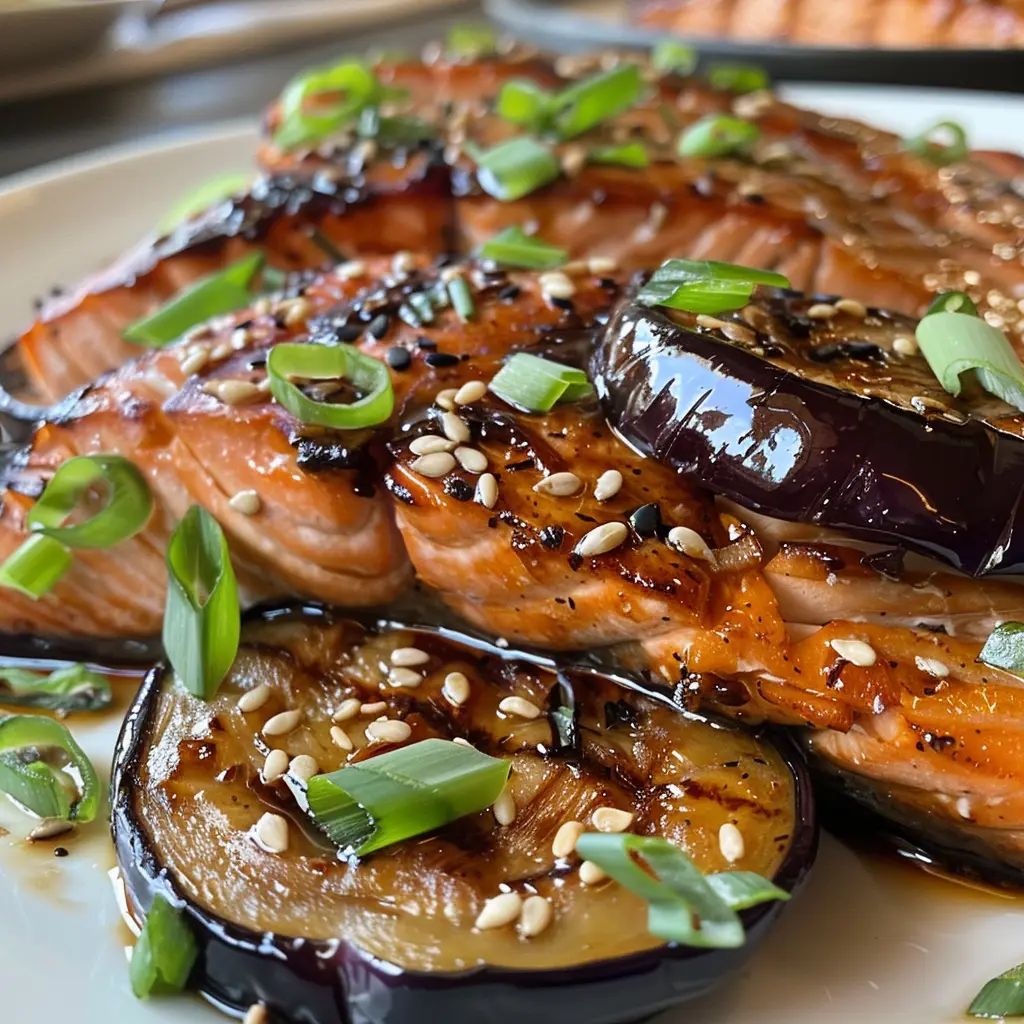
Honey soy glazed salmon with sesame eggplant bake layers caramelized roasted eggplant beneath salmon fillets lacquered in a sticky, glossy glaze of soy sauce, honey, sesame oil, ginger, and garlic. Everything bakes together until the glaze thickens and clings to both the salmon and the eggplant below it, finished with sesame seeds, green onions, and fresh herbs. It’s the kind of dish that makes you go back for the sauce.
| Detail | Info |
|---|---|
| Prep Time | 15 minutes |
| Cook Time | 25 minutes |
| Total Time | 40 minutes |
| Servings | 4 |
| Difficulty | Easy to Medium |
| Cuisine | Asian-Inspired / Fusion |
Why This Recipe Works
The eggplant layer beneath the salmon is doing more than providing a vegetable component. As the dish bakes, the honey soy glaze poured over the salmon drips down through the fillets and soaks into the eggplant below, transforming it from a simple roasted side into something deeply savory and slightly sweet that absorbs every drop of the Asian-inspired sauce. The eggplant becomes a flavor sponge in the best possible way, and the portion that’s sat in the pooled glaze at the bottom of the dish is often the most coveted part of the meal.
Roasting the eggplant separately before assembling the dish is the move that makes the finished result genuinely great rather than just decent. Raw eggplant in the baking dish would still be firm and slightly bitter when the salmon reaches its ideal flakiness at 10 to 12 minutes. Pre-roasted eggplant arrives in the dish already softened and slightly caramelized, ready to absorb the glaze rather than still fighting to cook through. The pre-roast also drives off excess moisture from the eggplant so the glaze doesn’t get diluted by eggplant liquid during the final bake.
The glaze is built on the four-flavor balance that makes Asian sauces work: salty from the soy sauce, sweet from the honey, sour from the rice vinegar, and rich from the sesame oil. None of these flavors dominates individually — they merge into a complex, layered sauce where you taste all four simultaneously without being able to fully separate them. The ginger adds a clean, slightly spicy warmth that connects the glaze to the salmon’s richness, and the garlic provides the savory backbone that makes the sauce taste complete.
Honey in a glaze does something that sugar alone cannot. Honey contains fructose, which caramelizes at lower temperatures than sucrose and produces a stickier, more viscous result that clings to the salmon surface rather than running off. As the dish bakes, the honey component of the glaze thickens and becomes increasingly glossy, creating the lacquered finish that’s characteristic of restaurant-quality glazed fish. Sugar-based glazes tend to be thinner and less adhesive at the same baking temperatures.
The sesame oil is used twice — once in the glaze and optionally once as a finishing drizzle right before serving. In the glaze it contributes its nutty, toasted flavor throughout the dish during baking. As a finishing touch it adds a fresh, aromatic intensity on top that the baked version alone doesn’t provide, since some of sesame oil’s most volatile aromatic compounds cook off during the oven time. That final drizzle is what gives the dish the glossy, restaurant-style presentation that makes it look as good as it tastes.
Ingredients
| Ingredient | Quantity | Notes |
|---|---|---|
| Salmon fillets, skinless or skin-on | 4 | About 6 oz each; skin-on holds together better during baking |
| Large eggplants, sliced lengthwise | 2 | Slice into half-inch planks for even roasting |
| Olive oil | 3 tablespoons | For brushing the eggplant before roasting |
| Garlic cloves, minced | 2 | Goes into the glaze; use fresh for the most vibrant flavor |
| Ginger, grated | 1 teaspoon | Fresh grated ginger; adds clean warmth to the glaze |
| Soy sauce | 3 tablespoons | Low-sodium allows better seasoning control |
| Honey | 2 tablespoons | Creates the sticky, caramelized glaze characteristic |
| Sesame oil | 1 tablespoon | Toasted sesame oil for maximum nutty depth |
| Rice vinegar | 1 tablespoon | Adds brightness and balances the sweetness of the honey |
| Chili flakes (optional) | 1 teaspoon | Adds heat; adjust to preference or omit entirely |
| Salt and black pepper | To taste | Light seasoning on salmon and eggplant before cooking |
| Sesame seeds | 2 tablespoons | White or black; added after baking for crunch and visual appeal |
| Green onions, chopped | 3 | Added after baking for freshness and color |
| Fresh cilantro or parsley | For garnish | Cilantro enhances the Asian flavor profile; parsley is more neutral |
Step-by-Step Instructions
Step 1: Roast the Eggplant
- Preheat the oven to 375 degrees F (190 degrees C). Line a large rimmed baking sheet with parchment paper.
- Slice the eggplants lengthwise into planks about half an inch thick. Brush both sides of each plank generously with olive oil and season lightly with salt and pepper. Arrange in a single layer on the prepared baking sheet — overlapping eggplant steams rather than roasts and won’t develop the golden color and flavor that makes it worth eating.
- Roast for 18 to 20 minutes, flipping once halfway through, until the eggplant planks are fully softened, golden on both sides, and slightly caramelized at the edges. The eggplant should feel tender when pressed and have some visible browning — pale eggplant means it needs more time. Remove from the oven and set aside.
Step 2: Make the Honey Soy Glaze
- While the eggplant roasts, combine the soy sauce, honey, sesame oil, rice vinegar, minced garlic, grated ginger, and chili flakes in a small bowl. Whisk until the honey is fully dissolved and the sauce is smooth and glossy. Taste it — it should be balanced between salty, sweet, and slightly acidic with a background warmth from the ginger. Adjust with an extra drizzle of honey if it seems too sharp, or a splash more rice vinegar if it seems too sweet.
Step 3: Season the Salmon
- Pat the salmon fillets dry with paper towels. Season both sides lightly with salt and black pepper. For a more developed flavor and better glaze adhesion, sear the salmon briefly in a hot skillet with a teaspoon of oil for 1 to 2 minutes per side before baking — this creates a slightly golden surface that holds the glaze better than raw salmon. This step is optional but recommended.
Step 4: Assemble and Bake
- Arrange the roasted eggplant planks in a single layer in a baking dish large enough to hold all four salmon fillets without crowding. Lay the salmon fillets on top of the eggplant, spacing them evenly.
- Pour the honey soy glaze generously over the salmon and eggplant, making sure every surface gets coated. Reserve a few tablespoons of glaze for basting and finishing.
- Bake for 10 to 14 minutes, depending on the thickness of the salmon fillets, until the salmon is just cooked through and flakes easily when pressed with a fork. Baste once with the reserved glaze at the halfway point for maximum stickiness. The salmon is done when it transitions from translucent to opaque throughout — a slightly translucent center is acceptable since the residual heat will finish it. Overcooked salmon is dry and chalky; pull it a minute early rather than a minute late.
Step 5: Finish and Serve
- Remove from the oven. For a glossy, restaurant-style finish, drizzle a small amount of sesame oil and any remaining glaze over each salmon fillet immediately after pulling from the oven.
- Scatter sesame seeds and sliced green onions over everything. Add fresh cilantro or parsley leaves as a final garnish. Serve immediately, spooning the pooled glaze from the bottom of the baking dish over each portion.
Chef Tips for Perfect Results
Don’t overcook the salmon. Salmon is one of the most unforgiving proteins in terms of the window between perfectly cooked and overdone. Perfectly cooked salmon is just opaque throughout with a moist, slightly yielding center. Overcooked salmon is dry, chalky, and loses the rich, fatty quality that makes it worth eating. Use an instant-read thermometer and pull the fish at 125 to 130 degrees F for medium — it will carry over to 130 to 135 degrees F as it rests, which is the ideal internal temperature for salmon that’s fully cooked but still moist.
Marinate the salmon in the glaze for 20 minutes before baking. If you have time, place the salmon fillets in a shallow dish, pour half the glaze over them, and let them marinate in the refrigerator for 20 minutes before assembling and baking. The soy sauce lightly cures the surface of the salmon during the marinade, helping the glaze adhere more effectively and producing a more deeply flavored fish. Bake with the remaining fresh glaze poured over the top.
Use toasted sesame oil, not regular sesame oil. The two are very different products. Toasted sesame oil is made from roasted sesame seeds and has a deep, nutty, aromatic flavor that defines the dish. Regular sesame oil is made from raw sesame seeds and has almost no flavor. Make sure the bottle says toasted or dark sesame oil.
Roast the eggplant until genuinely golden. Pale, under-roasted eggplant has a slightly bitter, spongy quality that doesn’t work well under the rich salmon and glaze. Golden, slightly caramelized eggplant is sweet, silky, and absorbs the honey soy glaze beautifully. Don’t pull the eggplant from the oven before it has real color on both sides — this is the step where patience produces significantly better results.
Serve with the pan sauce. The pooled honey soy glaze at the bottom of the baking dish after everything is cooked is concentrated, slightly caramelized, and intensely flavorful. Spoon it over the salmon and eggplant before serving and again at the table over rice. It’s the best part of the dish and should not be left in the pan.
Common Mistakes to Avoid
Skipping the eggplant pre-roast. Raw eggplant placed directly in the baking dish takes far longer to cook than the salmon needs. By the time the raw eggplant is fully softened, the salmon will be overcooked and dry. The pre-roast is not optional — it’s what makes the timing of the entire dish work.
Using too much glaze during baking without reserving some. Glaze that bakes for 12 minutes at 375 degrees F becomes concentrated and sticky — but it also caramelizes and darkens significantly. Using all the glaze in the initial pour can result in over-caramelized, slightly bitter glaze by the time the salmon is done. Reserve a few tablespoons for the final drizzle after baking for the freshest, most vibrant flavor on top.
Crowding the baking dish. Salmon fillets that touch each other steam rather than bake properly in the glaze. They won’t develop the lacquered, slightly caramelized surface the recipe aims for. Use a dish large enough that each fillet has a little space around it.
Not patting the salmon dry before glazing. Surface moisture on the salmon dilutes the glaze and prevents it from adhering properly. Pat each fillet dry with paper towels before seasoning and glazing. A dry surface accepts the glaze immediately and begins caramelizing from the first minute in the oven.
Baking salmon that’s still cold from the refrigerator. Cold salmon placed directly into a hot oven cooks unevenly — the outside can be overcooked by the time the center reaches the right temperature. Pull the salmon from the refrigerator 10 to 15 minutes before baking to take the chill off. Room temperature salmon bakes more evenly and in less time.
Variations and Substitutions
Teriyaki variation: Add a tablespoon of mirin to the glaze and reduce the rice vinegar to half a tablespoon. Mirin gives the glaze a more classically Japanese teriyaki character — slightly sweeter and more sake-like. This is the direction to take the dish if you want it to taste more traditional and less fusion.
Different protein: The glaze works equally well with chicken thighs, tofu, cod, sea bass, or shrimp. Chicken thighs need 25 to 30 minutes of baking time rather than 10 to 14. Tofu should be pressed and baked for 20 minutes before the glaze goes on. Shrimp need only 5 to 7 minutes and work best pan-seared rather than baked.
Add bok choy: Place halved baby bok choy alongside the roasted eggplant in the baking dish before adding the salmon. They soften in 10 to 12 minutes in the oven and absorb the glaze beautifully, adding a fresh, slightly bitter green vegetable note that balances the richness of the salmon and sweetness of the honey.
Miso glaze variation: Add a tablespoon of white miso paste to the glaze mixture and reduce the soy sauce to 2 tablespoons. The miso adds a deeper, more complex umami fermented note that makes the glaze taste like it came from a serious restaurant kitchen. White miso is milder and sweeter; red miso is more assertive and saltier.
Serving Suggestions
Steamed jasmine or short-grain rice is the natural first choice alongside — it soaks up the honey soy glaze pooled in the baking dish and provides a clean, neutral base for the bold flavors of the salmon and eggplant. Soba noodles tossed with a drop of sesame oil and sliced cucumber work for a lighter, more noodle-focused presentation.
For a complete meal presentation, plate rice first, lay an eggplant plank over the rice, place the salmon on top, and spoon a generous amount of the concentrated glaze from the baking dish over everything. Scatter sesame seeds, green onions, and cilantro for the final visual layer. The dish looks dramatically good plated this way and the flavor layering — rice, eggplant, salmon, glaze — produces a different bite at every spoonful.
Storage and Reheating
Refrigerator: Store cooled salmon and eggplant together with any remaining glaze in an airtight container for up to 2 days. Salmon is best eaten within 24 hours of cooking for optimal texture and flavor.
Reheating: The oven is the best option for reheating salmon without drying it out. Cover loosely with foil and warm at 275 degrees F for 10 to 12 minutes — low and slow preserves moisture. The microwave works but can make the salmon rubbery if heated too aggressively; use 50 percent power in 30-second intervals until just warmed through. Leftover salmon is also excellent eaten cold over rice or in a grain bowl — the glaze tastes even more concentrated after a night in the refrigerator.
Freezer: Cooked salmon can be frozen for up to 1 month but the texture suffers significantly after thawing. If you know you’ll have leftovers, the raw glazed salmon can be frozen before baking — freeze flat on a parchment-lined sheet until solid, then transfer to a freezer bag. Thaw overnight in the refrigerator and bake from cold, adding 3 to 4 minutes to the bake time.
Nutritional Information
| Nutrient | Per Serving |
|---|---|
| Calories | 460 |
| Protein | 38g |
| Carbohydrates | 24g |
| Fat | 24g |
| Saturated Fat | 4g |
| Fiber | 6g |
| Sodium | 780mg |
| Omega-3 Fatty Acids | ~2g |
Nutritional values are estimates based on 6-ounce salmon fillets and standard ingredient brands. Values will vary based on salmon variety and specific brands used.
FAQ
How do I know when salmon is done without overcooking it?
The most reliable method is an instant-read thermometer. Pull the salmon at 125 to 130 degrees F for medium — it will carry over another 5 degrees as it rests. Visual cues: the flesh transitions from translucent and shiny to opaque and matte, and it flakes easily when pressed gently with a fork at the thickest point. The center can still be slightly translucent when you pull it from the oven — residual heat finishes it during the few minutes it rests on the eggplant before serving. A 1-inch thick fillet takes approximately 10 to 12 minutes at 375 degrees F.
Can I use frozen salmon?
Yes, but thaw it completely in the refrigerator before using — never at room temperature, which creates uneven thawing and food safety risks. Pat the thawed salmon very thoroughly dry before seasoning and glazing since frozen fish retains more surface moisture than fresh. Frozen and thawed salmon bakes in roughly the same time as fresh at the same thickness.
Can I make the glaze ahead of time?
Yes. The glaze keeps in an airtight jar in the refrigerator for up to 5 days. The honey may thicken slightly when cold — give it a quick stir and it will loosen back to its original consistency. Having the glaze premade makes this dish genuinely fast on a weeknight — if the eggplant is pre-roasted and the glaze is ready in the refrigerator, the active assembly and bake time is under 20 minutes.
What type of soy sauce works best?
Low-sodium soy sauce is recommended since it gives you more control over the final saltiness of the dish — the glaze reduces and concentrates during baking, intensifying the salt level. Regular soy sauce can make the finished glaze quite salty, especially if the salmon is also seasoned with salt before baking. Japanese soy sauce (shoyu) has a slightly more delicate, less sharp flavor than Chinese-style soy sauce and is the best choice for this particular glaze. Tamari is a good gluten-free alternative with a deeper, slightly less salty profile.
Can I cook this entirely on the stovetop instead of baking?
Yes. Pre-roast or pan-fry the eggplant slices in batches in a skillet with olive oil until golden on both sides. Sear the seasoned salmon fillets in the same skillet for 3 to 4 minutes per side until just cooked through. Return the eggplant to the pan around the salmon, pour the glaze over everything, and cook over medium heat for 1 to 2 minutes until the glaze reduces and caramelizes around the salmon. The stovetop version produces a more intensely caramelized glaze since the direct heat concentration is higher than the oven.
Conclusion
Honey soy glazed salmon with sesame eggplant bake is the kind of recipe that expands your sense of what a weeknight dinner can be. Forty minutes, one baking dish, and a handful of pantry ingredients produce something that looks and tastes like it came from a restaurant with a serious commitment to Asian-influenced cooking. The glaze alone is worth memorizing — once you have it in your repertoire you’ll find yourself reaching for it every time salmon is on the menu, and then on chicken, tofu, and vegetables after that.