
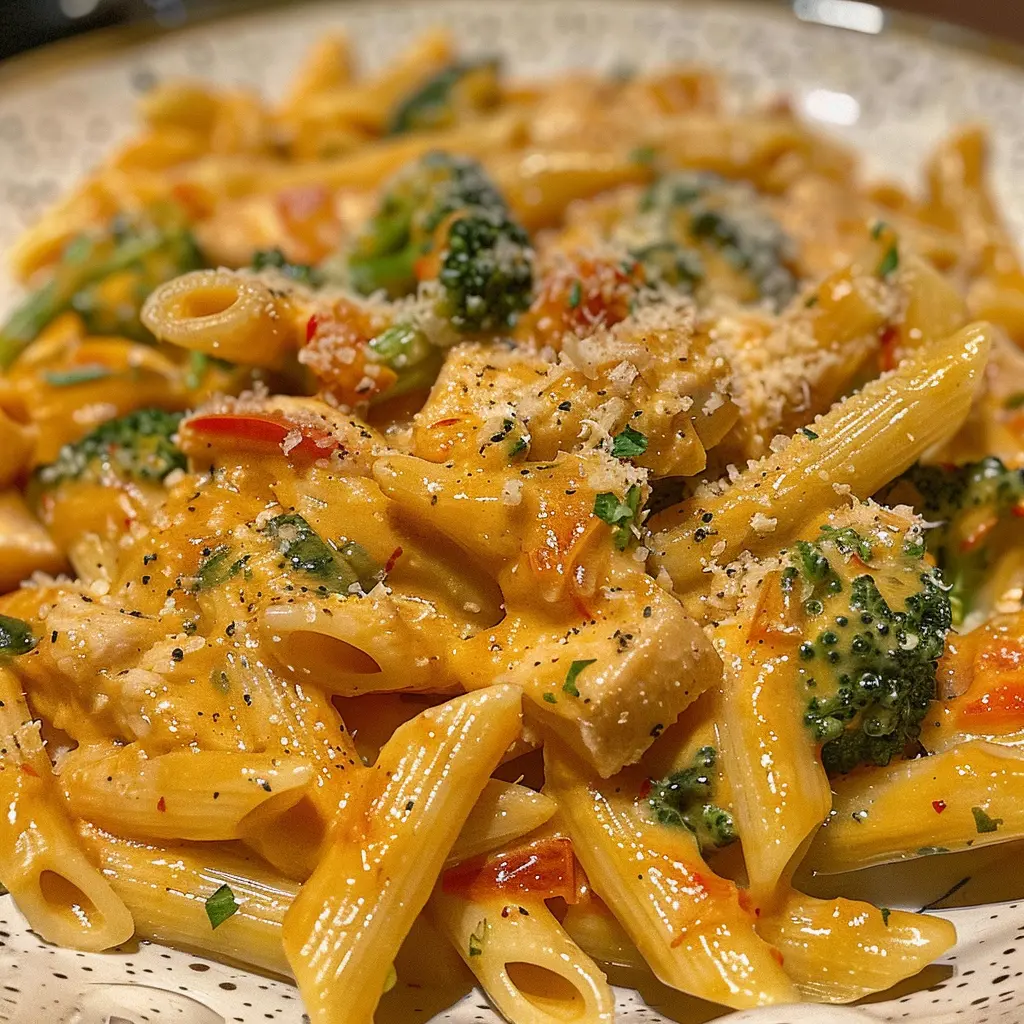
Creamy chicken penne with broccoli and peppers sears golden chicken strips in a skillet, sautees sweet red pepper and garlic in the same pan, then builds a quick cream sauce with chicken broth, mozzarella, and Parmesan that coats every piece of penne, broccoli, and chicken in something rich and satisfying. This is a 35-minute weeknight dinner that tastes like something that required considerably more planning.
| Detail | Info |
|---|---|
| Prep Time | 15 minutes |
| Cook Time | 20 minutes |
| Total Time | 35 minutes |
| Servings | 3 to 4 |
| Difficulty | Easy |
| Cuisine | Italian-American |
Why This Recipe Works
Cooking the broccoli directly in the pasta water during the last two minutes of cooking is one of those efficiency moves that actually produces a better result than cooking it separately. The broccoli softens to just the right degree — tender but still with some bite — in exactly the time it takes to reach al dente pasta. More importantly, both components are ready at the same moment and drain together, which means the broccoli is warm and properly seasoned when it goes into the sauce rather than cold from being cooked ahead and waiting on the side.
Building the sauce in the same pan used to sear the chicken and saute the pepper means the flavor from the chicken’s sear — the browned bits, the rendered fat from the olive oil, the aromatics — is already present in the pan when the broth and cream go in. Those flavors dissolve into the liquid immediately and infuse the sauce before any cheese is added. A sauce built this way starts with a head start on depth that a clean pan can’t replicate without extra ingredients or longer cooking time.
Deglazing with chicken broth before adding the heavy cream does two things. First, the broth lifts any fond from the pan surface and incorporates those browned, concentrated flavors into the sauce. Second, it provides a savory backbone that prevents the cream sauce from tasting purely of dairy — the broth’s gelatin and proteins add body and a savory note that makes the finished sauce taste more complex than its short ingredient list suggests.
Red bell pepper sauteed until slightly softened adds a natural sweetness that contrasts with and complements the richness of the cream sauce. Raw pepper added at the end would have a grassy, slightly bitter edge and crunch that doesn’t integrate into a cream sauce. Two to three minutes of saute softens the pepper enough to become part of the dish rather than a textural outlier, and the heat draws out its natural sugars, making it sweet rather than sharp.
The two-cheese approach — mozzarella or cheddar for melt and creaminess, Parmesan for sharp flavor and depth — gives the sauce a more complete flavor than a single cheese would provide. Mozzarella melts smoothly and adds a creamy, mild richness. Parmesan adds the salty, umami-forward note that makes the sauce taste finished and properly seasoned. Using only mozzarella produces a bland sauce; using only Parmesan can make it grainy and too sharp. Together, they cover both the texture and flavor dimensions the sauce needs.
Ingredients
| Ingredient | Quantity | Notes |
|---|---|---|
| Chicken | ||
| Chicken breasts, sliced | 2 | Slice into even strips against the grain for the most tender texture |
| Olive oil | 1 tablespoon | For searing the chicken |
| Garlic powder | 1/2 teaspoon | Applied to the chicken before cooking |
| Salt | To taste | Season the chicken generously on both sides |
| Black pepper | To taste | Freshly cracked preferred |
| Pasta | ||
| Penne | 8 oz | Cook al dente with broccoli added in the last 2 minutes |
| Vegetables | ||
| Broccoli | 1 cup | Cut into small florets; added to pasta water for last 2 minutes |
| Red bell pepper, sliced | 1 | Sliced into thin strips; sauteed until slightly softened |
| Garlic cloves, minced | 2 | Added to the pan with the peppers |
| Sauce | ||
| Chicken broth | 1/2 cup | Deglazes the pan and adds savory depth to the cream sauce |
| Heavy cream | 1 cup | Full-fat for the richest result |
| Mozzarella or cheddar cheese, shredded | 1/2 cup | Low-moisture mozzarella melts most smoothly |
| Parmesan cheese, grated | 1/4 cup | Freshly grated for the best melt and flavor |
| Garnish | ||
| Fresh parsley, chopped | To taste | Adds color and a fresh finish |
| Chili flakes | To taste | Optional; adds warmth and visual appeal |
| Extra Parmesan | To taste | For the table |
Step-by-Step Instructions
Phase 1: Cook Pasta and Broccoli Together
- Bring a large pot of generously salted water to a boil. Add the penne and cook according to package directions until al dente, adding the broccoli florets to the pot during the last 2 minutes of cooking. Drain together and set aside. Reserve half a cup of pasta water before draining.
Phase 2: Sear the Chicken
- Season the chicken strips with salt, black pepper, and garlic powder on all sides. Heat the olive oil in a large skillet over medium-high heat until shimmering. Add the chicken in a single layer and cook for 4 to 5 minutes per side until golden brown and cooked through. Remove to a plate and set aside. Do not clean the pan.
Phase 3: Saute Vegetables and Build the Sauce
- In the same skillet over medium heat, add the sliced red bell pepper. Saute for 2 to 3 minutes, stirring occasionally, until slightly softened. Add the minced garlic and cook for 30 seconds more, stirring constantly, until fragrant.
- Pour in the chicken broth and stir, scraping up any browned bits from the pan. Let it simmer for about 1 minute.
- Add the heavy cream and bring to a gentle simmer. Cook for 3 to 4 minutes, stirring frequently, until the sauce has thickened slightly and coats the back of a spoon.
- Add the shredded mozzarella (or cheddar) and grated Parmesan in two additions, stirring between each until fully melted and the sauce is smooth. Season with salt and black pepper to taste.
Phase 4: Combine and Serve
- Return the drained penne and broccoli to the skillet along with the cooked chicken strips. Toss everything together until fully coated in the cream sauce. If the sauce seems too thick, add reserved pasta water a tablespoon at a time until it reaches your preferred consistency.
- Serve immediately in warm bowls, garnished with fresh parsley, chili flakes, and extra Parmesan.
Chef Tips for Perfect Results
Don’t overcook the broccoli. Two minutes in boiling pasta water produces broccoli that’s bright green, tender, and still has a slight bite. More than that and it goes limp and loses its color. Since the broccoli will spend a brief moment in the hot sauce after draining, slightly underdone is better than overdone at this stage.
Slice the chicken strips evenly. Strips of varying thickness cook at different rates — thin ends overcook before thick ends are done. Even, half-inch strips produce chicken that’s golden and cooked through simultaneously across the entire batch.
Don’t skip scraping the pan when the broth goes in. The fond left from searing the chicken is where a significant portion of the sauce’s savory depth comes from. Pour the broth into the hot pan and immediately scrape with a wooden spoon to dissolve those browned bits into the liquid.
Add cheese gradually over gentle heat. Both mozzarella and Parmesan can clump if added to a sauce that’s boiling or if too much cheese is added at once. Reduce the heat to a gentle simmer and stir each addition completely smooth before the next goes in.
Use rotisserie chicken for a faster version. Shredded rotisserie chicken skips the searing step entirely. Add it directly to the sauce in Phase 4 along with the pasta and broccoli. The sauce won’t have the chicken fond base, so consider adding an extra half teaspoon of garlic powder and a small pat of butter to the pan before the peppers to compensate for the lost fond flavor.
Common Mistakes to Avoid
Adding the broccoli to the pasta water too early. More than 2 minutes in boiling water produces mushy, grey-green broccoli with little texture or visual appeal. Set a timer and add it with precision.
Crowding the chicken in the pan. Strips that overlap steam rather than sear, producing pale, soft chicken without the golden crust that adds flavor to both the chicken and the pan fond beneath it. Work in two batches if the pan can’t accommodate all the chicken with space around each piece.
Boiling the cream sauce. A rolling boil risks breaking the cream and making the sauce grainy. A gentle simmer with small, lazy bubbles is what thickens the sauce properly without destabilizing it.
Not reserving pasta water. The starchy pasta cooking water is the best tool for loosening a sauce that tightens when the pasta is added. It’s easy to forget before draining, so set a reminder or a cup next to the pot as a visual cue.
Serving without tasting first. The Parmesan and the chicken broth both carry salt. Always taste the finished dish before adding more seasoning and adjust based on what’s actually in the pan.
Variations and Substitutions
Swap broccoli for spinach or peas: Baby spinach stirred in for 60 seconds at the end wilts quickly and adds color. Frozen peas added with the pasta need no additional cooking — the residual heat warms them through as everything is tossed together.
Add cream cheese for extra richness: Two ounces of softened cream cheese melted into the sauce before the shredded cheeses adds body, a slight tang, and a creamier mouthfeel that makes the sauce even more indulgent.
Add sun-dried tomatoes: A quarter cup of oil-packed sun-dried tomatoes, drained and roughly chopped, added with the red bell pepper introduces a concentrated, slightly tangy tomato note that adds another dimension to the sauce.
Use cheddar instead of mozzarella: Sharp cheddar produces a more assertively flavored sauce with a deeper yellow color. It’s an excellent swap for anyone who finds mozzarella too mild — the finished dish tastes bolder and more complex.
Whole wheat pasta: Whole wheat penne works as a nutritionally denser alternative with a slightly nuttier flavor. Cook it the same way, adding the broccoli in the final 2 minutes. The sauce coats it just as well as regular penne.
Serving Suggestions
Serve immediately in warmed bowls with a crack of black pepper and a generous dusting of extra Parmesan. A pinch of chili flakes over each bowl adds color and a welcome warmth that cuts through the richness of the cream sauce. Garlic bread on the side is ideal for the sauce that inevitably pools at the bottom of the bowl. A simple green salad dressed with lemon vinaigrette provides a bright, acidic contrast to the creamy pasta.
Storage and Reheating
Refrigerator: Store in an airtight container for up to 3 days. The sauce thickens as it cools — add a splash of cream or broth when reheating to restore the right consistency.
Reheating: Warm gently in a skillet over low heat with a splash of liquid, stirring frequently. The microwave works for individual portions in 60-second intervals, stirring between each.
Freezing: Not recommended. Cream-based pasta sauces tend to separate when frozen and thawed, and the broccoli texture deteriorates significantly after freezing.
Nutritional Information
| Nutrient | Per Serving (approx.) |
|---|---|
| Calories | ~610 |
| Protein | 44g |
| Carbohydrates | 46g |
| Fat | 28g |
| Saturated Fat | 15g |
| Fiber | 4g |
| Sodium | 620mg |
Nutritional values are estimates based on standard ingredients and will vary depending on specific brands and cheese choices used.
FAQ
Can I use frozen broccoli instead of fresh?
Yes. Add frozen broccoli florets directly to the pasta water in the last 2 to 3 minutes of cooking — no thawing needed. The results are very similar to fresh broccoli and this is a practical option when fresh isn’t available.
Why is my sauce too thin?
This usually means the cream didn’t simmer long enough to reduce before the cheese was added, or too much pasta water was added when combining everything. Let the cream simmer for the full 3 to 4 minutes before adding the cheese, and add pasta water only in small amounts if the sauce needs loosening.
Can I use chicken thighs instead of breasts?
Yes, and many people prefer thighs for their richer flavor and more forgiving texture. Boneless, skinless thighs can be sliced and cooked exactly the same way as chicken breasts, and they stay juicy even with slightly longer cooking times.
Can I make this vegetarian?
Yes. Omit the chicken and substitute vegetable broth for the chicken broth. Add extra vegetables — mushrooms, zucchini, or cherry tomatoes — to make the dish more substantial. The cream sauce works just as well as the base for a vegetable pasta as it does for chicken.
Can I prep any components ahead of time?
The chicken can be cooked and sliced up to a day ahead and stored in the refrigerator. The sauce is best made fresh since cream sauces don’t hold well over time. Cook the pasta and broccoli fresh at serving time and combine everything quickly — the whole process from fresh pasta to table takes only about 15 minutes if the chicken is already cooked.
Conclusion
Creamy chicken penne with broccoli and peppers is the weeknight dinner that covers all the bases: protein, vegetables, pasta, and a sauce worth scraping the bowl for, all from a single pan in 35 minutes. The one-pan technique keeps cleanup minimal and flavor maximal, and the flexibility of the recipe means it works with whatever vegetables and cheese you have on hand. Make it once and it earns a permanent place in the regular rotation.