
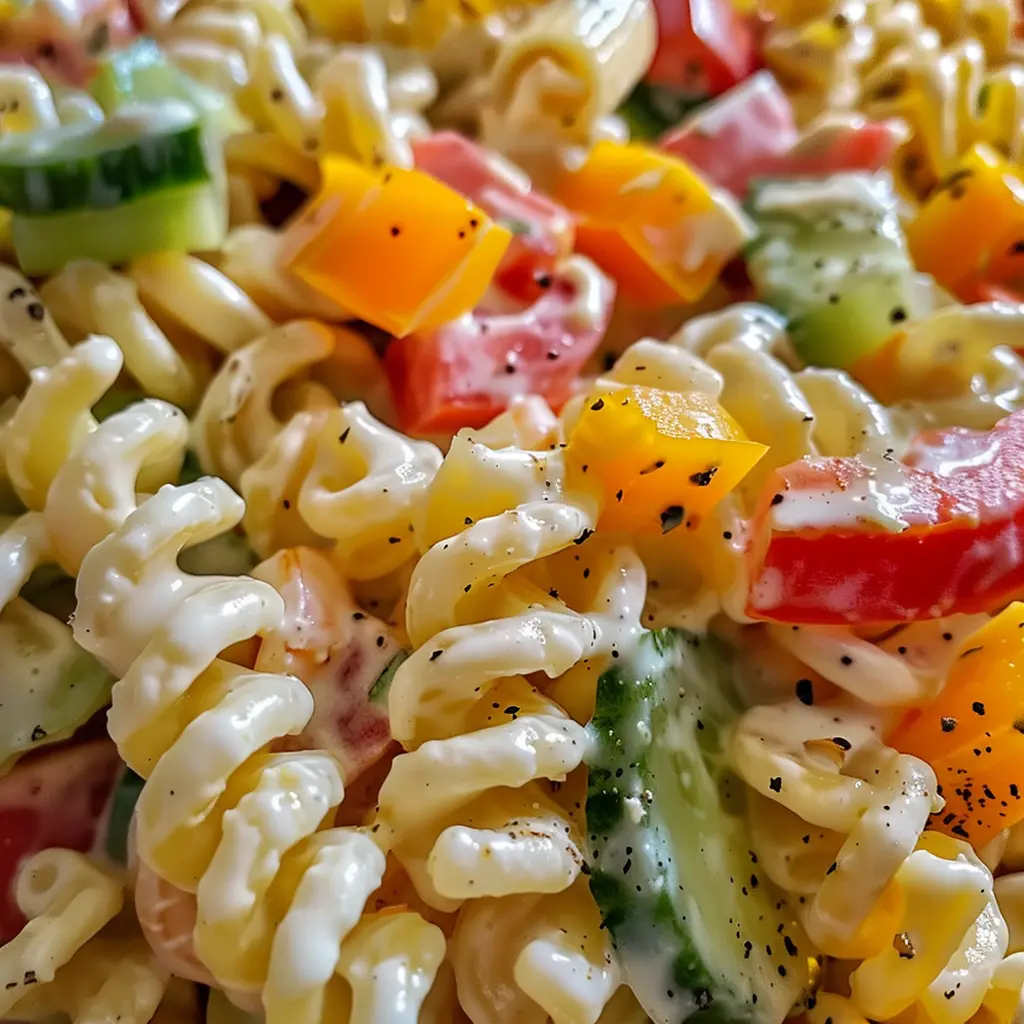
Creamy rotini pasta salad combines spiral pasta with cucumber, tomato, cheddar, red onion, bell pepper, carrot, and parsley in a tangy mayo-sour cream dressing sharpened with Dijon and apple cider vinegar. It’s the kind of side dish that travels well, improves with time, feeds a crowd from a single bowl, and disappears reliably from every potluck, barbecue, and picnic table it’s placed on.
| Detail | Info |
|---|---|
| Prep Time | 20 minutes |
| Cook Time | 10 minutes |
| Chill Time | 1 hour minimum |
| Total Time | About 1 hour 30 minutes |
| Servings | 8 to 10 |
| Difficulty | Easy |
| Cuisine | American |
Why This Recipe Works
Rotini — or its close relative fusilli — is the right pasta shape for this salad because of what its tight spirals do to dressing. The coils and grooves of rotini trap and hold the creamy mayo-sour cream dressing in a way that flat pasta like penne or shells can’t match. Every spiral carries dressing into the bite rather than just being coated on the outside, producing a more consistently creamy pasta salad throughout the bowl and even on the bottom of a serving that’s been sitting for a while. Shape choice in pasta salads matters more than it does in hot pasta dishes, where the sauce is abundant and mobile. In a cold salad where the dressing has set and thickened, the pasta’s ability to hold onto it determines whether every fork is creamy or whether the salad is dry with a pool of dressing at the bottom.
Rinsing the cooked pasta under cold water after draining is standard practice for pasta salads and necessary for two reasons. First, it stops the cooking immediately and prevents the pasta from continuing to soften as it sits in the residual heat. Pasta that’s allowed to cool on its own continues cooking from internal heat and can go from al dente to soft and mushy before the salad is assembled. Second, rinsing removes the surface starch from the pasta that would otherwise cause the pieces to stick together in the bowl. Cold pasta salad needs to stay loose and well-separated so the dressing can coat each piece; starchy pasta clumps and the dressing can’t penetrate the stuck-together mass.
The combination of mayonnaise and sour cream as the dressing base produces a more complex, more balanced result than mayonnaise alone. Mayonnaise provides the rich, fat-based creaminess and the emulsified quality that makes a pasta salad dressing cling rather than slide. It can taste flat or one-dimensional as the sole dressing base. Sour cream adds a tangier, lighter dairy note that brightens the dressing and prevents it from feeling heavy or cloying. Together they produce a dressing that’s creamy and rich but with enough acidity and tang to complement rather than overwhelm the vegetables and cheese.
Apple cider vinegar alongside the Dijon mustard is doing more than adding acidity. Dijon provides a sharp, pungent mustard note and also acts as an emulsifier that keeps the mayo and sour cream fully blended even after the dressing has been sitting. Apple cider vinegar provides a fruitier, slightly sweeter acidity than white vinegar and complements the cheddar and vegetables without the harsh edge that white vinegar can introduce in a cold application. The combination of both acidic components produces a dressing with more depth than either alone.
The one-hour minimum refrigeration before serving is not just for food safety — it’s when the salad becomes its best version. During that hour, the dressing penetrates the pasta and absorbs into its surface, the vegetables release a small amount of their moisture into the dressing and thin it slightly to a better consistency, and the garlic powder and onion powder rehydrate and bloom in the dressing’s liquid. The garlic powder specifically sharpens and becomes more pronounced during this period. A pasta salad served immediately after assembly tastes like dressed pasta; the same salad after an hour of refrigeration tastes like a unified dish where all the components belong together.
Ingredients
| Ingredient | Quantity | Notes |
|---|---|---|
| Rotini or fusilli pasta | 1 pound | Cooked al dente; rinsed cold and drained fully before combining |
| Cucumber, diced | 1 medium | English or Persian cucumbers can be used with skin on; regular should be peeled |
| Tomatoes, diced | 2 medium | Roma tomatoes hold their shape best; seed them to reduce water in the salad |
| Cheddar cheese, cubed | 1 cup | Sharp cheddar for the most flavor; cubed rather than shredded for better texture |
| Red onion, finely diced | 1/2 cup | Fine dice; large pieces are too aggressive in a cold salad |
| Bell pepper, diced (any color) | 1/2 cup | Red or orange bell pepper for the sweetest flavor; green for more bite |
| Shredded carrots | 1/2 cup | Adds color, sweetness, and a subtle crunch |
| Fresh parsley, chopped | 1/4 cup | Adds herbal freshness and color throughout the salad |
| Dressing | ||
| Mayonnaise | 1 cup | Full-fat; the base of the dressing |
| Sour cream | 1/2 cup | Adds tang and lightens the dressing |
| Dijon mustard | 1 tablespoon | Sharpens flavor and acts as an emulsifier |
| Apple cider vinegar | 1 tablespoon | Adds fruity acidity that complements cheddar and vegetables |
| Garlic powder | 1 teaspoon | Blooms during the chill period for more pronounced flavor |
| Onion powder | 1 teaspoon | Adds savory depth throughout the dressing |
| Salt | 1/2 teaspoon | Adjust after the full chill; cold dulls seasoning |
| Black pepper | 1/2 teaspoon | Freshly cracked preferred |
Step-by-Step Instructions
Phase 1: Cook and Cool the Pasta
- Bring a large pot of generously salted water to a boil. Cook the rotini according to package directions until al dente — firm but cooked through. Drain immediately and rinse thoroughly under cold running water until the pasta is completely cool and no longer warm to the touch. Drain well and set aside. If the pasta will sit for more than a few minutes before combining, toss it with a small drizzle of olive oil to prevent sticking.
Phase 2: Make the Dressing
- In a medium bowl, whisk together the mayonnaise, sour cream, Dijon mustard, apple cider vinegar, garlic powder, onion powder, salt, and black pepper until completely smooth and well combined. Taste the dressing — it should be tangy, creamy, and well-seasoned. Adjust with a pinch more salt or an extra splash of vinegar if it tastes flat.
Phase 3: Combine and Chill
- In a large bowl, combine the cooled pasta, diced cucumber, diced tomatoes, cubed cheddar, diced red onion, diced bell pepper, shredded carrots, and chopped parsley. Toss briefly to distribute the vegetables and cheese evenly through the pasta.
- Pour the dressing over the pasta mixture and toss until everything is thoroughly and evenly coated. Make sure to reach all the way to the bottom of the bowl where the dressing tends to pool.
- Cover the bowl tightly with plastic wrap and refrigerate for at least 1 hour before serving. Two hours produces an even better result. Toss once more before serving to redistribute the dressing, and taste for seasoning — cold dulls salt, so a small pinch more may be needed after chilling.
Chef Tips for Perfect Results
Make the dressing slightly more assertive than you think you need. The pasta, cheese, and vegetables absorb and mellow the dressing’s flavors during the refrigeration period. A dressing that tastes just right when freshly made will taste underseasoned after an hour. Taste it before adding to the salad and push the seasoning slightly beyond where it would be comfortable on its own — it will settle into perfect balance after chilling.
Seed the tomatoes before dicing. Tomato seeds and the gel around them release significant water into the salad, diluting the dressing over time and producing a watery bowl by the time the salad has been sitting for an hour. Cut the tomatoes in half, scoop out the seeds and gel with a spoon or your finger, then dice the remaining flesh. The tomato flavor stays; the excess water doesn’t.
Make it the day before for the best possible result. This salad genuinely improves overnight. All the flavors integrate more deeply, the pasta absorbs the dressing to a more uniform creaminess, and the garlic and onion powder have maximum time to bloom in the liquid. Day-two pasta salad is consistently better than day-one.
Reserve some dressing to add before serving. Pasta absorbs dressing as it sits, and a salad that looked perfectly dressed when assembled may seem dry after a few hours in the refrigerator. Setting aside a quarter cup of dressing and adding it just before serving restores the original creamy consistency without having to make a fresh batch.
Add the tomatoes and cucumber close to serving time for the freshest texture. If making the salad a day ahead, combine everything except the tomatoes and cucumber and refrigerate overnight. Fold in the freshly diced tomato and cucumber 15 to 30 minutes before serving. Both vegetables soften and release water over extended refrigeration, and adding them closer to serving keeps their texture at its crispest.
Common Mistakes to Avoid
Not rinsing the pasta cold. Warm pasta coated in a mayo-based dressing begins to absorb the dressing immediately and can produce a dry, sticky salad rather than a creamy one. Always cool the pasta completely before adding any dressing.
Using too little dressing. Pasta salad looks well-dressed immediately after assembly and can look dry after 30 minutes of refrigeration as the pasta absorbs the coating. Use the full amount of dressing and don’t hold back — the pasta needs extra to account for absorption. Reserving a little extra is even better.
Not tasting after chilling. Cold significantly dulls the perception of salt. A salad that tastes well-seasoned fresh may need a pinch more salt after chilling. Always taste immediately before serving and adjust.
Using pre-shredded cheddar. Pre-shredded cheddar has anti-caking agents that give it a dry, slightly powdery texture that doesn’t integrate well into a creamy pasta salad. Cubed cheddar provides distinct bites of cheese with clean edges and a firm texture that stays intact rather than breaking down into the dressing.
Serving immediately after assembly. Pasta salad requires time to become itself. The 1-hour minimum refrigeration is when the flavors integrate and the dressing settles into the right consistency. Served immediately, it tastes like dressed pasta. After the chill, it tastes like a finished dish.
Variations and Substitutions
Add diced dill pickles: A half cup of finely diced dill pickles adds a tangy, briny dimension that echoes the Dijon and vinegar in the dressing. Pickle juice (a tablespoon stirred into the dressing) amplifies this further and is one of the most effective ways to add complexity to a mayo-based dressing.
Add hard-boiled eggs: Three or four quartered hard-boiled eggs folded into the salad add protein, richness, and make the dish more substantial. Classic egg-and-pasta salad combinations have existed for decades with good reason.
Add salami or pepperoni: Sliced deli salami or pepperoni added with the other ingredients transforms this into an Italian pasta salad with a more savory, charcuterie-influenced character.
Greek version: Replace the mayo-sour cream dressing with a lemon-olive oil vinaigrette, add Kalamata olives, diced red bell pepper, crumbled feta instead of cheddar, and a generous pinch of dried oregano. This variation requires no refrigeration time to integrate the flavors.
Serving Suggestions
Serve cold directly from the refrigerator in a large bowl with a generous sprinkle of fresh parsley and an extra crack of black pepper over the top. This salad is the natural companion to grilled meats, fried chicken, hot dogs, burgers, or any warm main dish where a creamy, cold side provides contrast. For a potluck or picnic, it holds well for up to 4 hours at room temperature (below 90 degrees F) before food safety becomes a concern with a mayo-based dressing.
Storage
Refrigerator: Store covered for up to 4 days. Add a splash of milk, a spoonful of sour cream, or a tablespoon of vinegar when refreshing a day-old salad if it seems dry — the pasta will have absorbed much of the original dressing.
Do not freeze. Mayo-based dressings separate when frozen and the vegetables lose their texture entirely after thawing.
Nutritional Information
| Nutrient | Per Serving (approx., based on 9 servings) |
|---|---|
| Calories | 420 |
| Protein | 11g |
| Carbohydrates | 42g |
| Fat | 24g |
| Saturated Fat | 6g |
| Fiber | 3g |
| Sodium | 480mg |
Nutritional values are estimates based on standard ingredient brands. Values will vary based on mayonnaise brand and the specific vegetables used.
FAQ
How far in advance can I make this?
Up to 24 hours ahead with the best results. Beyond that, the pasta continues to absorb dressing and the vegetables (especially cucumber and tomato) release water that dilutes the dressing. For maximum advance prep, make everything up to 48 hours ahead but hold the cucumber and tomato separate, adding them 30 minutes before serving. Stir in a fresh spoonful of mayo or sour cream at serving time to restore the creamy consistency.
Can I use light mayo or Greek yogurt instead of regular mayo and sour cream?
Yes. Light mayo produces a slightly less rich but still very creamy dressing. Greek yogurt substituted for the sour cream (same quantity) produces a tangier, protein-richer dressing with a slightly thinner consistency. Full-fat Greek yogurt produces the most similar result to sour cream. The salad will taste fresh and slightly lighter with these substitutions.
Why does my pasta salad seem dry after refrigerating?
Pasta absorbs its dressing over time, which is why this recipe calls for more dressing than may seem necessary when freshly made. Stir in a tablespoon or two of mayonnaise, a splash of sour cream, or a small drizzle of apple cider vinegar before serving to refresh it. Reserving a quarter cup of dressing before the initial toss specifically for this moment is the most reliable prevention.
Can I use a different pasta shape?
Yes, though rotini and fusilli are the ideal shapes for a creamy pasta salad because their spirals trap and hold dressing. Penne works but is less effective at holding dressing in its tubes than spirals are in their grooves. Bowtie pasta (farfalle) looks attractive and holds dressing reasonably well. Avoid spaghetti, linguine, or other long pasta — they’re difficult to toss and serve in a cold salad.
Can I add protein to make this a main dish?
Yes. Diced rotisserie chicken, sliced hard-boiled eggs, crumbled bacon, diced salami, or drained canned tuna all work well folded into the salad. Adding protein transforms it from a side into a complete, satisfying lunch or light dinner. Add protein at the same stage as the other mix-ins, before the dressing goes on.
Conclusion
Creamy rotini pasta salad is the side dish that earns its reputation by being exactly what every gathering needs — make-ahead, crowd-sized, colorful, creamy, and consistently crowd-pleasing without requiring any skill to execute. Make it the night before, refrigerate, toss before serving, and focus on the main event knowing the side dish is already handled and will be better for the wait.