
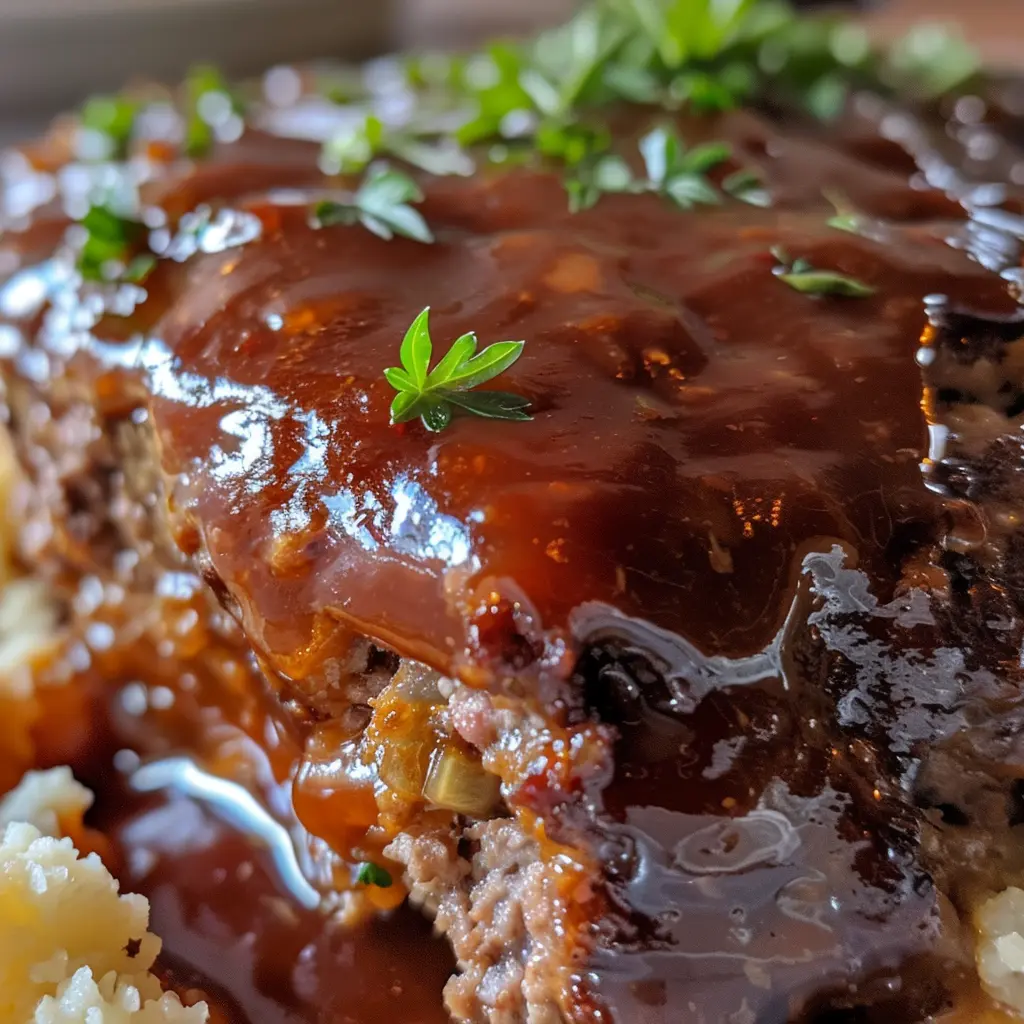
Meatloaf with velvet brown gravy is the kind of dinner that fills a kitchen with the kind of smell that makes everyone wander in from the other room to ask when it’s ready. Seasoned ground beef shaped into a tender, juicy loaf and finished with a glossy, silky brown gravy poured generously over each slice — this is classic American comfort food done with enough care and technique that it earns its reputation every time it hits the table.
| Detail | Info |
|---|---|
| Prep Time | 15 minutes |
| Cook Time | 60 minutes |
| Rest Time | 10 minutes |
| Total Time | 1 hour 25 minutes |
| Servings | 4 to 6 |
| Difficulty | Easy |
| Cuisine | American Comfort Food |
Why This Recipe Works
The 80/20 ground beef blend is the foundation of a good meatloaf, and it’s not negotiable if you want a juicy result. The 20 percent fat renders during baking and bastes the meat from within, keeping every slice moist and flavorful. Leaner blends like 90/10 produce a meatloaf that’s tight, dry, and dense — technically cooked correctly but texturally disappointing. The fat is not the enemy here; it’s doing essential work.
Soaking the breadcrumbs in milk before mixing them into the meat is a technique called a panade, and it’s responsible for the characteristic tenderness of a well-made meatloaf. The milk-soaked breadcrumbs create a barrier between the protein strands in the beef as they contract during cooking, keeping the texture open and moist rather than dense and compact. Dry breadcrumbs added directly absorb moisture from the meat itself and make the finished loaf coarser in texture.
Mixing the meat gently and stopping as soon as the ingredients are just combined is critical. Ground beef mixed too aggressively develops the proteins in the same way kneading develops gluten in bread dough — the result is a dense, tough, sausage-like texture rather than the soft, sliceable meatloaf you’re after. Mix with your hands or a fork, use light pressure, and stop the moment you don’t see any unmixed ingredients.
The ketchup glaze on top is not just a visual finishing touch. As the meatloaf bakes, the ketchup caramelizes and forms a savory-sweet lacquer that keeps the surface from drying out and adds a concentrated flavor to every bite of the outer crust. It also signals doneness visually — when the ketchup has darkened and set into a shiny glaze, the meatloaf is close to done.
The brown gravy is built on a proper butter-flour roux, which gives it a velvety, smooth texture that holds together rather than separating as it cools. Cooking the roux for a full two minutes before the broth goes in is what produces that deep, nutty flavor at the base of the gravy — and it’s what separates this gravy from the kind made by dissolving a packet in water.
Ingredients
| Ingredient | Quantity | Notes |
|---|---|---|
| Meatloaf | ||
| Ground beef (80/20) | 500g (about 1 lb) | 80/20 blend essential for juicy result |
| Small onion, finely chopped | 1 | Finely chopped so it softens fully during baking |
| Large egg | 1 | Binds the loaf so it holds together when sliced |
| Breadcrumbs | 1 cup | Plain or Italian-seasoned; soak in milk before mixing |
| Whole milk | 1/2 cup | For soaking the breadcrumbs; creates the panade |
| Ketchup | 1/3 cup | Spread over the top before baking for a caramelized glaze |
| Salt | 1 teaspoon | Season the meat mixture directly |
| Black pepper | 1/2 teaspoon | Freshly cracked for best flavor |
| Brown Gravy | ||
| Unsalted butter | 2 tablespoons | Base of the roux |
| All-purpose flour | 2 tablespoons | Cooked into the butter before the broth goes in |
| Beef broth | 1 1/2 cups | Low-sodium allows seasoning control; good quality broth matters |
| Salt and black pepper | To taste | Season at the end after the gravy has reduced |
Step-by-Step Instructions
Phase 1: Prepare and Bake the Meatloaf
- Preheat your oven to 350 degrees F. Lightly grease a standard loaf pan or line a rimmed baking sheet with parchment paper. A baking sheet allows the sides of the meatloaf to brown and develop a crust; a loaf pan produces a softer, more steamed exterior. Both work — it’s a matter of preference.
- In a small bowl, combine the breadcrumbs and milk. Stir briefly and let them sit for 5 minutes to absorb fully. The mixture should look like a thick, paste-like slurry when ready.
- In a large bowl, combine the ground beef, soaked breadcrumbs and milk, finely chopped onion, egg, salt, and pepper. Mix with your hands or a fork using gentle, folding motions until everything is just combined. Stop mixing the moment you can no longer see distinct patches of unmixed ingredients. The whole process should take about 60 seconds.
- Transfer the meat mixture to the prepared baking dish or sheet pan. Shape it into a loaf roughly 9 inches long and 4 inches wide, with slightly rounded sides and a flat top. Aim for even thickness throughout so the loaf bakes at the same rate from end to end.
- Spread the ketchup evenly over the entire top surface of the loaf, going all the way to the edges.
- Bake for 50 to 60 minutes, until the internal temperature reads 160 degrees F on an instant-read thermometer inserted into the thickest part of the center. If the ketchup starts to get very dark before the meatloaf reaches temperature, tent loosely with foil for the remaining bake time.
- Remove the meatloaf from the oven and let it rest, uncovered, for 10 minutes before slicing. Resting allows the juices to redistribute through the loaf. Slicing too early causes them to pour out onto the cutting board rather than staying in the meat.
Phase 2: Make the Brown Gravy
- While the meatloaf rests, make the gravy. Melt the butter in a medium saucepan over medium heat.
- Add the flour all at once and whisk constantly for 1 to 2 minutes until the mixture turns a light golden color and smells slightly nutty. This is the roux — it should bubble gently and look smooth, not clumpy.
- Pour in the beef broth in a slow, steady stream while whisking vigorously. Any lumps that form at the start will smooth out as you whisk and the broth heats. Keep whisking until the mixture is fully smooth.
- Bring the gravy to a simmer over medium heat, stirring frequently, and cook for 4 to 5 minutes until it thickens to a consistency that coats the back of a spoon. Draw your finger across the back of the spoon — if the line holds without the gravy running back into it, the gravy is ready.
- Season with salt and black pepper to taste. If the gravy seems too thick, add a splash of additional broth. If it seems too thin, simmer for another minute or two.
Phase 3: Slice and Serve
- Slice the rested meatloaf into portions about an inch thick using a sharp knife. Thicker slices hold together better than thin ones.
- Place slices on serving plates and spoon warm gravy generously over the top. Serve immediately.
Chef Tips for Perfect Results
Add Worcestershire sauce to the meat mixture. A tablespoon stirred in with the other seasonings adds a savory, slightly tangy depth that makes the beef taste more complex without adding any identifiable flavor. It’s one of those ingredients that improves the dish without announcing itself.
Use a blend of beef and pork. Replace half the ground beef with ground pork for a juicier, more tender loaf. Pork fat renders differently than beef fat and stays more liquid throughout baking, which bastes the interior more effectively. The flavor is richer and the texture is noticeably softer.
Grate the onion instead of chopping it. A grated onion dissolves completely into the meat mixture during baking and releases its flavor throughout the loaf without leaving detectable pieces. This is especially valuable if you have family members who object to visible onion in their meatloaf — the flavor stays, the texture disappears.
Let the pan drippings inform the gravy. If you baked the meatloaf on a sheet pan, pour the pan drippings into the saucepan with the butter before adding the flour. Those drippings carry concentrated meatloaf flavor and make the gravy taste like it belongs specifically with this dish rather than like a generic brown sauce.
Use an instant-read thermometer. Meatloaf is one of those dishes where guessing doneness by time and visual cues is unreliable. An instant-read thermometer takes two seconds and confirms the center has reached 160 degrees F — the safe temperature for ground beef — without any guesswork.
Common Mistakes to Avoid
Overmixing the meat. This is the most common meatloaf mistake and the one with the most dramatic consequences. An overmixed meatloaf has the tight, dense, bouncy texture of a sausage rather than the soft, sliceable texture of a proper meatloaf. Mix as little as possible and stop as soon as the ingredients are combined.
Using lean ground beef. Extra-lean ground beef produces a dry, crumbly meatloaf that no amount of milk-soaked breadcrumbs can fully rescue. The fat in 80/20 beef is doing active work during baking. Use it.
Skipping the rest period. Slicing a meatloaf straight from the oven sends a pool of juice onto the cutting board rather than keeping it in the meat. Ten minutes of rest costs nothing and produces noticeably juicier slices. Set a timer and don’t touch it until it goes off.
Making the gravy too thick. A velvet brown gravy should pour from a spoon smoothly, not plop. If your gravy is thick enough to hold a mound on a plate, it’s overdone. Add broth a tablespoon at a time, whisking between additions, until it pours in a thin, glossy stream.
Under-seasoning the gravy. Beef broth carries some salt but not enough to season a finished gravy properly. Taste after the gravy has thickened and season generously — the gravy should taste boldly savory on its own since it will be diluted slightly by the juices of the meatloaf when poured over the top.
Variations and Substitutions
Mushroom brown gravy: Saute a cup of finely sliced cremini mushrooms in the butter before adding the flour. The mushrooms add earthy depth and texture to the gravy that pairs particularly well with the beef meatloaf. Cook them until they’ve released and reabsorbed their moisture before the flour goes in.
BBQ glazed meatloaf: Replace the ketchup glaze with your favorite barbecue sauce for a smokier, tangier exterior. Brush additional sauce on halfway through baking for a thicker, more caramelized coating. Serve with the brown gravy or skip the gravy and let the BBQ sauce carry the dish.
Stuffed meatloaf: Press half the meat mixture into the loaf pan, create a well in the center, and fill it with a mixture of sauteed mushrooms and Swiss cheese. Cover with the remaining meat and bake as directed. The filling stays molten inside the loaf and creates a dramatic cross-section when sliced.
Turkey meatloaf: Ground turkey works as a lighter substitute. Because turkey is leaner than beef, add an extra tablespoon of oil to the meat mixture and an extra egg yolk to keep the texture moist. Season more aggressively since turkey is milder than beef.
Serving Suggestions
Mashed potatoes are the traditional and correct accompaniment — the gravy pools into the potatoes and creates a unified, deeply satisfying plate. Roasted green beans, steamed broccoli, or glazed carrots round the meal out with color and nutrition. Dinner rolls or crusty bread on the side are useful for chasing the last of the gravy around the plate.
For next-day leftovers, cold meatloaf sliced thin and placed between two pieces of white bread with a smear of ketchup or mustard is one of the better sandwiches in the home cook’s repertoire. The meatloaf firms up in the refrigerator and slices cleanly, and the flavors deepen overnight.
Storage and Reheating
Refrigerator: Store cooled meatloaf slices and gravy separately in airtight containers for up to 4 days. Storing them separately prevents the gravy from making the meatloaf soggy.
Freezer: Freeze cooked slices individually wrapped in plastic wrap and then foil for up to 3 months. The uncooked shaped loaf can also be frozen — wrap tightly, freeze on a sheet pan until solid, then transfer to a freezer bag. Thaw overnight in the refrigerator and bake from fully thawed.
Reheating: Warm slices in a covered skillet over medium-low heat with a splash of broth to prevent drying. Reheat gravy separately in a small saucepan over low heat, whisking in a splash of broth if it has thickened in the refrigerator. The microwave works for quick reheating — cover and heat in 60-second intervals until warmed through.
Nutritional Information
| Nutrient | Per Serving (with gravy, approx.) |
|---|---|
| Calories | 420 |
| Protein | 28g |
| Carbohydrates | 22g |
| Fat | 24g |
| Saturated Fat | 10g |
| Fiber | 1g |
| Sodium | 780mg |
Nutritional values are estimates based on standard ingredients and will vary depending on specific brands and portion sizes.
FAQ
How do I keep meatloaf from falling apart when I slice it?
Three things hold a meatloaf together: the egg, the breadcrumbs, and the rest period after baking. If your meatloaf crumbles when sliced, check that you used the full egg and the full amount of breadcrumbs, that you let it rest for the full 10 minutes before cutting, and that you’re using a sharp knife. A dull knife drags and breaks the loaf rather than cutting cleanly through it.
Can I make this meatloaf ahead of time?
Yes. Mix and shape the loaf up to 24 hours ahead, cover tightly with plastic wrap, and refrigerate. Apply the ketchup glaze right before baking. Add 5 to 10 minutes to the baking time since the loaf starts cold. The gravy is best made fresh since it reheats easily in 5 minutes and tastes significantly better fresh than reheated.
Why is my gravy lumpy?
Lumpy gravy comes from adding the broth too quickly before the roux is ready to absorb it, or from not whisking vigorously enough as the broth goes in. Prevention: add the broth in a slow, steady stream while whisking constantly. Fix: pour the lumpy gravy through a fine-mesh strainer to remove the lumps, then return to the pan and continue cooking.
Can I bake this in a loaf pan instead of free-form on a sheet pan?
Both work. A loaf pan produces a more uniform shape and a softer exterior because the sides are enclosed. A sheet pan produces a crustier exterior on all sides and allows the fat to drain away from the meat during baking, which some people prefer. Free-form on a sheet pan also produces better browning on the ketchup glaze since the heat circulates around the entire loaf.
What can I add to the meat mixture for more flavor?
A tablespoon of Worcestershire sauce is the most impactful single addition. Beyond that, a teaspoon of garlic powder, a teaspoon of onion powder, or a tablespoon of Dijon mustard all add depth. Some cooks add a tablespoon of soy sauce for umami. Fresh herbs like thyme or parsley mixed in work well too. Add any extra seasonings with the salt and pepper and taste the raw mixture (a small cooked patty in a skillet) before forming the loaf to confirm the seasoning is where you want it.
Conclusion
Meatloaf with velvet brown gravy is one of those recipes that rewards the cook who pays attention to the details — the panade, the gentle mixing, the rest period, the properly made roux. Get those things right and the result is a dinner that genuinely earns the word comfort. It’s the kind of meal that brings people to the table in a good mood and sends them away full and satisfied. Make it on a Sunday and the leftovers make Monday significantly better.