
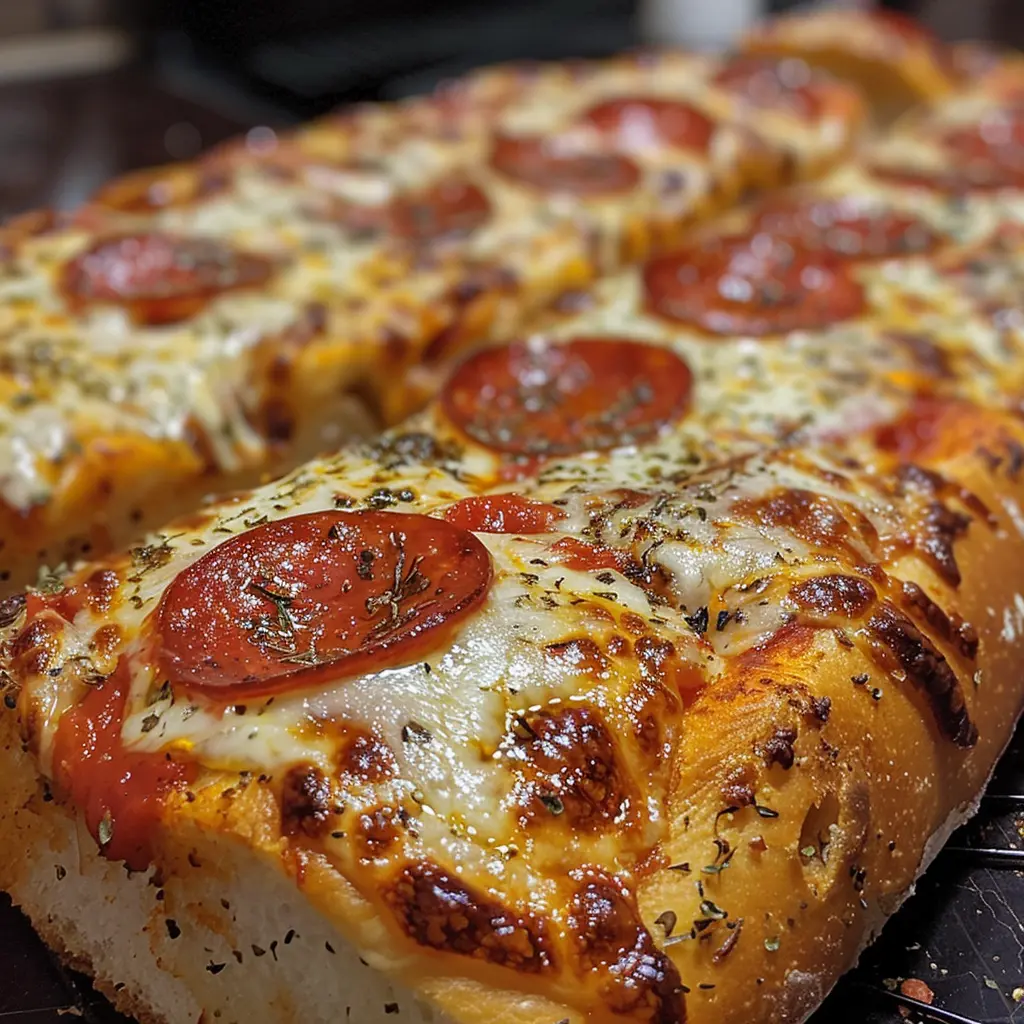
Giant garlic bread pizza spreads garlic butter across the cut faces of a baguette, loads them with marinara, Parmesan, mozzarella, and pepperoni, and bakes at high heat until the cheese is bubbling and the bread is golden and crispy on the bottom. It’s pizza and garlic bread simultaneously, it takes 25 minutes start to finish, and it produces the kind of dinner that makes everyone at the table unreasonably happy for something that required almost no effort.
| Detail | Info |
|---|---|
| Prep Time | 10 minutes |
| Bake Time | 12 to 15 minutes |
| Total Time | 25 minutes |
| Servings | 6 |
| Difficulty | Easy |
| Cuisine | Italian-American |
Why This Recipe Works
A baguette is structurally better suited to this application than a standard Italian loaf or sandwich bread. Its crust is firm and crisp enough to hold the weight of the sauce, cheese, and pepperoni without becoming soggy or collapsing when picked up, and its interior crumb is open and airy enough to absorb the garlic butter without becoming saturated and dense. The long, narrow shape also produces a natural portion format — cut crosswise into pieces after baking, each piece is a self-contained slice with crust on three sides and toppings across the top, exactly like a conventional pizza slice but on garlic bread. The baguette’s shape and structure are not incidental to the recipe’s success; they’re the reason it works as well as it does.
Room temperature butter is the specification that makes the garlic butter easy to spread evenly across the cut surface of the baguette without tearing the bread. Cold butter applied to bread compresses and tears the crumb rather than spreading smoothly, and the uneven coverage it produces means some areas of the baked bread will be richly buttered and golden while others are dry and pale. Room temperature butter spreads like frosting — in one smooth, even pass that covers every inch of the cut surface uniformly. That even butter layer is what produces the uniformly golden, crispy bottom that makes garlic bread pizza so satisfying to bite into.
Fresh garlic mixed directly into the butter rather than garlic powder produces a fundamentally different flavor in the finished pizza. Garlic powder provides a mild, even, background garlic note. Fresh minced garlic blooms in the hot butter during the bake, releasing its oils and aromatic compounds directly into the bread beneath them and producing distinct, sharp garlic flavor in every bite that encounters a garlic piece. The baguette at 425 degrees F for 12 to 15 minutes produces enough heat to mellow the raw garlic’s sharpest edge without eliminating the fresh garlic character that makes homemade garlic bread taste noticeably better than any packaged version.
The layering order — marinara first, then Italian seasoning, then Parmesan, then mozzarella, then pepperoni — is the sequence that produces the best result for each ingredient. Marinara goes directly on the garlic-buttered bread to anchor the toppings and provide the sauce layer closest to the bread. Italian seasoning applied over the sauce distributes its herbal notes through the moisture of the sauce, which carries the flavor through the entire topping layer during baking. Parmesan under the mozzarella melts and becomes part of the cheese layer rather than sitting on top where it would brown too aggressively. Mozzarella over the Parmesan provides the primary melted cheese surface. Pepperoni on top ensures it crisps at the edges and renders its fat down through the cheese layer during the bake.
The 425 degree F bake temperature is the choice that produces both a properly melted, slightly golden cheese top and a crispy bread bottom simultaneously. Lower temperatures would melt the cheese without crisping the bread; higher temperatures risk burning the bread edges before the cheese has time to bubble and brown. At 425 degrees F, the direct contact between the bread and the hot baking sheet produces the crispy, caramelized bottom crust while the oven’s ambient heat melts and browns the cheese on top — both things happening in the same 12 to 15 minute window.
Ingredients
| Ingredient | Quantity | Notes |
|---|---|---|
| Salted butter, room temperature | 4 tablespoons | Softened to room temperature for easy, even spreading |
| Garlic cloves, finely chopped | 4 | Fresh garlic; minced or finely chopped for even distribution |
| Large baguette | 1 (about 12 oz) | Cut lengthwise in half; the structural base of the pizza |
| Marinara sauce | 1/2 cup | Any good jarred marinara; don’t over-sauce or the bread becomes soggy |
| Italian seasoning | 1 teaspoon | Sprinkled over the sauce before the cheese goes on |
| Parmesan cheese, grated | 1/4 cup | Applied under the mozzarella; melts into the cheese layer |
| Mozzarella cheese, shredded | 2 cups | Low-moisture for the best melt and least excess moisture |
| Pepperoni | 4 oz (about 1 cup) | Scattered over the mozzarella; crisps at the edges during baking |
Step-by-Step Instructions
Phase 1: Prep the Garlic Bread Base
- Preheat the oven to 425 degrees F. Line a large baking sheet with parchment paper or foil for easy cleanup.
- In a small bowl, mix the softened butter and finely chopped garlic together until fully combined. The butter should be soft enough to blend easily — if it’s still firm, let it sit at room temperature for another 10 minutes.
- Cut the baguette in half lengthwise, as you would for a sandwich. Place both halves cut-side up on the prepared baking sheet. The bread may hang over the edges slightly — this is fine. Alternatively, cut each half crosswise into shorter pieces that fit more easily.
- Spread the garlic butter evenly across the cut surface of both baguette halves, going all the way to the edges. Use all the butter — complete, even coverage is what produces the golden, crispy bottom.
Phase 2: Top and Bake
- Spoon the marinara sauce evenly over the garlic-buttered bread. Use the back of the spoon to spread it close to the edges without going completely to them — leaving a small border of exposed garlic bread around the perimeter is intentional and produces the classic garlic bread pizza look.
- Sprinkle the Italian seasoning evenly over the marinara. Scatter the grated Parmesan over the sauce, then add the shredded mozzarella in an even layer covering the sauce completely. Arrange the pepperoni over the mozzarella in a single layer.
- Bake for 12 to 15 minutes until the mozzarella is fully melted and beginning to turn golden in spots, the pepperoni edges are curled and lightly crisped, and the bottom of the bread is golden brown and crispy when you lift a corner with a spatula to check.
- Remove from the oven and let cool for 2 minutes — the cheese is very hot directly from the oven. Slice crosswise into individual pieces and serve immediately.
Chef Tips for Perfect Results
Don’t over-sauce. Half a cup of marinara across a full baguette is the right amount — enough to flavor every bite without saturating the bread and making it soggy. More sauce means a wet, soft bread bottom rather than the crispy, golden base that makes this dish satisfying. When in doubt, use less sauce rather than more.
Check the bottom before pulling from the oven. The cheese on top is a less reliable doneness indicator than the bread bottom, which can vary based on the baguette’s density and the baking sheet’s material. Lift the edge of the bread with a spatula and look at the bottom — it should be deep golden brown and clearly crispy. If the cheese is done but the bottom is still pale, give it another 2 minutes.
Let it rest 2 minutes before slicing. Molten mozzarella slides off hot bread the moment it’s cut. Two minutes of rest allows the cheese to firm slightly and stay on the bread when sliced rather than pooling on the cutting board.
Add fresh basil after baking. A few torn fresh basil leaves scattered over the finished pizza immediately before serving adds a bright, herbal freshness that no dried herb added before baking can replicate. The basil wilts slightly from the residual heat of the cheese and releases its aroma as it does — the smell alone is worth the addition.
Use a serrated knife to slice. A straight-edged knife compresses the crispy bread crust and can tear the toppings. A serrated bread knife cuts through the crust cleanly and keeps the cheese and pepperoni in place on each piece.
Common Mistakes to Avoid
Using cold butter. Cold butter tears the bread surface and distributes unevenly, producing inconsistent garlic flavor and inconsistent browning. Always bring the butter to room temperature before making the garlic butter.
Using too much sauce. Excess marinara saturates the bread and produces a soft, soggy bottom rather than a crispy one. Half a cup across the full baguette is the correct amount.
Not checking the bread bottom. The top of the pizza can look perfectly done while the bottom is still pale and soft. Always verify the bottom is golden before removing from the oven.
Slicing immediately from the oven. Hot mozzarella is essentially liquid and will slide off the bread if cut immediately. Two minutes of rest makes a meaningful difference in how cleanly each piece holds together.
Using fresh mozzarella instead of low-moisture. Fresh mozzarella contains significantly more water than low-moisture shredded mozzarella and releases that water during baking, producing a wet, watery cheese layer rather than a properly melted, stretchy one. Always use low-moisture shredded mozzarella for baked applications.
Variations and Substitutions
Margherita version: Omit the pepperoni and top with fresh basil leaves and thin slices of fresh tomato added after baking. A drizzle of olive oil over the finished pizza completes the classic Margherita profile on a garlic bread base.
Sausage and pepper version: Replace the pepperoni with cooked Italian sausage crumbles and thin strips of sauteed bell pepper. The sausage and pepper combination on garlic bread is a particularly satisfying variation for anyone who prefers a heartier topping.
White pizza version: Omit the marinara and replace with a thin layer of ricotta cheese mixed with garlic, salt, and black pepper. Top with mozzarella, a drizzle of olive oil, and fresh herbs after baking. The white version showcases the garlic butter base more prominently.
Four cheese version: Replace the pepperoni with a combination of mozzarella, Parmesan, provolone, and fontina in roughly equal amounts for a pure cheese pizza on garlic bread that’s rich, complex, and requires no meat topping to be completely satisfying.
Serving Suggestions
Slice crosswise into 2 to 3 inch pieces and arrange on a cutting board or serving platter. Serve with extra marinara for dipping alongside. A simple green salad with Italian dressing turns this into a complete casual dinner. For a party or game day spread, cut into smaller pieces and set out as finger food — they hold up well at room temperature for 15 to 20 minutes and disappear quickly either way.
Storage and Reheating
Refrigerator: Store leftover pieces in an airtight container for up to 3 days. The bread softens in the refrigerator but reheats well.
Reheating: The oven or a skillet produces the best reheated result. For the oven, place pieces on a baking sheet at 375 degrees F for 8 to 10 minutes until the cheese re-melts and the bread crisps again. For the skillet, place cut-side down over medium heat for 2 to 3 minutes until the bottom crisps. The microwave reheats quickly but produces soft bread rather than a crispy bottom.
Freezer: Not recommended. The bread becomes soggy and loses its texture after freezing and thawing. This is a make-and-eat recipe best enjoyed fresh.
Nutritional Information
| Nutrient | Per Serving (approx.) |
|---|---|
| Calories | 420 |
| Protein | 18g |
| Carbohydrates | 34g |
| Fat | 24g |
| Saturated Fat | 12g |
| Fiber | 2g |
| Sodium | 820mg |
Nutritional values are estimates based on standard ingredient brands. Values will vary based on baguette size and specific cheese brands used.
FAQ
Can I use garlic powder instead of fresh garlic?
Yes, though the flavor difference is noticeable. Fresh garlic produces a sharp, distinct garlic character in each bite that garlic powder can’t fully replicate. If substituting, use half a teaspoon of garlic powder mixed into the softened butter in place of the 4 fresh cloves. The result is milder and more evenly distributed — good, but less punchy than the fresh garlic version.
Can I use a different bread?
Yes. A ciabatta loaf halved lengthwise works particularly well — its open, airy crumb absorbs the garlic butter readily and its crust crisps beautifully at 425 degrees F. Italian bread or a thick sandwich loaf also work. Avoid very soft sandwich bread, which doesn’t have the structural integrity to hold the toppings without becoming soggy and collapsing when picked up.
How do I prevent the bread from getting soggy?
Three things prevent soggy garlic bread pizza: using the right amount of sauce (no more than half a cup for a full baguette), using low-moisture mozzarella rather than fresh, and baking at high heat (425 degrees F) on a preheated baking sheet if possible. The high heat drives off moisture quickly before it has time to saturate the bread.
Can I make this ahead?
The garlic butter can be made up to 3 days ahead and refrigerated. Let it return to room temperature before spreading. The assembled, uncooked pizza can be prepared up to 2 hours ahead and held at room temperature before baking — any longer and the sauce begins to saturate the bread. Bake just before serving for the best result.
Can I add more toppings?
Yes, with one caveat: toppings that release a lot of moisture during baking — fresh tomatoes, mushrooms, bell peppers — should be lightly sauteed or patted dry before adding to prevent the bread from becoming soggy. Dry toppings like olives, sun-dried tomatoes, cooked sausage, or additional cured meats can be added directly without any preparation.
Conclusion
Giant garlic bread pizza is the recipe that earns permanent weeknight status by delivering genuine pizza satisfaction in 25 minutes with ingredients most households already have. The baguette base produces a crust that’s simultaneously crispy and garlicky in a way that no standard pizza dough can replicate, the high-heat bake produces bubbling, slightly golden cheese in the same time the bread crisps, and the result is a dinner that’s more than the sum of its very simple parts. Make it once and it becomes the answer every time someone asks what’s for dinner and the answer needs to come fast.