
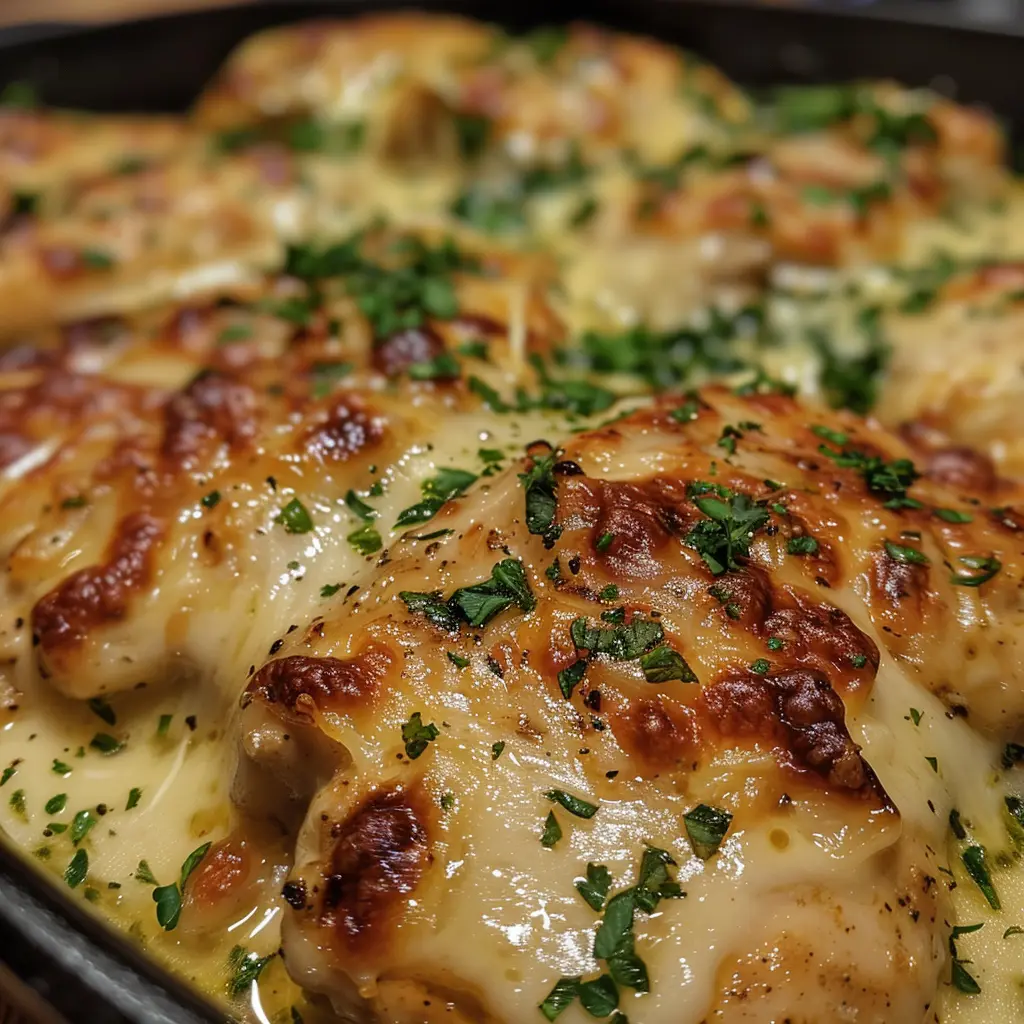
Cheesy garlic butter chicken bake coats chicken breasts in a seasoned garlic butter with Italian seasoning, paprika, and garlic powder, bakes them covered until nearly done, then uncovers them for a mozzarella and Parmesan topping that melts and turns golden in the final stretch. The chicken stays juicy from the covered bake, the garlic butter becomes a pan sauce that concentrates around each breast, and the two-cheese topping produces the kind of golden, bubbly finish that makes this look far more involved than 10 minutes of prep actually is.
| Detail | Info |
|---|---|
| Prep Time | 10 minutes |
| Bake Time | 35 to 40 minutes |
| Total Time | 50 minutes |
| Servings | 4 |
| Difficulty | Easy |
| Cuisine | American |
Why This Recipe Works
The covered bake for the first 25 minutes is the technique that keeps boneless, skinless chicken breasts — the leanest, most prone-to-drying cut of chicken — moist and juicy through the oven time. Chicken breasts baked uncovered at 375 degrees F for the full duration lose significant surface moisture to evaporation and can emerge dry and stringy regardless of how well-seasoned they are going in. The foil cover traps the steam released by the chicken and the garlic butter, creating a moist, basting environment around each breast that keeps the surface hydrated throughout the first two-thirds of the bake. The chicken arrives at the cheese-adding stage properly cooked and moist rather than already dried out before the topping goes on.
Melted butter as the coating medium rather than olive oil produces a more flavorful basting liquid that also serves as the pan sauce for the finished dish. Butter’s milk solids develop flavor as they heat in the oven, producing a slightly nutty, rich quality that olive oil can’t replicate. The garlic suspended in the melted butter blooms in the oven heat, releasing its aromatic oils directly into the butter rather than sitting on the surface of the chicken as dry seasoning would. By the time the foil comes off at 25 minutes, the garlic butter has become a fragrant, concentrated pan sauce pooled around each breast that continues basting the chicken through the uncovered finishing stage.
Paprika alongside the Italian seasoning and garlic powder does more than add mild warmth to the flavor profile. At 375 degrees F, paprika’s natural pigments caramelize and produce a golden-red coloration on the chicken surface that makes the uncovered bake look visually more appealing — a chicken breast that’s been sitting in paprika-seasoned butter for 35 minutes has a warm, amber color that signals properly seasoned, well-cooked chicken. Without paprika, the chicken surface would look pale under the cheese, even if it tasted identically well-seasoned.
Adding the cheese only after the foil comes off rather than baking it on from the start produces a properly melted, golden cheese topping rather than one that has been overcooked for 35 minutes. Cheese baked for the full duration of a covered chicken recipe becomes oily, separated, and rubbery rather than creamy and stretchy. Added in the final 10 to 15 minutes of uncovered baking, the mozzarella and Parmesan melt from their freshly shredded state to golden, bubbly perfection in exactly the time needed to finish cooking the chicken through to 165 degrees F — two things happening simultaneously in the same final window.
The Parmesan and mozzarella combination produces a topping where both cheeses contribute what the other can’t. Mozzarella melts into stretchy, glossy pools and provides the visual appeal and mild creamy flavor of a properly melted cheese topping. Parmesan, with significantly less moisture and more concentrated flavor, stays more distinct through the melt and contributes sharpness and saltiness that cuts through the richness of the butter and mozzarella. Mozzarella alone is mild and one-dimensional; Parmesan alone would brown too aggressively in the short uncovered bake. Together they produce a topping that’s both visually excellent and well-balanced in flavor.
Ingredients
| Ingredient | Quantity | Notes |
|---|---|---|
| Boneless, skinless chicken breasts | 4 | Even thickness produces even cooking; pound thicker ends if needed |
| Unsalted butter, melted | 4 tablespoons | Unsalted gives control over salt level; the garlic butter becomes the pan sauce |
| Garlic cloves, minced | 4 | Fresh garlic; blooms in the butter during baking |
| Italian seasoning | 1 teaspoon | Herbal depth in the butter coating |
| Paprika | 1 teaspoon | Adds mild warmth and golden color to the chicken surface |
| Garlic powder | 1/2 teaspoon | Adds even background garlic flavor alongside the fresh garlic |
| Salt and black pepper | To taste | Season the butter mixture generously |
| Mozzarella cheese, shredded | 1.5 cups | Low-moisture; added only after the foil comes off |
| Parmesan cheese, shredded | 1/2 cup | Combined with mozzarella for the topping; adds sharpness and color |
| Fresh parsley, chopped | 1 tablespoon | Optional; scattered over just before serving for color and freshness |
Step-by-Step Instructions
Phase 1: Season and Coat
- Preheat the oven to 375 degrees F. Lightly grease a 9×13-inch baking dish.
- If the chicken breasts vary significantly in thickness, pound the thicker ends gently with a meat mallet or rolling pin until the breast is an even thickness throughout. Even thickness means even cooking — a thick end that’s still underdone when the thin end is at 165 degrees F is the most common chicken breast problem.
- Arrange the chicken breasts in a single layer in the prepared baking dish.
- In a small bowl, combine the melted butter, minced garlic, Italian seasoning, paprika, garlic powder, salt, and black pepper. Stir until fully mixed. Pour the garlic butter mixture evenly over the chicken, making sure each breast is fully coated.
Phase 2: Covered Bake
- Cover the baking dish tightly with aluminum foil. Bake covered for 25 minutes. The foil traps steam and keeps the chicken moist through this stage — press it firmly against the rim of the dish to create a proper seal.
Phase 3: Add Cheese and Finish
- Remove the foil. The chicken should be mostly cooked through at this point — the surface will look opaque and the garlic butter will have pooled around the breasts as a fragrant pan sauce.
- Sprinkle the shredded mozzarella and Parmesan evenly over each chicken breast, covering the surface completely.
- Return to the oven uncovered and bake for an additional 10 to 15 minutes until the cheese is fully melted and lightly golden and the chicken reads 165 degrees F on an instant-read thermometer inserted into the thickest part.
- Scatter fresh parsley over the top if using and serve immediately, spooning the garlic butter pan sauce from the baking dish over each portion.
Chef Tips for Perfect Results
Pound the chicken to even thickness. Chicken breasts are naturally thicker at one end than the other. The thin end reaches 165 degrees F significantly before the thick end does, producing a breast that’s overcooked and dry at the thin end by the time the thick end is safe to eat. Two minutes of pounding the thick end to match the thin end eliminates this problem entirely and produces a breast that’s evenly cooked throughout.
Spoon the pan sauce over each portion before serving. The garlic butter that pools in the baking dish during the covered bake is concentrated and intensely flavored — it’s essentially a compound butter that has been slowly infused with garlic and the chicken’s natural juices for 35 minutes. Spooning it generously over each serving before it reaches the table is the step that connects the rich sauce to the finished dish and makes each bite more complete.
Use an instant-read thermometer. Chicken breast thickness varies enough between different packages that oven time alone is an unreliable doneness indicator. An instant-read thermometer at 165 degrees F is the only reliable confirmation that the chicken is both safe and at peak juiciness — much above 165 degrees F and boneless chicken breasts begin to dry out rapidly.
Let the chicken rest 5 minutes before serving. Chicken breasts cut immediately from the oven release their juices onto the plate rather than redistributing them through the meat. Five minutes of rest produces noticeably juicier servings and allows the cheese topping to firm slightly from its molten state.
Add sun-dried tomatoes for extra depth. A quarter cup of oil-packed sun-dried tomatoes, drained and roughly chopped, scattered over the chicken before the cheese goes on adds a concentrated, slightly tangy sweetness that pairs naturally with the garlic butter and mozzarella. The tomato pieces soften further in the uncovered bake and become integrated with the melted cheese.
Common Mistakes to Avoid
Not covering tightly with foil. A loose foil cover lets steam escape and the chicken can dry out before the cheese stage. Press the foil firmly against the dish rim for a proper seal during the covered bake.
Adding cheese before removing the foil. Cheese baked under foil for the full duration becomes overcooked, oily, and rubbery. Always add it only after the foil comes off for the final 10 to 15 minutes.
Skipping the thermometer. Visual checks on chicken breast doneness are unreliable — the surface can look cooked while the interior is still underdone, or the breast can be overcooked and dry while still appearing pale. Always verify with a thermometer.
Using chicken breasts of very uneven size. Very large breasts next to very small ones in the same dish will have the small ones overcooked by the time the large ones reach temperature. Choose breasts of similar size, or pound as needed, for even results across the dish.
Not spooning the pan sauce over before serving. The garlic butter in the dish is the most flavorful element of the recipe. Leaving it in the dish rather than spooning it over the chicken and whatever is served alongside is a missed opportunity that significantly reduces the impact of the finished dish.
Variations and Substitutions
Add bacon: Four strips of cooked, crumbled bacon scattered over the chicken before the cheese goes on adds a smoky, salty element that pushes the dish firmly into comfort food territory and pairs naturally with the garlic butter and mozzarella.
Spinach and artichoke version: Spread a thin layer of spinach and artichoke dip over each chicken breast before adding the cheese for a creamy, slightly tangy filling between the chicken and the cheese layer that makes this feel closer to a stuffed chicken dish.
Lemon garlic version: Add the zest and juice of one lemon to the garlic butter mixture before pouring it over the chicken. The lemon brightens the richness of the butter and produces a lighter, more aromatic pan sauce that pairs particularly well with the Parmesan.
Use chicken thighs: Bone-in, skin-on chicken thighs work very well in this recipe with a slightly longer covered bake of 35 minutes rather than 25. Thighs are more forgiving than breasts — their higher fat content keeps them moist even if the oven runs slightly hot.
Serving Suggestions
Serve immediately with the garlic butter pan sauce spooned generously over each breast. Mashed potatoes, roasted vegetables, steamed broccoli, or buttered egg noodles all pair naturally and absorb the pan sauce well. A piece of crusty bread alongside for sauce-soaking is worth adding to the table. Scatter fresh parsley over the dish just before serving for a clean, bright contrast to the golden cheese topping.
Storage and Reheating
Refrigerator: Store in an airtight container for up to 4 days. The garlic butter solidifies when cold — let it return to room temperature on the chicken or melt it briefly before reheating.
Reheating: Cover with foil and reheat in a 325 degree F oven for 15 to 20 minutes until heated through. The microwave works for individual portions — reheat in 60-second intervals. Avoid high microwave power which can make the cheese rubbery and the chicken tough.
Freezer: Freeze in portions for up to 2 months. Thaw overnight in the refrigerator before reheating in the oven. The cheese texture changes slightly after freezing but the flavor remains very good.
Nutritional Information
| Nutrient | Per Serving (approx.) |
|---|---|
| Calories | 480 |
| Protein | 52g |
| Carbohydrates | 3g |
| Fat | 28g |
| Saturated Fat | 15g |
| Fiber | 0g |
| Sodium | 620mg |
Nutritional values are estimates based on standard ingredient brands. Values will vary based on chicken breast size and specific cheese brands used.
FAQ
Can I use chicken thighs instead of breasts?
Yes. Boneless, skinless chicken thighs work well and are more forgiving — their higher fat content keeps them moist even if the oven runs slightly hot or the bake goes a few minutes long. Use the same recipe and timing. Bone-in, skin-on thighs also work but require a longer covered bake of 35 minutes and an uncovered finishing time of 15 to 20 minutes.
Can I prepare this ahead of time?
Yes. Arrange the chicken in the baking dish, pour the garlic butter over the top, cover tightly, and refrigerate for up to 24 hours before baking. Bake directly from the refrigerator, adding 5 to 10 minutes to the covered bake time to account for the cold start. Add the cheese and finish uncovered as directed.
Why is my chicken dry?
Dry chicken breast has two common causes: the foil wasn’t sealed tightly enough to trap steam during the covered bake, or the chicken was significantly over the 165 degree F target by the time it came out of the oven. Check foil coverage before baking and always use a thermometer to pull the chicken at exactly 165 degrees F. Pounding to even thickness eliminates the thin-end overcooking problem that produces dry patches in otherwise properly cooked breasts.
Can I use garlic powder instead of fresh garlic?
Yes, though fresh garlic blooms in the butter during baking and produces a noticeably more distinct, aromatic garlic flavor than powder alone. If substituting, use one teaspoon of garlic powder in the butter mixture in place of the four fresh cloves — this is in addition to the half teaspoon of garlic powder already in the recipe, bringing it to one and a half teaspoons total. The result is milder and more evenly distributed than fresh garlic.
What can I serve alongside this to use the pan sauce?
Mashed potatoes are the best vehicle for the garlic butter pan sauce — they absorb it readily and the sauce turns them into something considerably more flavorful than plain mashed potatoes. Egg noodles, steamed rice, or crusty bread all work equally well. Roasted broccoli or green beans alongside add a vegetable component and the sauce drizzled over them is excellent.
Conclusion
Cheesy garlic butter chicken bake is the weeknight dinner that earns its regular rotation spot by consistently delivering juicy chicken, a genuinely flavorful garlic butter pan sauce, and a golden cheese topping that looks impressive for something that took 10 minutes to put together. Season the butter, coat the chicken, cover and bake, add the cheese, finish uncovered, and arrive at the table with something that tastes like considerably more effort than the recipe actually requires.