
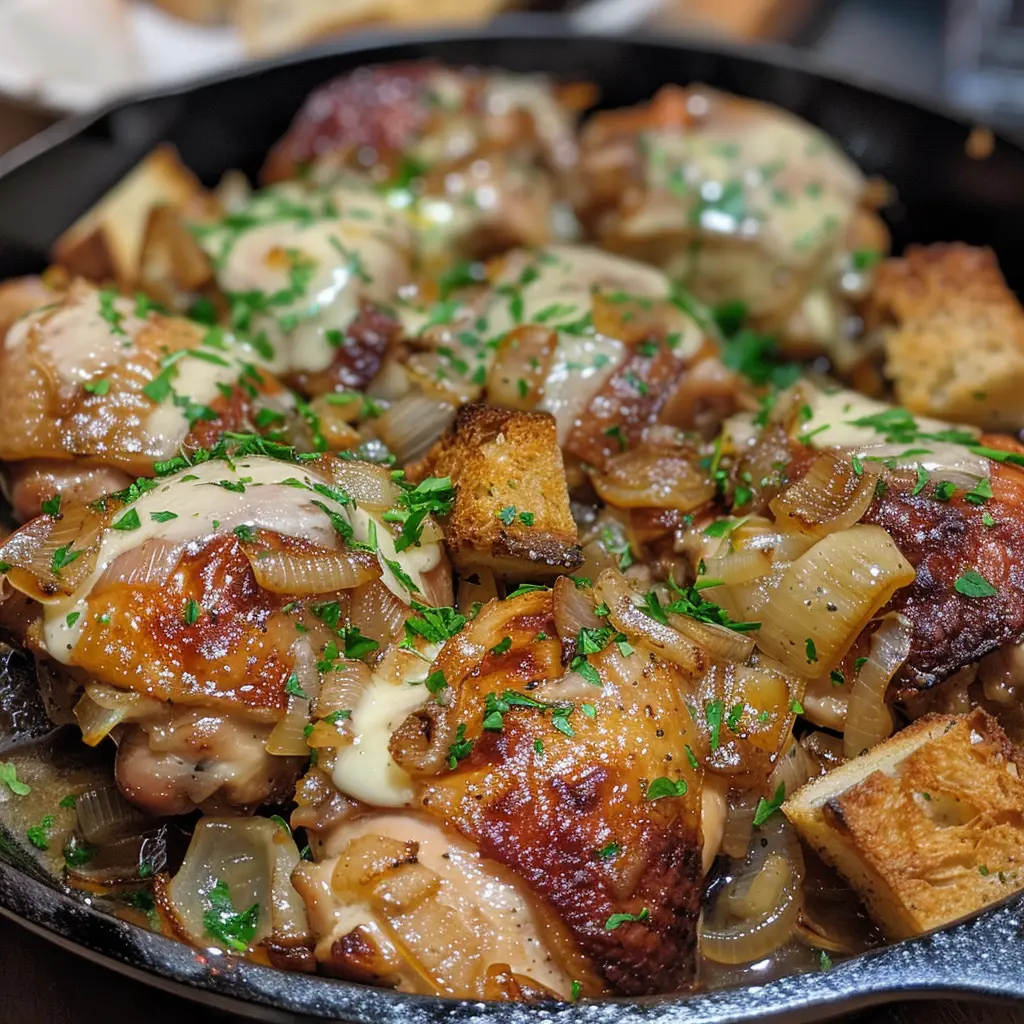
French onion chicken thighs sear bone-in, skin-on chicken thighs until the skin is shatteringly crisp, then caramelize onions in the same pan with butter and balsamic vinegar until they’re deeply golden and sweet, add broth and fresh thyme, nestle the chicken and cubed sourdough bread into the onion braise, blanket everything in Gruyère, and finish in the oven until the cheese is bubbly and the bread has absorbed the onion broth and toasted at the edges. It’s French onion soup and roast chicken combined into one skillet, and it delivers on the bistro promise completely.
| Detail | Info |
|---|---|
| Prep Time | 10 minutes |
| Cook Time | 50 to 60 minutes |
| Total Time | About 1 hour 10 minutes |
| Servings | 4 to 6 |
| Difficulty | Medium |
| Cuisine | French-American |
Why This Recipe Works
Searing the chicken skin-side down in a dry skillet before any other cooking produces the crispy, rendered, deeply golden skin that defines this dish visually and texturally. Chicken skin crisps through the rendering of its subcutaneous fat — as the skin heats against the hot pan, the fat beneath it liquefies and drains away, leaving behind a thin, crispy layer of skin with the Maillard browning that produces its characteristic savory depth. Skin seared this way maintains significant crispiness even through the subsequent braise and oven finish, because the fat has already been rendered out and the skin’s structure is set. Chicken skin that hasn’t been seared will steam through the covered braise and emerge pale, soft, and unappetizing regardless of how well everything else in the dish performs.
Caramelizing the onions in the same skillet used to sear the chicken is the technique that concentrates flavor from two sources simultaneously. The fond — the browned bits and rendered chicken fat left on the pan surface after searing — dissolves into the butter as the onions cook and distributes concentrated chicken flavor through the onion caramelization process. The onions don’t just caramelize in butter; they caramelize in butter already infused with the flavor of the seared chicken skin. The result is an onion base that tastes more integrated and complex than onions caramelized in a clean pan would be, and the chicken, when it returns to the pan, sits in a sauce already built partly from its own flavor.
Balsamic vinegar added during the onion caramelization stage is the ingredient that gives these caramelized onions their depth and complexity beyond what butter and heat alone can produce. Balsamic contains concentrated grape sugars, acidity, and flavor compounds from barrel aging that, when reduced into caramelizing onions, add a rich, slightly sweet, slightly tangy layer that amplifies the onions’ own natural sweetness without making them taste Italian or acidic. A teaspoon is the right amount — enough to be present and meaningful without dominating. The balsamic also deepens the color of the finished onions toward a rich mahogany that looks precisely as developed as properly caramelized onions should.
Sourdough bread cubes nestled into the onion broth around the chicken is the element that transforms this from a chicken and onion braise into something with the full French onion soup experience. The bread cubes absorb the thyme-scented chicken broth and onion liquid during the oven bake, becoming saturated with flavor on the inside while their exposed surfaces toast and develop a crust in the hot oven. Each bread cube ends up with a crispy top, a broth-soaked interior, and the Gruyère melted over it — a miniature version of the crouton that sits in a bowl of French onion soup, but integrated directly into the chicken dish rather than served separately.
Gruyère rather than any other cheese is the choice that completes the French onion soup character of the dish and produces the specific melted cheese quality the recipe promises. Gruyère has a high melting point and excellent melting properties — it produces a smooth, bubbly, slightly stretchy melted surface that turns golden at the edges during the oven bake. Its flavor is nutty, slightly sharp, and complex in a way that’s specifically associated with French cooking and French onion soup in particular. Swiss cheese is a reasonable substitute with a milder, less complex flavor. Neither American nor mozzarella would produce the same bistro character the dish aspires to.
Ingredients
| Ingredient | Quantity | Notes |
|---|---|---|
| Bone-in, skin-on chicken thighs | 4 to 6 | Bone-in, skin-on specifically; boneless or skinless produce a different result |
| Large yellow onions, thinly sliced | 2 | Sliced thin for faster, more even caramelization |
| Butter | 2 tablespoons | For caramelizing the onions |
| Balsamic vinegar | 1 teaspoon | Added during onion caramelization; adds depth and color |
| Chicken broth | 1 cup | Forms the braising liquid with the onions |
| Gruyère cheese, shredded | 1/2 cup | Or Swiss as a substitute; scattered over the top before the oven |
| Fresh thyme | Several sprigs | Added with the broth; the herbal note that anchors the French bistro flavor |
| Sourdough bread, cubed | A few cups | Day-old or slightly stale works best; nestled around the chicken before baking |
| Salt and black pepper | To taste | Season the chicken generously before searing |
Step-by-Step Instructions
Phase 1: Sear the Chicken
- Pat the chicken thighs completely dry with paper towels — dry skin sears; wet skin steams. Season generously with salt and black pepper on both sides.
- Heat a large oven-safe skillet (cast iron is ideal) over medium-high heat with no oil added — the chicken skin will render its own fat. Place the chicken thighs skin-side down in the hot skillet. Don’t move them for 6 to 8 minutes until the skin is deeply golden and releases easily from the pan. Flip and sear the flesh side for 2 minutes. Remove the chicken to a plate and set aside. Leave the rendered fat and fond in the pan.
Phase 2: Caramelize the Onions
- Reduce heat to medium-low. Add the butter to the skillet with the chicken fat. Once melted, add the thinly sliced onions and a pinch of salt. Cook, stirring every few minutes, for 25 to 30 minutes until the onions are deeply golden brown, sweet, and significantly reduced in volume. Don’t rush this stage — properly caramelized onions are the flavor foundation of the dish. If the onions are browning too fast, reduce the heat.
- Add the balsamic vinegar and stir to coat the onions. Cook for 1 additional minute until the balsamic reduces and coats the onions.
Phase 3: Braise and Bake
- Preheat the oven to 400 degrees F while the onions caramelize.
- Pour the chicken broth over the caramelized onions and add the fresh thyme sprigs. Stir to combine and bring to a gentle simmer.
- Return the seared chicken thighs to the skillet, skin-side up, nestling them into the onion broth. Tuck the sourdough bread cubes into the spaces around the chicken, pressing them gently into the broth so the bottom of each cube absorbs liquid while the top remains exposed.
- Scatter the shredded Gruyère evenly over the chicken and bread cubes.
- Transfer the skillet to the oven and bake for 20 minutes until the cheese is melted, golden, and bubbly, the bread cubes are toasted on top and broth-soaked inside, and the chicken reaches an internal temperature of 165 degrees F.
- Remove the thyme sprigs before serving. Rest for 5 minutes before bringing to the table.
Chef Tips for Perfect Results
Don’t rush the onion caramelization. Twenty-five to thirty minutes at medium-low heat is the minimum for properly caramelized onions. Onions cooked at higher heat for less time produce browned onions that are sweet at the surface but sharp inside; truly caramelized onions are uniformly sweet, soft, and deeply flavored throughout. The patience here is the technique that produces the bistro quality the recipe promises.
Use a cast iron skillet if you have one. Cast iron retains and distributes heat more evenly than stainless or non-stick and is directly oven-safe to any temperature. The even heat produces more consistent caramelization and a better sear on the chicken skin. It also goes from stovetop to oven without any transfer — the entire dish, from first sear to finished bake, happens in one pan.
Use day-old or slightly stale sourdough. Fresh bread absorbs the broth too quickly and can become mushy before it has a chance to toast on the exposed surfaces. Day-old sourdough is drier, absorbs the broth more slowly during the bake, and produces better textural contrast between the toasted top and the broth-soaked interior.
Keep the chicken skin-side up throughout the braise and bake. Skin that’s submerged in broth loses its crispiness entirely. Position the chicken skin-side up when it goes back into the pan and keep the broth level below the skin throughout the bake. The skin stays exposed to the dry oven heat while the leg and thigh meat braises in the onion broth below.
Add a splash of dry white wine with the broth. A quarter cup of dry white wine (Chardonnay or Sauvignon Blanc) poured into the caramelized onions before the broth adds an additional layer of complexity to the braising liquid. The wine’s acidity brightens the onion flavor and produces a more nuanced sauce than broth alone.
Common Mistakes to Avoid
Not drying the chicken skin before searing. Wet skin steams in the pan and won’t develop the crispy, golden crust the dish needs. Pat dry every time.
Moving the chicken during the sear. The skin needs sustained, undisturbed contact with the hot pan to render its fat and develop the crust. Move it before it’s ready and it will tear and stick. It releases cleanly when the crust has formed.
Caramelizing at too high a heat. Onions browned too quickly on the outside without cooking through lose the sweetness and depth that makes caramelized onions so special. Medium-low, patient cooking is the only way.
Submerging the chicken skin in the broth. Any skin that sits below the broth line will steam rather than stay crispy. Keep skin-side up and the broth below skin level.
Using pre-shredded cheese. Anti-caking agents in pre-shredded cheese prevent the smooth, golden melt that Gruyère is known for. Buy a block and shred it just before using.
Variations and Substitutions
Add mushrooms to the onion caramelization: A cup of sliced cremini mushrooms added with the onions produces a richer, earthier base that’s even closer to the bistro character of a classic French preparation. Mushrooms and caramelized onions together in a Gruyère sauce are a combination that needs no further justification.
Use bone-in chicken breasts: Bone-in, skin-on chicken breasts work in this recipe with a slightly shorter bake time — check for 165 degrees F at the thickest point at 15 minutes rather than 20. The sear and caramelization stages are identical.
Add Dijon mustard: A tablespoon of Dijon mustard whisked into the broth before it goes into the pan adds a classic French bistro note that pairs particularly well with the Gruyère and thyme. Dijon in chicken dishes is a hallmark of the Lyonnaise cooking tradition that this recipe draws from.
Swap sourdough for baguette: Sliced baguette rounds nestle around the chicken more naturally than cubes and produce an even more authentically French presentation. The baguette’s tighter crumb also stands up to the broth absorption slightly better than sourdough’s open crumb.
Serving Suggestions
Serve directly from the skillet at the table — a cast iron pan arriving on a trivet with golden cheese-covered chicken and toasted bread cubes visible is its own presentation. Each serving should include a chicken thigh, a generous portion of the caramelized onion and broth, and two or three sourdough cubes with melted Gruyère. A simple green salad with Dijon vinaigrette alongside provides the light, acidic counterpoint the richness of the dish needs. A glass of the same dry white wine used in the braise, if you went that route, is the natural pairing.
Storage and Reheating
Refrigerator: Store covered for up to 3 days. The chicken skin will soften in the refrigerator. The onion broth and bread components continue to develop and are particularly good as leftovers.
Reheating: Reheat in a 350 degree F oven for 15 to 20 minutes. The skin won’t return to its original crispiness but the flavors will be intact and excellent. Individual portions reheat in the microwave in 90-second intervals.
Freezer: The chicken and onion braise freeze well for up to 2 months; the bread components do not. Freeze without the bread, thaw overnight in the refrigerator, and serve over fresh toasted sourdough when reheating.
Nutritional Information
| Nutrient | Per Serving (approx., based on 5 servings) |
|---|---|
| Calories | 520 |
| Protein | 38g |
| Carbohydrates | 28g |
| Fat | 28g |
| Saturated Fat | 11g |
| Fiber | 2g |
| Sodium | 620mg |
Nutritional values are estimates based on standard ingredient brands. Values will vary based on chicken thigh size and specific bread used.
FAQ
Can I use boneless, skinless chicken thighs?
Yes, with adjusted expectations. Boneless, skinless thighs won’t produce the crispy skin that’s the visual and textural centerpiece of the dish, and they don’t have the bone to contribute collagen to the braising liquid. They’ll still be tender and delicious — the caramelized onion and Gruyère components ensure that — but the dish loses some of its bistro character. If using boneless thighs, reduce the sear time to 3 to 4 minutes per side and reduce the oven bake to 15 minutes.
Why do my onions take so long to caramelize?
Proper caramelization takes 25 to 35 minutes at medium-low heat and cannot be significantly rushed without compromising the result. Onions are 85 to 90 percent water — the first 15 minutes of cooking is largely about evaporating that water before the sugars can begin to caramelize. Any shortcut that applies high heat to speed the process produces browned but not fully caramelized onions that are sweet on the outside and still somewhat sharp inside. The patience is the technique.
Can I make this without an oven-safe skillet?
Yes. Complete the searing and onion caramelization in any skillet, then transfer everything — chicken, onions, broth, bread, and cheese — to an oven-safe baking dish for the final 20-minute bake. A 9×13 dish works well. The result is identical; the only difference is one more dish to wash.
What’s the best sourdough to use?
A hearty, rustic sourdough with a tight, chewy crumb holds up best to the broth absorption during baking. An airy, open-crumb sourdough can become mushy too quickly. Day-old or two-day-old bread is preferable to fresh — slightly stale bread absorbs liquid more slowly and maintains textural contrast between the toasted top and the broth-soaked interior for longer. Cut into generous 1 to 1.5-inch cubes.
Can I prepare the caramelized onions ahead of time?
Yes — and it makes weeknight cooking significantly faster. Caramelized onions can be made up to 5 days ahead and refrigerated in an airtight container. When ready to cook, simply reheat them in the skillet, add the seared chicken and proceed from step 6. This approach reduces the active cooking time to about 15 minutes on a weeknight.
Conclusion
French onion chicken thighs earn the bistro descriptor through the accumulated quality of every technique: the crispy seared skin, the properly caramelized onions that took the time they needed, the balsamic depth, the thyme-scented broth, the sourdough cubes that became something between a crouton and a bread stuffing, and the Gruyère that finished it all in golden, bubbly splendor. It’s a restaurant-quality dish made in one skillet with accessible ingredients — the kind of dinner that makes a Tuesday feel like an occasion.