
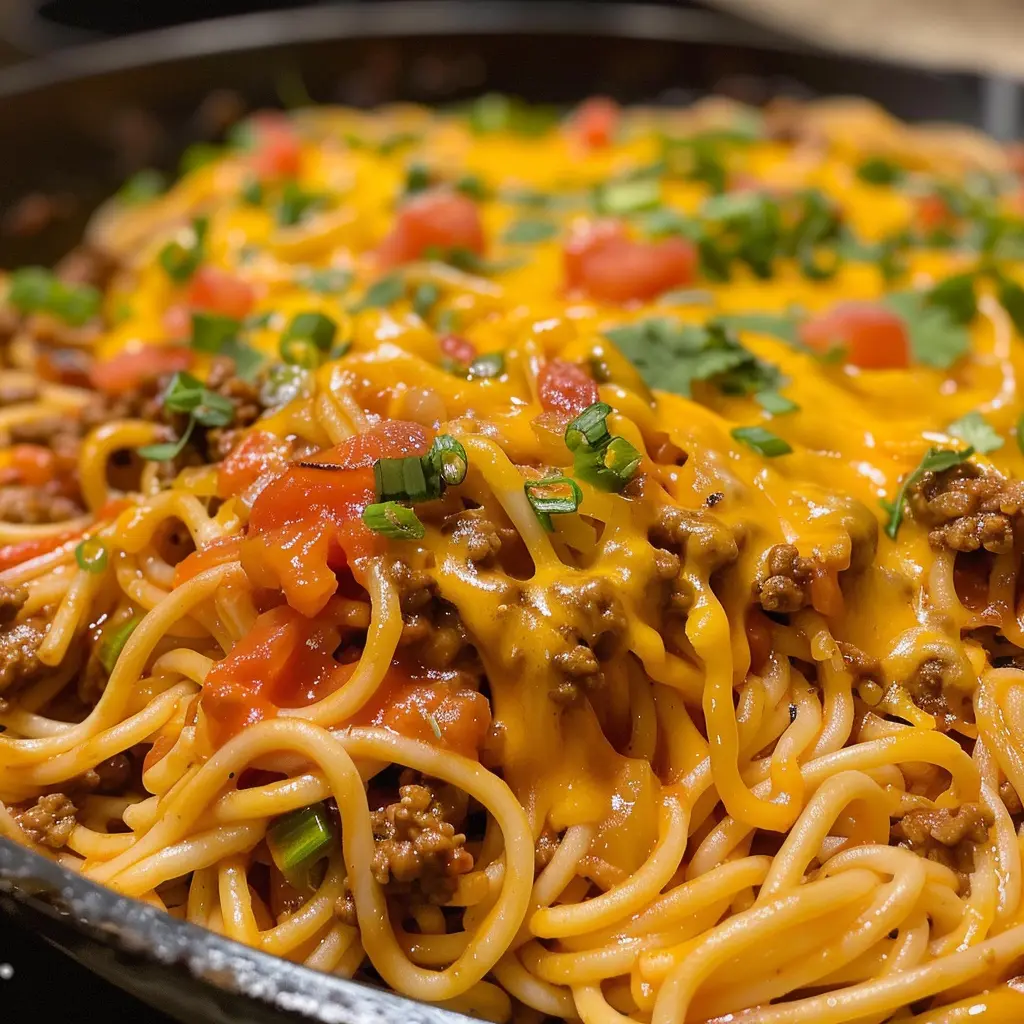
Cheesy taco spaghetti browns seasoned ground beef with diced tomatoes and green chilies, melts a full box of Velveeta into a creamy, spiced cheese sauce right in the same skillet, and tosses cooked spaghetti through it until every strand is coated in the kind of cheesy taco sauce that makes this dish disappear from the pot before it reaches the table. It’s two beloved weeknight dinners combined into one, and the result is better than either on its own.
| Detail | Info |
|---|---|
| Prep Time | 10 minutes |
| Cook Time | 20 minutes |
| Total Time | 30 minutes |
| Servings | 6 |
| Difficulty | Easy |
| Cuisine | American / Tex-Mex |
Why This Recipe Works
Velveeta melted directly into the skillet with the seasoned beef and tomatoes rather than making a separate cheese sauce produces a fully integrated dish where the cheese sauce is infused with the taco beef’s flavor from the moment it forms. A separately made cheese sauce poured over the beef and pasta would sit alongside the other components; Velveeta melted into the cooking liquid from the tomatoes and beef fat becomes a unified sauce where every element — the taco seasoning, the green chilies, the beef fat, the tomato liquid — is dissolved into the cheese base. The result tastes more cohesive and more deeply seasoned than a two-step approach would produce.
Velveeta’s emulsifying salts are the ingredient property that makes it the right cheese for this application. Natural cheese melted into the hot beef and tomato mixture at this stage of cooking would likely break — the fat would separate from the dairy proteins and produce a greasy, grainy mess rather than a smooth sauce. Velveeta’s processed cheese formulation includes sodium citrate and other emulsifying salts that prevent this separation, keeping the cheese in stable, smooth suspension regardless of the heat, the acidity of the tomatoes, or the fat from the beef. The sauce stays creamy and cohesive through the addition of the pasta and through reheating.
Diced tomatoes with green chilies — Rotel is the most common brand — rather than plain diced tomatoes is the ingredient choice that does the most flavor work with the least effort. Rotel’s combination of tomatoes and diced green chilies (and in some varieties, jalapeños) provides a layered heat and tomato acidity that’s more complex than either plain tomatoes or plain salsa would offer. The undrained can contributes its liquid to the sauce base, which the Velveeta then absorbs and disperses through the entire cheese sauce. The green chilies’ mild heat builds through the dish and is present in every bite even though no additional hot sauce or fresh chile is required.
Milk added with the Velveeta serves as a consistency calibrator that adjusts the final sauce to the right texture for coating pasta. Velveeta melted without any added liquid produces a sauce that’s thick enough to coat the beef and potatoes in a dip application but too dense and stiff to toss with and coat a pound of spaghetti evenly. The cup of milk thins the Velveeta to a pourable, pasta-coating consistency that distributes evenly through the cooked spaghetti when tossed, ensuring every strand gets an even coat rather than the sauce sitting in a pool at the bottom of the skillet.
Tossing the cooked spaghetti directly into the skillet with the cheese sauce rather than plating the pasta and ladling the sauce over it produces a uniformly coated dish where every strand has absorbed some of the sauce rather than a plate where the sauce pools at the base of a pasta mound and the strands on top are poorly dressed. The tossing motion also breaks up any pasta that stuck together during draining and redistributes the beef and tomato pieces evenly through the entire pot rather than leaving them concentrated at the sauce level while the pasta sits separately above.
Ingredients
| Ingredient | Quantity | Notes |
|---|---|---|
| Ground beef | 1 pound | 80/20 for best flavor; drain excess fat after browning |
| Spaghetti | 12 to 16 oz | Cooked al dente and drained before adding to the sauce |
| Velveeta Original, cubed | 1 box (16 oz) | Cubed for faster, more even melting |
| Diced tomatoes with green chilies, undrained | 1 can (10 oz) | Rotel or equivalent; the undrained liquid becomes part of the sauce |
| Taco seasoning | 1 packet | Added to the beef and tomatoes; the primary flavor driver |
| Milk | 1 cup | Thins the Velveeta to pasta-coating consistency |
| Garlic powder (optional) | 1 teaspoon | Adds background savory depth |
| Shredded Mexican blend cheese (optional) | 1 cup | Sprinkled over and melted just before serving for extra cheesiness |
| Cilantro or green onions (optional) | For garnish | Added immediately before serving for color and freshness |
Step-by-Step Instructions
Phase 1: Cook the Pasta and Beef
- Bring a large pot of generously salted water to a boil. Cook the spaghetti according to package directions until al dente. Drain and set aside — toss with a drizzle of oil if it will sit for more than a few minutes to prevent sticking.
- While the pasta cooks, brown the ground beef in a large, deep skillet over medium heat, breaking it into fine crumbles. Drain the excess fat.
Phase 2: Build the Sauce
- Add the taco seasoning, diced tomatoes with green chilies (undrained), and garlic powder if using to the browned beef. Stir to combine and simmer for 2 to 3 minutes until the flavors have blended and the mixture is fragrant.
- Reduce the heat to low. Add the cubed Velveeta and the milk to the skillet. Stir continuously as the Velveeta melts, keeping the heat low to prevent scorching on the bottom. Continue stirring until the cheese is completely melted and the sauce is smooth, creamy, and uniform — about 3 to 5 minutes.
Phase 3: Combine and Serve
- Add the cooked, drained spaghetti to the skillet. Toss with tongs until every strand is evenly coated in the cheesy taco sauce and the beef and tomato pieces are distributed throughout the pasta.
- If using the shredded Mexican cheese topping, sprinkle it evenly over the tossed pasta, cover the skillet with a lid, and let sit for 2 to 3 minutes until the cheese melts over the top.
- Scatter cilantro or green onions over the finished dish and serve immediately from the skillet.
Chef Tips for Perfect Results
Keep the heat low when melting the Velveeta. High heat causes Velveeta to scorch on the bottom of the skillet and can cause the sauce to become grainy or uneven. Low heat with constant stirring produces the smoothest, most uniform sauce. The Velveeta will melt fully at low heat — patience here is rewarded with a better sauce.
Reserve half a cup of pasta water before draining. The starchy pasta water is the best tool for adjusting the sauce consistency after the spaghetti is tossed in. If the sauce seems too thick once the pasta is added, a splash of pasta water loosens it while adding starch that helps the sauce cling to the strands. Plain water dilutes flavor; pasta water doesn’t.
Use Rotel Original for moderate heat, Rotel Hot for a spicier version. The level of heat in the finished dish comes primarily from the diced tomatoes and green chilies — Original produces mild warmth, Hot produces a clear, building heat. Swapping varieties is the easiest way to adjust the spice level for your household without any other recipe changes.
Add black beans and corn for a more substantial dish. A drained can of black beans and a cup of frozen corn stirred into the beef and tomato mixture before the Velveeta goes in adds protein, fiber, and color that makes the dish more nutritionally complete and more visually appealing. Both pair naturally with the taco seasoning and become part of the sauce base.
Toss the pasta while the sauce is hot. Velveeta sauce that has cooled to below about 140 degrees F starts to thicken and becomes more difficult to toss evenly through the pasta. Have the pasta ready to add the moment the sauce is smooth and the heat is still low — hot sauce coats spaghetti far more evenly than warm or cooled sauce.
Common Mistakes to Avoid
Melting the Velveeta on too high heat. Scorching and graininess result from impatient high-heat melting. Always low heat, always stirring.
Draining the tomatoes before adding. The liquid in the can is part of the sauce. Always add undrained.
Not tossing the pasta into the sauce. Plating pasta separately and pouring sauce over it produces a dish where the pasta and sauce are never fully integrated. Always toss in the skillet.
Overcooking the pasta before adding to the sauce. Fully cooked pasta tossed in hot sauce and then covered to melt the optional cheese topping becomes overcooked and soft. Cook to al dente — it will soften slightly from the residual heat of the sauce.
Not stirring continuously while the Velveeta melts. Velveeta left unstirred over heat can form a skin or scorch in spots. Continuous stirring produces the smoothest, most even sauce.
Variations and Substitutions
Add Rotel with habanero peppers: Rotel makes a habanero variety for serious heat seekers. Combined with the taco seasoning, it produces a version of this dish with a slow-building, persistent heat that’s for people who specifically want their comfort food to have some fire.
Ground turkey or chicken: Either substitutes well for a leaner version. Season more assertively since both are milder than beef — the taco seasoning does most of the work, but an extra half teaspoon of cumin helps close the flavor gap.
Add cream cheese: A four-ounce block of cream cheese added with the Velveeta produces a tangier, even creamier sauce with a slightly thicker consistency. The cream cheese version has a more pronounced dairy richness that many people prefer.
Chorizo upgrade: Replace half the ground beef with Mexican chorizo (casing removed) for a version with more spice and smokiness. The chorizo’s rendered fat becomes part of the sauce and adds a distinctly different depth that makes the dish more complex.
Serving Suggestions
Serve directly from the skillet with tongs, piled into wide bowls or onto plates. Top with the optional Mexican cheese melt, green onions, and fresh cilantro. Tortilla chips on the side for scooping up the cheesy sauce are a natural addition that leans into the Tex-Mex identity of the dish. Sliced jalapeños and sour cream on the table let each person customize their heat and coolness. This dish is a complete meal on its own — the beef provides protein, the pasta provides starch, and the cheese sauce provides everything else.
Storage and Reheating
Refrigerator: Store covered for up to 4 days. The pasta absorbs the cheese sauce as it sits and the dish will be thicker after refrigeration.
Reheating: Add a splash of milk before reheating and stir to redistribute the sauce. Reheat in a skillet over medium-low heat, stirring frequently, or in the microwave in 60-second intervals with milk stirred in before heating. The Velveeta sauce re-melts smoothly with added milk.
Freezer: Not recommended. The Velveeta sauce can separate slightly after freezing and thawing, and the pasta texture degrades. This is a make-fresh recipe best enjoyed within the refrigerator storage window.
Nutritional Information
| Nutrient | Per Serving (approx.) |
|---|---|
| Calories | 620 |
| Protein | 34g |
| Carbohydrates | 58g |
| Fat | 28g |
| Saturated Fat | 13g |
| Fiber | 2g |
| Sodium | 1060mg |
Nutritional values are estimates based on standard ingredient brands without optional toppings. Sodium is significant due to the Velveeta and taco seasoning; values will vary based on specific brands used.
FAQ
Can I use a different cheese instead of Velveeta?
Velveeta is specifically chosen for its emulsifying properties — it melts into a stable, smooth sauce that doesn’t break under the heat and acidity of the tomatoes and beef fat. Natural cheese substituted directly will likely break and become grainy. If you want to avoid Velveeta, the best alternative is to make a bechamel-based cheese sauce: melt two tablespoons of butter, whisk in two tablespoons of flour, add two cups of milk gradually, then stir in two cups of shredded cheddar over low heat. Use this in place of the Velveeta and milk in the recipe.
Can I use a different pasta shape?
Yes. Rotini, penne, or cavatappi work well and hold the cheese sauce in their ridges and tubes effectively. The Tex-Mex character of the dish arguably works better with shorter pasta shapes that scoop up the beef and sauce together. Spaghetti is traditional for the fusion appeal of the dish name; shorter shapes are more practical for eating.
How do I prevent the sauce from getting too thick?
Two things manage sauce thickness: the pasta water reserved before draining (add a splash and stir to loosen), and additional milk stirred in after the spaghetti is tossed (start with two tablespoons and add more if needed). The sauce thickens as the pasta absorbs it — adjust consistency right after tossing while everything is still hot, before it sets.
Can I make this ahead for a weeknight meal?
The beef and sauce can be made ahead and refrigerated for up to 2 days. When ready to serve, cook fresh pasta, reheat the beef and sauce in a skillet over medium-low heat with a splash of milk, and toss the pasta in when everything is hot. This approach produces a fresher result than reheating the fully assembled dish.
Is this dish spicy?
With Rotel Original and standard taco seasoning, the heat level is mild to moderate — noticeable warmth with the green chile but not spicy enough to challenge most palates. For a milder version, use plain diced tomatoes instead of Rotel. For more heat, use Rotel Hot, add jalapeños, or use a hot taco seasoning blend.
Conclusion
Cheesy taco spaghetti is the weeknight recipe that earns its place in the regular rotation by being genuinely fast, genuinely easy, and genuinely more satisfying than the standard versions of either dish it combines. The Velveeta taco sauce coats every strand of spaghetti, the seasoned beef is distributed through every serving, and the whole thing comes together in 30 minutes in one skillet. Make it once and it becomes the answer any time dinner needs to happen quickly and leave everyone at the table satisfied.