
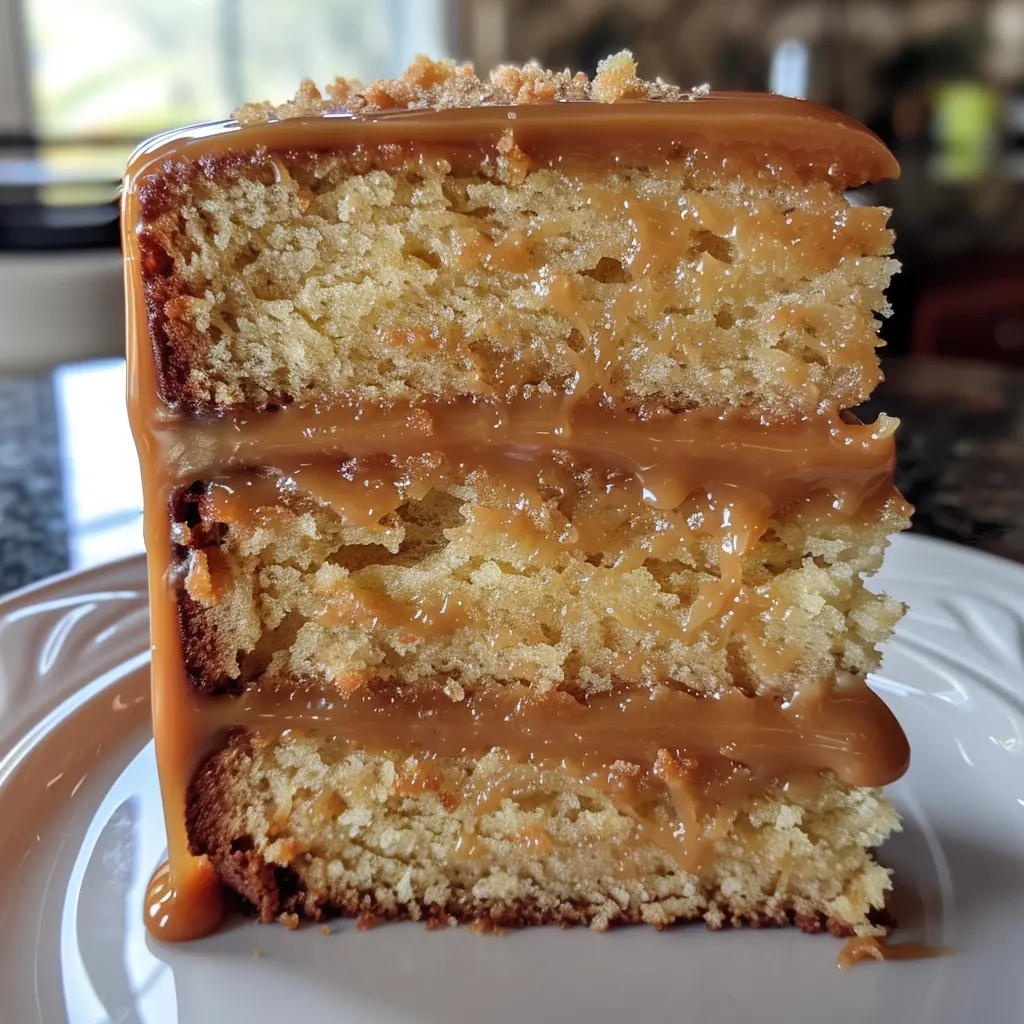
Baptist pound cake is a dense, tight-crumbed, buttery Southern layer cake made with both butter and shortening for structure, six eggs for richness, and buttermilk for a slight tang that balances the sweetness. Covered in a thick, fudgy Southern caramel icing that sets fast and slices clean, it’s the cake that has appeared at church potlucks, family reunions, and Sunday dinners across the South for generations — and the one that always arrives home with an empty plate and a request for the recipe.
| Detail | Info |
|---|---|
| Prep Time | 30 minutes |
| Bake Time | 28 to 35 minutes per layer |
| Total Time | About 2 hours (including cooling) |
| Servings | 12 to 16 |
| Difficulty | Medium |
| Cuisine | American / Southern |
Why This Recipe Works
The combination of butter and shortening in the creamed fat base produces a cake with qualities that neither alone can fully achieve. Butter provides the flavor — the rich, dairy-forward taste that makes a good pound cake unmistakably buttery and complex. But butter also has a lower melting point than shortening, and a cake made with butter alone can have a slightly denser, less stable crumb structure. Shortening has a higher melting point and contributes structural support to the crumb — it keeps the batter lofted longer during baking, producing a cake with a more even, consistent crumb and a slightly more tender texture that holds its structure when sliced. Together they produce a cake that tastes like pure butter but slices like a properly structured layer cake.
Six eggs in the batter rather than the three or four a standard layer cake calls for is the element that makes this cake a pound cake in character rather than simply a layer cake. Eggs provide protein, fat, emulsification, and lift simultaneously — six eggs create a batter so rich and emulsified that it produces the characteristically dense, tight, moist crumb of a pound cake rather than the open, airy crumb of a standard layer cake. The additional egg yolks also deepen the color of the baked crumb to a richer yellow and contribute a more pronounced richness to the flavor that becomes especially prominent alongside the caramel icing.
Buttermilk alternated with the sifted flour rather than sweet milk or water is the liquid choice that produces a subtle but important flavor and texture contribution. Buttermilk’s lactic acid reacts with the small amount of baking powder in the recipe to provide lift, but more importantly it contributes a barely perceptible tang that cuts through the sweetness of three cups of sugar and makes the cake taste more complex and less cloying. The acidity also tenderizes the gluten in the flour, contributing to the moist, tight crumb that defines this style of cake. The alternating addition — flour, buttermilk, flour, buttermilk, flour — prevents the batter from developing too much gluten at any one stage and produces the most tender possible crumb.
The Southern caramel icing is built in two stages — a cooked brown sugar and butter base simmered with milk, then beaten with powdered sugar — and the result is a hybrid between a poured caramel glaze and a traditional buttercream. The cooked stage develops real caramel flavor from the brown sugar’s molasses component and the butter’s milk solids as they heat together — this is the flavor depth that instant caramel frostings made from powdered sugar and flavoring can’t replicate. The powdered sugar beaten in at the end provides body, sweetness, and structure that transforms the poured caramel base into something thick enough to spread and stack. The result is a caramel icing with the complex, cooked flavor of candy-making and the spreadable consistency of frosting.
The instruction to work quickly when spreading the caramel icing is not a stylistic note — it’s an operational requirement. The cooked caramel begins setting from the moment it cools below approximately 140 degrees F, and a caramel icing that’s been beaten with powdered sugar has a working window of roughly 5 to 10 minutes before it becomes too stiff to spread cleanly. Having all three cooled cake layers ready on the counter, the offset spatula at hand, and a plan for the assembly sequence before the caramel icing is made is the preparation that determines whether the finished cake looks like it was made by someone who has done this before.
Ingredients
Pound Cake
| Ingredient | Quantity | Notes |
|---|---|---|
| All-purpose flour, sifted | 3 cups | Sift before measuring for the most accurate, lightest flour addition |
| Baking powder | 1/2 teaspoon | A small amount only — this is a dense pound cake, not a light layer cake |
| Salt | 1/2 teaspoon | Added to the flour during sifting |
| Unsalted butter, room temperature | 1 cup (2 sticks) | Room temperature is essential for proper creaming |
| Shortening (Crisco) | 1/2 cup | Adds structure and moisture retention alongside the butter |
| Granulated sugar | 3 cups | Creamed with the fats for 5 to 7 minutes |
| Large eggs, room temperature | 6 | Added one at a time; room temperature eggs emulsify more smoothly |
| Whole buttermilk | 1 cup | Alternated with the flour; adds tang and tenderness |
| Pure vanilla extract | 2 teaspoons | Stirred in at the end of mixing |
Southern Caramel Icing
| Ingredient | Quantity | Notes |
|---|---|---|
| Unsalted butter | 1 cup | Melted in the saucepan as the base |
| Light brown sugar, packed | 2 cups | Cooked with the butter to develop the caramel base |
| Whole milk or evaporated milk | 1/2 cup | Evaporated milk produces a richer, creamier caramel |
| Salt | Pinch | Enhances the caramel flavor |
| Powdered sugar, sifted | 4 cups | Added one cup at a time after cooling; provides body and spreadability |
| Vanilla extract | 1 teaspoon | Stirred in before spreading |
Step-by-Step Instructions
Phase 1: Make the Cake
- Preheat the oven to 325 degrees F. Grease and flour three 8 or 9-inch round cake pans, tapping out any excess flour. Line the bottoms with parchment circles for insurance against sticking.
- Sift the flour, baking powder, and salt together into a bowl and set aside.
- In a stand mixer fitted with the paddle attachment, beat the butter, shortening, and sugar together on medium speed for 5 to 7 minutes, stopping to scrape down the sides twice, until the mixture is very pale, light, and fluffy. This extended creaming is not optional — it’s the step that incorporates air into the fat and sugar base and determines the final crumb structure.
- Add the eggs one at a time, beating for 30 seconds after each addition and scraping down the bowl between additions. All six eggs should be fully incorporated before the next stage.
- With the mixer on low, add the sifted flour mixture and buttermilk alternately in five additions: flour, buttermilk, flour, buttermilk, flour. Begin and end with the flour. Mix only until just combined after each addition — overmixing at this stage develops gluten and toughens the cake.
- Stir in the vanilla extract. Give the batter a final fold with a spatula to ensure nothing is stuck at the bottom of the bowl.
- Divide the batter evenly among the three prepared pans and smooth the tops. Bake for 28 to 35 minutes until a toothpick inserted in the center comes out clean and the edges have begun to pull away from the pan sides.
- Cool in the pans for 10 minutes, then turn out onto wire racks to cool completely before icing. The cake must be completely cool — a warm layer will melt the caramel icing and produce a sloppy, sliding assembly.
Phase 2: Make the Caramel Icing
- Have all three cooled cake layers on the counter, the offset spatula nearby, and a plan for assembly before starting the icing. Once the icing is made, you have approximately 5 to 10 minutes to work with it.
- In a large, heavy-bottomed saucepan over medium heat, melt the butter completely. Add the brown sugar and a pinch of salt. Cook, stirring constantly, for 2 to 3 minutes until the sugar is fully dissolved and the mixture is smooth and beginning to bubble.
- Slowly pour in the milk, stirring as you add it. Bring to a gentle boil, then reduce heat and simmer for 4 to 5 minutes, stirring frequently. Remove from heat and let cool for 5 minutes — the mixture should be warm but not scorching.
- Beat in the sifted powdered sugar one cup at a time, whisking vigorously between additions, until the icing is smooth, thick, and spreadable. Stir in the vanilla extract.
Phase 3: Assemble and Ice
- Place the first cake layer on a serving plate or cake board. Spread a generous layer of warm caramel icing over the top, going to the edges. Set the second layer on top and repeat. Add the third layer and pour or spread the remaining icing over the top, letting it run slightly over the edges and smoothing the sides with an offset spatula. Work quickly — the icing sets fast.
- Once iced, leave the cake undisturbed at room temperature until the icing has fully set and firmed — at least 30 minutes, preferably an hour. The icing should be firm to the touch and slice cleanly without smearing before serving.
Chef Tips for Perfect Results
Cream the fat and sugar for the full 5 to 7 minutes. This is the most commonly rushed step and the one with the most impact on final texture. The extended creaming incorporates air into the fat-sugar matrix that gives the pound cake its structure. Under-creamed batter produces a denser, flatter cake. Use a timer and don’t stop early.
All ingredients must be room temperature. Cold butter won’t cream properly and will produce a lumpy, dense batter. Cold eggs added to creamed butter can cause the batter to curdle. Cold buttermilk can shock the emulsification. Set butter, eggs, and buttermilk out 30 to 60 minutes before baking.
Use evaporated milk in the caramel icing. The recipe lists whole milk or evaporated milk — evaporated milk’s higher fat content and pre-reduced moisture produce a noticeably richer, creamier caramel base that holds its consistency slightly longer during spreading and has a more intense, candy-shop caramel flavor. It’s the choice that experienced Southern bakers default to.
Reheat the caramel icing if it sets too quickly. If the icing becomes too stiff to spread mid-assembly, place the saucepan back over very low heat and stir for 30 to 60 seconds until it loosens to spreading consistency. Add a teaspoon of milk if needed to thin. Work immediately after reheating.
Let the finished cake sit overnight before slicing. The caramel icing continues to set and firm for several hours after assembly, and the cake layers absorb moisture from the icing, producing a more cohesive, sliceable cake the next day than immediately after assembly. If possible, ice the cake the evening before serving for the cleanest slices and the most developed flavor.
Common Mistakes to Avoid
Under-creaming the butter, shortening, and sugar. Five to seven minutes is not excessive — it’s necessary. Use a timer.
Overmixing after the flour is added. Once the flour goes in, mix only until combined. Overworked gluten produces a tough, rubbery cake rather than a tender one.
Icing a warm cake. Warm cake melts caramel icing on contact and the layers slide. The cake must be completely cool — not just not warm, but genuinely room temperature throughout the interior. Allow at least 2 hours after removing from the pans.
Not having everything ready before making the caramel icing. The icing sets within minutes. Scrambling to find the spatula or position the layers while the caramel firms in the saucepan produces a cracked, uneven icing that can’t be smoothed after it sets. Prepare everything before the icing goes on the stove.
Adding powdered sugar to hot caramel. Very hot caramel base combined with powdered sugar can produce a grainy texture. The 5-minute rest after removing from heat is enough to cool the base to the right temperature — warm enough to incorporate the sugar smoothly but not so hot it causes graininess.
Variations and Substitutions
Chocolate caramel version: Stir two tablespoons of unsweetened cocoa powder into the brown sugar and butter during the cooked caramel stage for a chocolate-caramel icing that pairs beautifully with the vanilla pound cake beneath it.
Add lemon zest: The zest of one lemon folded into the batter with the vanilla produces a lemon pound cake that pairs unexpectedly well with the caramel icing — the bright citrus cuts through the sweetness and adds complexity to the flavor combination.
Pecan variation: A half cup of finely chopped toasted pecans folded into the caramel icing just before spreading adds a textural crunch and nutty flavor that’s classically Southern and particularly well-suited to this combination of butter cake and brown sugar caramel.
Tube pan version: The batter can be baked in a greased and floured 10-inch tube pan or Bundt pan at 325 degrees F for 75 to 90 minutes for a single-piece pound cake. The caramel icing poured over a tube cake produces a beautiful drip effect and requires no layering skills.
Serving Suggestions
Slice with a sharp, clean knife for the cleanest cuts through the caramel icing — wipe the blade between slices for picture-perfect pieces. Serve at room temperature where the icing is at its correct firm-but-yielding texture. A cup of strong coffee or sweet iced tea alongside is the traditional Southern pairing. This cake doesn’t need anything else — a proper slice of Baptist pound cake with caramel icing is complete on its own.
Storage
Room temperature: Store covered at room temperature for up to 4 days. The caramel icing continues to set over the first day and the cake gets progressively better as the layers meld together. Do not refrigerate — the refrigerator dries the cake and causes the caramel icing to become overly firm and sticky.
Freezer: Freeze uniced cake layers individually wrapped in plastic and foil for up to 3 months. Thaw at room temperature and ice fresh. Fully iced slices can be frozen individually, though the caramel icing texture changes slightly after thawing.
Nutritional Information
| Nutrient | Per Serving (approx., based on 14 servings) |
|---|---|
| Calories | 720 |
| Protein | 6g |
| Carbohydrates | 104g |
| Fat | 32g |
| Saturated Fat | 17g |
| Fiber | 1g |
| Sugar | 84g |
| Sodium | 160mg |
Nutritional values are estimates based on standard ingredient brands. Values will vary based on layer thickness and amount of icing used per serving.
FAQ
Why is this called a “Baptist” pound cake?
The name is a Southern tradition with multiple explanations, none definitively documented. The most widely accepted is that this style of dense, rich, butter-and-shortening pound cake became associated with church potlucks and Baptist church socials throughout the South, where it was the cake brought by skilled home bakers to feed large crowds. The name recognizes the cake’s social history as much as any specific recipe characteristic — it’s the cake that shows up at funerals, homecomings, and Sunday dinners in the Southern church tradition.
Why does the caramel icing set so fast?
Caramel made with brown sugar and butter begins crystallizing as it cools below a certain temperature — the same process that makes caramel candy firm. Once powdered sugar is beaten in and the temperature drops further, the setting process accelerates. Working quickly and having everything prepared before the icing is made is the only way to manage this window. If the icing sets before you finish, see the reheating tip in the Chef Tips section above.
Can I make this as a sheet cake instead of layers?
Yes. Bake in a greased and floured 9×13 baking pan at 325 degrees F for 45 to 55 minutes until a toothpick comes out clean. Pour the caramel icing over the top of the cooled single-layer cake and let it spread to the edges naturally. The sheet cake version requires no layering skills and produces the same flavors in a more casual format.
What’s the difference between this caramel icing and store-bought frosting?
The cooked caramel base is what makes this icing categorically different from any store-bought or powdered-sugar-only frosting. The 4 to 5 minutes of simmering the brown sugar and butter together develops actual caramel flavor from the Maillard reaction and the sugar’s molasses compounds — the same process that makes candy caramel taste like candy caramel. Store-bought caramel frosting and powdered-sugar-only caramel icing skip this cooking stage and taste like sweetened butter with caramel flavoring. The cooked version tastes like fudge.
Why do I need to sift the flour?
Sifted flour is lighter and more aerated than flour measured directly from the bag, and it produces a more accurate volume measurement because unsifted flour compacts. In a pound cake where the flour-to-fat ratio is precisely calibrated for the dense, tight crumb this cake is known for, accurate flour measurement matters. Over-measured flour produces a dry, dense cake; properly sifted flour produces the moist, tight crumb the recipe intends.
Conclusion
Baptist pound cake with caramel icing is the cake that earns its legendary status at church potlucks and family gatherings through the accumulated quality of every detail: the butter-shortening crumb that’s simultaneously rich and tender, the six eggs that push it firmly into pound cake territory, the buttermilk tang that keeps three cups of sugar from being cloying, and the cooked caramel icing that tastes like a Southern candy shop put a layer cake in business. Make it once and understand immediately why this cake never comes home with anything left on the plate.