
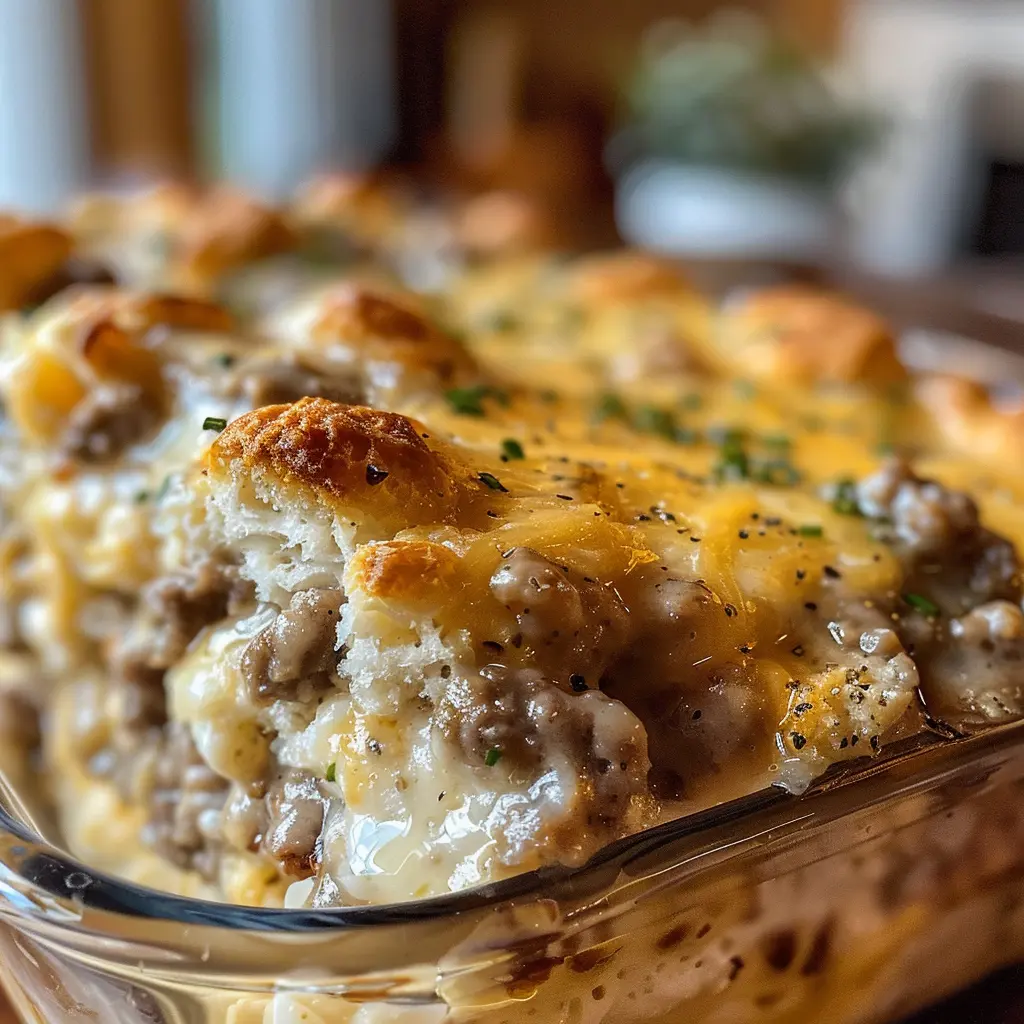
Biscuits and gravy breakfast casserole layers sausage gravy, lightly scrambled eggs, and quartered refrigerator biscuits in a 9×13 baking dish and bakes everything into a cohesive, golden-topped breakfast that brings together the classic comfort of biscuits and gravy with the satisfying heartiness of a proper egg casserole. It serves eight generously from a single dish, requires no individual plating, and arrives at the table looking and smelling like the best reason anyone could have to get out of bed on a Saturday.
| Detail | Info |
|---|---|
| Prep Time | 20 minutes |
| Cook Time | 25 minutes |
| Rest Time | 5 minutes |
| Total Time | 50 minutes |
| Servings | 8 |
| Difficulty | Easy |
| Cuisine | American / Southern |
Why This Recipe Works
Layering the sausage gravy in thirds — below the eggs, between the eggs, and above the eggs — distributes the gravy through the entire casserole rather than concentrating it in one place. This layering means every forkful from every part of the dish reaches all three components simultaneously: the savory sausage gravy, the soft egg, and the biscuit above it. A casserole with all the gravy on one level and all the eggs on another would produce bites that taste like eggs, then bites that taste like gravy, then biscuit, rather than the unified, cohesive bite that makes this dish feel like something deliberately composed.
Scrambling the eggs only until just set before they go into the casserole is a technique choice that prevents them from becoming rubbery in the oven. Eggs that are fully cooked in the skillet will continue cooking during the 20 to 25 minutes of oven time and arrive at the table overdone — dry, with a slightly sulfurous edge. Eggs pulled from the heat while still slightly underdone and wet-looking will finish cooking in the oven and arrive perfectly set — tender, moist, and fully cooked without any of the toughness that comes from double-cooking them all the way through twice.
Evaporated milk in this recipe does more than serve as a milk substitute. Evaporated milk has had roughly 60 percent of its water content removed during processing, which concentrates its proteins and sugars and produces a richer, creamier result in both the gravy and the egg mixture than regular milk provides. In the gravy, evaporated milk creates a thicker, more stable sauce that holds its consistency during baking without breaking or separating. In the egg mixture, it produces a creamier, more tender scrambled egg than water or regular milk — the concentrated dairy fat and protein content change the texture of the cooked egg noticeably.
Quartering the biscuits rather than using them whole or halved is what produces the patchwork, pull-apart topping that makes this casserole so visually appealing and practically convenient. Whole biscuits on top would be too large to cook through evenly in the oven time without the layers beneath them overcooking. Quartered biscuits have the right surface-area-to-thickness ratio to puff, brown, and cook through completely during the 20 to 25 minute bake — producing a golden, pull-apart topping that serves as both the bread component of the casserole and its visual signature.
Making the gravy directly in the sausage skillet rather than a separate pan captures every bit of fat and fond left by the browning sausage. Country gravy gets its characteristic savory depth from the rendered pork fat and browned bits that linger in the pan after the sausage has cooked. Sprinkling the gravy mix directly over the sausage and building the liquid into the same pan means the gravy absorbs all of that sausage flavor instantly and produces something noticeably richer than gravy made in a clean pan with the same packet.
Ingredients
| Ingredient | Quantity | Notes |
|---|---|---|
| Refrigerated biscuits, 8-count tube | 1 tube | Standard size; quartered before topping the casserole |
| Breakfast sausage | 1 pound | Pork breakfast sausage; cook and crumble in the skillet |
| Country gravy mix | 2 packets | Use directly in the sausage skillet to capture the rendered fat and fond |
| Evaporated milk | 1 can (12 oz), divided | Split between the gravy and the egg mixture for richness in both |
| Large eggs | 12 | Lightly scrambled until just set before layering |
| Water | 1 cup | Combined with the evaporated milk to make the gravy liquid |
| Salt and black pepper | To taste | Seasoned into the egg mixture; the sausage and gravy mix also carry salt |
Step-by-Step Instructions
Phase 1: Cook the Sausage and Make the Gravy
- Preheat the oven to 350 degrees F. Grease a 9×13-inch baking dish with cooking spray and set aside.
- Cook the breakfast sausage in a large skillet over medium heat, breaking it into crumbles as it browns. Cook for 7 to 8 minutes until fully browned with no pink remaining. Drain the excess fat, leaving a thin coating in the pan — this fat carries flavor into the gravy.
- Sprinkle both packets of country gravy mix evenly over the browned sausage. Stir to coat the sausage in the dry mix.
- Pour in 1 cup of evaporated milk and 1 cup of water, stirring constantly to dissolve the gravy mix into the liquid. Bring to a gentle simmer over medium heat, stirring frequently, until the gravy thickens to a spoonable consistency — about 3 to 4 minutes. Remove from heat.
Phase 2: Scramble the Eggs
- In a large bowl, whisk together the 12 eggs, the remaining evaporated milk, salt, and black pepper until fully combined and slightly frothy.
- Melt a small knob of butter in a clean skillet or the same skillet used for the gravy over medium-low heat. Pour in the egg mixture and cook, gently folding with a spatula, until the eggs are just barely set — they should still look slightly underdone and wet in places. Remove immediately from the heat. They will finish cooking in the oven.
Phase 3: Layer the Casserole
- Spread one-third of the sausage gravy evenly across the bottom of the prepared baking dish.
- Layer half of the lightly scrambled eggs over the gravy, spreading them gently to cover.
- Spread another third of the sausage gravy over the eggs.
- Add the remaining scrambled eggs in an even layer over the second gravy layer.
- Top with the remaining sausage gravy, spreading it to cover the eggs as evenly as possible.
Phase 4: Top with Biscuits and Bake
- Quarter each of the 8 biscuits by pressing them flat and cutting or tearing into four roughly equal pieces. Arrange the biscuit quarters evenly over the top of the casserole, covering as much of the surface as possible with a slightly overlapping patchwork pattern.
- Bake uncovered for 20 to 25 minutes until the biscuits are puffed, deeply golden brown on top, and cooked through. Press a biscuit piece gently — it should feel set and firm, not doughy.
- Allow the casserole to rest for 5 minutes before serving. Scoop into portions with a large spoon, ensuring each serving gets biscuit, egg, and gravy from all the layers.
Chef Tips for Perfect Results
Undercook the scrambled eggs before layering. The eggs will spend 20 to 25 minutes in a 350 degree F oven. Fully cooked eggs going into that environment will come out rubbery and dry. Pull them off the heat while they still look slightly underdone — glossy and barely set — and they’ll arrive at the table perfectly cooked after the oven time.
Build the gravy in the sausage pan. The rendered fat and fond left in the pan after browning the sausage are the most flavorful components of the gravy. Building it directly in that pan rather than making it separately captures every bit of that sausage-infused fat and transfers it into the sauce.
Don’t skip the rest period. A casserole cut immediately from the oven has very hot, still-mobile layers that collapse when scooped. Five minutes of rest allows everything to firm slightly and hold together from dish to plate.
Flatten the biscuit quarters slightly before arranging them. Thick, unflattened biscuit pieces stacked high on top of the casserole can produce a doughy center even after 25 minutes of baking. Flattening each quarter to about half an inch ensures they cook through fully in the bake time.
Season the egg mixture assertively. The sausage and gravy mix both carry significant salt, but the egg layer is a distinct component that needs its own seasoning or it will taste bland alongside the bold gravy. Season the egg mixture with enough salt and pepper that it tastes slightly over-seasoned when tasted raw — the oven bake mellows salt noticeably.
Common Mistakes to Avoid
Fully cooking the eggs before the casserole goes in. This is the most common mistake and the one that most often produces a disappointing, rubbery egg layer. The eggs go into the casserole to finish cooking in the oven, not to be reheated after being fully cooked twice. Stop scrambling when they look underdone.
Draining all the fat from the sausage. The rendered sausage fat is what gives the gravy its characteristic savory depth. Drain the excess — too much fat makes the gravy greasy — but always leave a thin coating in the pan to build the gravy in.
Baking covered. A covered casserole traps steam that softens the biscuit topping rather than allowing it to puff and brown. Always bake uncovered for the golden, crisped biscuit topping the recipe is designed to produce.
Using too thick biscuit quarters. Biscuit pieces that are too thick may remain doughy in the center even after 25 minutes of baking. Flatten them slightly before arranging and check the center of one by pressing gently — it should feel set, not soft and raw, before the casserole comes out.
Not greasing the baking dish. The sausage gravy on the bottom layer can adhere aggressively to an ungreased baking dish and make the first servings difficult to remove cleanly. A thorough coat of cooking spray before anything goes in prevents this.
Variations and Substitutions
Add shredded cheese: Scatter a cup of shredded cheddar between the egg layers and over the final gravy layer before the biscuits go on top. The cheese melts into the gravy and egg during baking and adds a richness that most people find makes the casserole even more irresistible.
Add diced bell pepper and onion to the eggs: Saute a diced bell pepper and half a diced onion before adding the egg mixture to the skillet for a Denver-style egg layer with more color and vegetable flavor.
Spicy version: Use hot breakfast sausage instead of regular, and add a pinch of cayenne and red pepper flakes to the egg mixture. The heat builds gradually through the casserole and contrasts well with the creamy gravy.
Make-ahead assembly: Prepare all the components the night before — cook the gravy, scramble the eggs to just-set, and quarter the biscuits. Refrigerate the gravy and eggs separately. In the morning, layer and bake, adding 5 to 10 minutes to the bake time to account for the cold ingredients.
Serving Suggestions
Scoop generous portions directly from the baking dish, making sure each serving captures all the layers. Fresh fruit on the side adds a bright, sweet contrast to the rich, savory casserole. A simple pot of coffee and a glass of orange juice complete the breakfast table without any additional effort. For a brunch gathering, this casserole pairs well with a simple arugula salad dressed with lemon to cut through the richness.
Storage and Reheating
Refrigerator: Store covered for up to 3 days. The biscuits soften as they sit and absorb the gravy, producing a different but still satisfying texture on day two.
Reheating: Cover loosely with foil and reheat in a 325 degree F oven for 15 to 20 minutes until heated through. The microwave works for individual portions in 60-second intervals, though the biscuit texture softens further with microwave reheating.
Freezer: Freeze individual portions in airtight containers for up to 2 months. The egg and gravy layers freeze well; the biscuit topping becomes softer after thawing but remains flavorful. Thaw overnight in the refrigerator before reheating in the oven.
Nutritional Information
| Nutrient | Per Serving (approx.) |
|---|---|
| Calories | 490 |
| Protein | 26g |
| Carbohydrates | 28g |
| Fat | 30g |
| Saturated Fat | 11g |
| Fiber | 1g |
| Sodium | 980mg |
Nutritional values are estimates based on standard ingredient brands. Sodium varies significantly based on the specific gravy mix and sausage brands used.
FAQ
Can I use homemade sausage gravy instead of a packet mix?
Yes, and it produces an even better result. After browning the sausage and draining the excess fat, whisk 3 tablespoons of flour directly into the pan over medium heat for 1 minute, then gradually pour in 2 cups of whole milk, whisking constantly until the gravy thickens. Season with salt, black pepper, and a pinch of garlic powder. Use this in place of the packet-based gravy at the same quantity.
Can I use a different type of milk instead of evaporated milk?
Whole milk works as a substitute in both the gravy and egg mixture, though the gravy will be slightly thinner and the scrambled eggs slightly less rich. For the gravy specifically, using whole milk means the packet mix alone will need to do all the thickening — follow the packet directions for the milk-to-mix ratio. Evaporated milk is worth keeping on hand for this recipe specifically because of what it contributes to both components.
Can I assemble this the night before and bake in the morning?
The gravy and eggs can be prepared the night before and stored separately in the refrigerator. The biscuits should be quartered the morning of baking — they can dry out if left cut overnight. Layer the cold components in the morning, add the cold biscuit quarters, and bake at 350 degrees F for 30 to 35 minutes, adding extra time to account for the cold start.
What if the biscuits aren’t browned enough at 25 minutes?
Continue baking in 5-minute increments, checking after each, until the biscuits are deeply golden and feel set when pressed. If the layers beneath are getting very hot but the biscuits still look pale, switch to the broiler for 2 to 3 minutes at the end, watching closely to avoid burning.
Can I make this for a smaller group?
Yes. Halve all the ingredients and use an 8×8-inch or 9×9-inch baking dish. The bake time remains approximately the same since the dish depth is similar — check at 20 minutes and continue until the biscuits are golden and the center is set.
Conclusion
Biscuits and gravy breakfast casserole takes everything comforting about a classic Southern breakfast and packages it into a single baking dish that feeds eight without any individual order-taking or plate-by-plate assembly. The layered gravy and egg construction, the golden biscuit topping, and the one-dish format make it the obvious choice for weekend mornings with family, holiday brunches, or any occasion where a genuinely satisfying breakfast needs to appear without a lot of last-minute effort.