
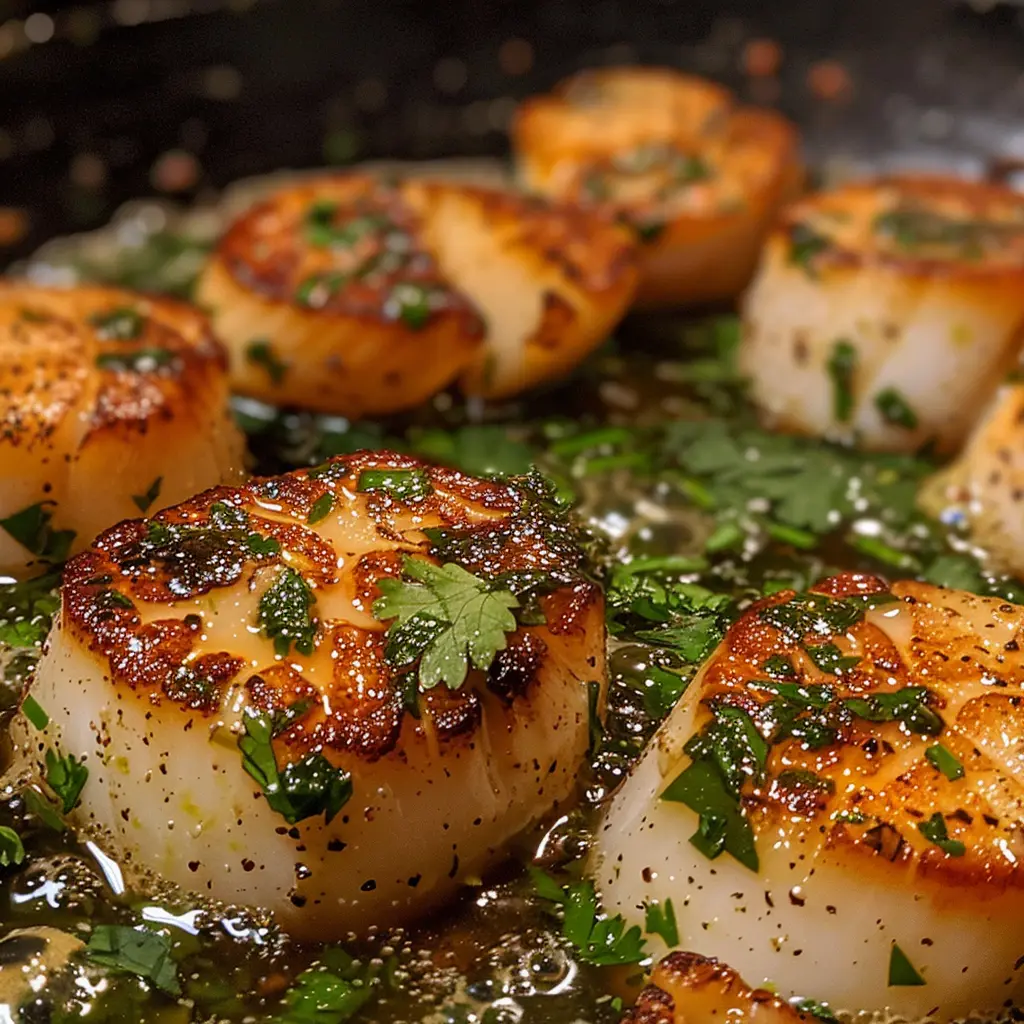
Sizzling scallops with zesty lime cilantro sauce sears sea scallops in a screaming-hot olive oil and butter pan until they’re deeply golden on both sides, then builds a quick garlic, lime, and cilantro sauce directly in the same pan using the browned butter and fond left behind. The whole process takes 15 minutes and produces scallops with the sear of a restaurant and a bright, citrusy sauce that makes every bite taste intentional and composed.
| Detail | Info |
|---|---|
| Prep Time | 5 minutes |
| Cook Time | 10 minutes |
| Total Time | 15 minutes |
| Servings | 4 |
| Difficulty | Medium |
| Cuisine | American / Coastal |
Why This Recipe Works
Patting the scallops completely dry before seasoning them is the single most important preparation step in the entire recipe, and the one most frequently neglected. Scallops are very high in moisture and they release additional liquid when they hit a hot pan. If that surface moisture hasn’t been removed before searing, it immediately creates steam between the scallop and the pan, preventing direct contact and preventing browning. A scallop that steams in a pan produces a gray, rubbery exterior with no crust. A scallop dried thoroughly with paper towels and placed on a screaming-hot surface sears instantly on contact and develops a golden, caramelized crust within 2 minutes. The paper towel step takes 30 seconds and is responsible for everything that makes this dish visually and texturally impressive.
The olive oil and butter combination produces the ideal searing fat for scallops. Olive oil has a higher smoke point than butter and handles the initial high heat without burning before the scallops hit the pan. Butter’s milk solids brown during cooking and add a nutty, rich flavor alongside the olive oil’s fruitiness that neither fat provides alone. The combination also produces a particularly attractive, deep golden color on the scallop’s seared face — more even and more appealing than either oil or butter used separately at high heat.
Removing the scallops before building the sauce is a technique decision that protects the sear from overcooking and allows the sauce to be made in a controlled environment. Scallops are done the moment they’re golden on both sides — any time beyond that in the hot pan produces rubbery, tough, overcooked seafood. Removing them immediately and building the sauce in the residual heat of the empty pan means the sauce can be made carefully without the risk of the scallops overcooking beside it. The scallops are returned only at the very end, for a brief warm-through under the finished sauce.
Lime zest alongside lime juice delivers citrus in two distinct dimensions. Lime juice provides the primary acidity — bright, direct, and water-soluble. Lime zest contains the essential oils from the lime’s skin, which are fat-soluble and more intensely aromatic than the juice. In the pan with the butter and garlic, the zest’s essential oils bloom into the fat and distribute through the sauce in a way that juice alone cannot replicate. The combination of both produces a lime flavor that’s simultaneously sharp and round — the juice provides the punch, the zest provides the fragrance and depth.
Fresh cilantro added as the final step before the scallops are returned to the pan preserves its aromatic, slightly citrusy character. Cilantro added to the pan while the heat is still on quickly loses its brightness and can turn slightly vegetal and flat. A sprinkle over the sauced scallops just before serving maintains the vivid, herbal freshness that makes the lime-cilantro combination so complementary to the rich, buttery seared scallop.
Ingredients
| Ingredient | Quantity | Notes |
|---|---|---|
| Sea scallops, patted dry | 1 pound | Dry them thoroughly — this is non-negotiable for a proper sear |
| Olive oil | 2 tablespoons | Higher smoke point than butter; handles the initial high searing heat |
| Butter | 1 tablespoon | Combined with olive oil; adds richness and promotes browning |
| Garlic cloves, minced | 2 | Sauteed briefly in the residual pan fat after the scallops are removed |
| Fresh lime juice | 2 tablespoons | Freshly squeezed; provides the primary acidity in the sauce |
| Lime zest | 1 teaspoon | From about 1 lime; adds aromatic depth that juice alone cannot provide |
| Fresh cilantro, chopped | 2 tablespoons | Added at the very end to preserve freshness and brightness |
| Paprika | 1/2 teaspoon | Seasoned onto the scallops before searing |
| Salt and black pepper | To taste | Season the scallops generously on both flat sides before searing |
| Lime wedges | For serving | Squeezed over individual portions at the table |
Step-by-Step Instructions
Phase 1: Prepare and Sear the Scallops
- Pat the scallops completely dry on all sides with paper towels. This step cannot be rushed or skipped. Press each scallop gently against the paper towel and blot until no moisture transfers. If they feel wet to the touch, blot again.
- Season both flat sides of each scallop with salt, black pepper, and a light dusting of paprika.
- Heat the olive oil and butter together in a large skillet over medium-high heat until the butter is melted and the pan is very hot — a drop of water should sizzle and evaporate immediately. The pan needs to be genuinely hot before the scallops go in.
- Add the scallops to the pan in a single layer, leaving space between each one. Do not move them. Sear for 2 to 3 minutes without touching until a deep golden-brown crust has formed on the bottom. Gently lift the edge of one scallop to check the color before flipping — it should be a rich amber gold, not pale or light yellow.
- Flip each scallop with tongs and sear the second side for another 2 minutes until golden. The scallops should be slightly translucent in the very center when properly cooked — they will continue cooking from residual heat. Transfer to a warm plate immediately and set aside.
Phase 2: Build the Lime Cilantro Sauce
- Reduce the heat to medium. Add the minced garlic to the same pan and saute for 30 seconds, stirring constantly, until fragrant. The residual fat in the pan will be enough to cook the garlic — add a small additional knob of butter if the pan looks dry.
- Pour in the lime juice and add the lime zest. Stir to combine and simmer for 1 minute, scraping up any browned bits from the pan. The sauce will reduce and concentrate slightly during this brief simmer.
- Remove from the heat and stir in the chopped cilantro.
Phase 3: Finish and Serve
- Return the seared scallops to the skillet and spoon the lime cilantro sauce over each one. Let them sit in the sauce for 30 seconds to warm through and absorb the citrus flavor.
- Serve immediately with fresh lime wedges on the side.
Chef Tips for Perfect Results
Remove the side muscle before searing. Sea scallops often have a small, tough muscle (the abductor muscle) attached to the side that looks like a rectangular flap of slightly different-colored meat. It’s edible but has a chewy texture that contrasts unpleasantly with the tender scallop. Pull it off with your fingers before patting dry — it comes away easily and takes 2 seconds per scallop.
Don’t crowd the pan. Scallops release moisture during searing. If too many are in the pan at once, that moisture can’t evaporate fast enough and the scallops steam rather than sear. Work in two batches if needed, giving each scallop at least half an inch of clearance on all sides.
Resist the urge to move them. The golden crust forms through sustained contact between the scallop’s surface and the hot pan. Every time the scallop is moved or shuffled, that contact is broken and browning stops. Set them down, walk away for 2 minutes, then check the color. One flip, one more minute, done.
Serve immediately. Scallops continue cooking from residual heat and become rubbery if left to sit. Have plates warm and everything else ready before the scallops hit the pan, so the moment the sauce is finished, the dish can be plated and served.
Buy dry-packed scallops. Grocery store scallops are often sold “wet-packed” — soaked in a sodium phosphate solution that causes them to absorb water and makes them impossible to sear properly. Dry-packed scallops have not been treated and sear dramatically better. Ask at the seafood counter which type is available, or look for packaging that says “dry” or “dry-packed.”
Common Mistakes to Avoid
Not drying the scallops. Wet scallops steam in the pan and produce a gray, rubbery exterior with no golden crust. The paper towel step is the most important step in the recipe.
Using a pan that isn’t hot enough. A pan that’s only moderately warm produces slow browning that gives the scallop time to overcook internally before the exterior develops color. The pan needs to be genuinely hot — hot enough that the scallops sizzle aggressively the moment they touch the surface.
Overcooking the scallops. Scallops cook in 2 to 3 minutes per side. Even 30 seconds beyond that produces noticeably tougher, less sweet seafood. They should be opaque on the outside and just barely translucent in the very center when removed from the pan.
Moving the scallops during the sear. The crust only forms when the scallop is in sustained contact with the hot pan. Moving, shuffling, or pressing breaks that contact and prevents the crust from forming. Set them down and leave them alone.
Adding cilantro while the heat is on. Cilantro added to a hot pan loses its bright, fresh character quickly. Add it after removing from the heat so it retains its vivid color and aromatic freshness through plating.
Variations and Substitutions
Add a splash of white wine: After the garlic, deglaze the pan with a quarter cup of dry white wine before the lime juice. Let it reduce by half, then add the lime. The wine adds a subtle complexity and softens the sauce’s acidity slightly.
Add a pinch of chili: A pinch of cayenne or a small finely diced jalapeño cooked with the garlic adds heat that pairs beautifully with the lime and cilantro in a classic citrus-chile-seafood combination.
Use shrimp instead of scallops: Large shrimp (16/20 count) seasoned and seared for 1 to 2 minutes per side work identically in this recipe. The lime cilantro sauce is equally complementary to shrimp.
Serve over rice or cauliflower rice: The lime cilantro sauce doubles as a dressing for the grain beneath the scallops, producing a complete plate that works as a light dinner rather than a standalone protein.
Serving Suggestions
Plate immediately on warmed plates, three to four scallops per serving, with the lime cilantro sauce spooned generously over and around them. A lime wedge on the side for squeezing over at the table adds a final burst of fresh acidity. Serve alongside steamed jasmine rice to absorb the sauce, a fresh corn salad, or a simple avocado and cucumber salad for a complete meal. A chilled glass of Sauvignon Blanc or Pinot Gris is the natural wine pairing for the lime and cilantro notes.
Storage and Reheating
Refrigerator: Store cooked scallops in an airtight container for up to 2 days. They are best eaten fresh — reheated scallops lose their seared crust and can become rubbery.
Reheating: Warm very gently in a skillet over low heat for 1 to 2 minutes, turning once. The microwave is not recommended — it overcooks the scallops rapidly and destroys their texture. The oven at a very low temperature (250 degrees F) for 5 minutes is a gentler option.
Make-ahead: The lime cilantro sauce can be made up to a day ahead and refrigerated. Sear the scallops fresh at serving time and warm the sauce briefly in the pan before spooning over.
Nutritional Information
| Nutrient | Per Serving (approx.) |
|---|---|
| Calories | 210 |
| Protein | 24g |
| Carbohydrates | 5g |
| Fat | 11g |
| Saturated Fat | 3g |
| Fiber | 0g |
| Sodium | 420mg |
Nutritional values are estimates based on standard ingredients. Values will vary based on scallop size and specific brands used.
FAQ
How do I know when the scallops are done?
A properly cooked scallop is opaque and golden on both seared sides and just barely translucent in the very center — sometimes described as a small pearl-colored circle when viewed from the side. It should feel slightly firm but yield gently when pressed with a finger. Fully opaque all the way through means overcooked. Still translucent on the outside means undercooked. The 2 to 3 minutes per side window is reliable for standard-sized sea scallops (about 1 to 1.5 inches in diameter).
What’s the difference between sea scallops and bay scallops?
Sea scallops are large — typically 1 to 2 inches in diameter — and are the right choice for searing because their size allows them to develop a golden exterior while remaining properly cooked inside. Bay scallops are much smaller, more tender, and better suited to quick sautes, pasta dishes, or chowders where a sear isn’t the goal. This recipe specifically requires sea scallops — bay scallops would cook through in under a minute and wouldn’t produce the dramatic golden crust the dish is built around.
Can I use bottled lime juice instead of fresh?
Bottled lime juice has a flat, slightly preserved flavor that lacks the brightness of freshly squeezed lime. For a sauce as simple as this one — where lime is the primary flavor — the difference is immediately perceptible. One lime yields approximately 2 tablespoons of juice and takes 30 seconds to squeeze. Always use fresh.
Why aren’t my scallops getting a golden crust?
Almost certainly one of two reasons: the scallops weren’t dry enough before searing, or the pan wasn’t hot enough. Moisture on the scallop’s surface creates steam that prevents contact browning. A pan that isn’t screaming hot allows the scallop to warm slowly rather than sear instantly. Address both and the crust forms reliably every time.
What should I serve with these scallops?
Steamed jasmine rice absorbs the lime cilantro sauce beautifully and is the most natural pairing. Garlic butter pasta alongside turns the dish into a more substantial dinner. A fresh corn, avocado, and cucumber salad dressed with lime is a complementary side that echoes the sauce’s citrus character. Roasted asparagus or sauteed spinach work well as simple vegetable sides that don’t compete with the bright, delicate flavor of the scallops.
Conclusion
Sizzling scallops with zesty lime cilantro sauce is the recipe that makes 15 minutes of cooking produce something that tastes like a restaurant appetizer. The technique — dry the scallops, use a screaming-hot pan, don’t move them, build the sauce in the same pan — is learnable in a single attempt, and once learned it applies to every scallop recipe you’ll ever make. Get the sear right once and you’ll make this dish repeatedly, because it’s exactly as good as it looks.